
List publications on a resume only when they add evidence for the position, such as research, technical writing, policy work, or communication. Include enough identifying details for the reader to recognize the work, show your real authorship, and label its status accurately. A manuscript submitted to a journal is not a published article, and an accepted article may still lack a final issue or page range. Nonacademic resumes often need a short selected list or a single relevant accomplishment; an academic CV may need full citations. The examples below are fictional.
Choose a Resume Entry or a Longer CV List
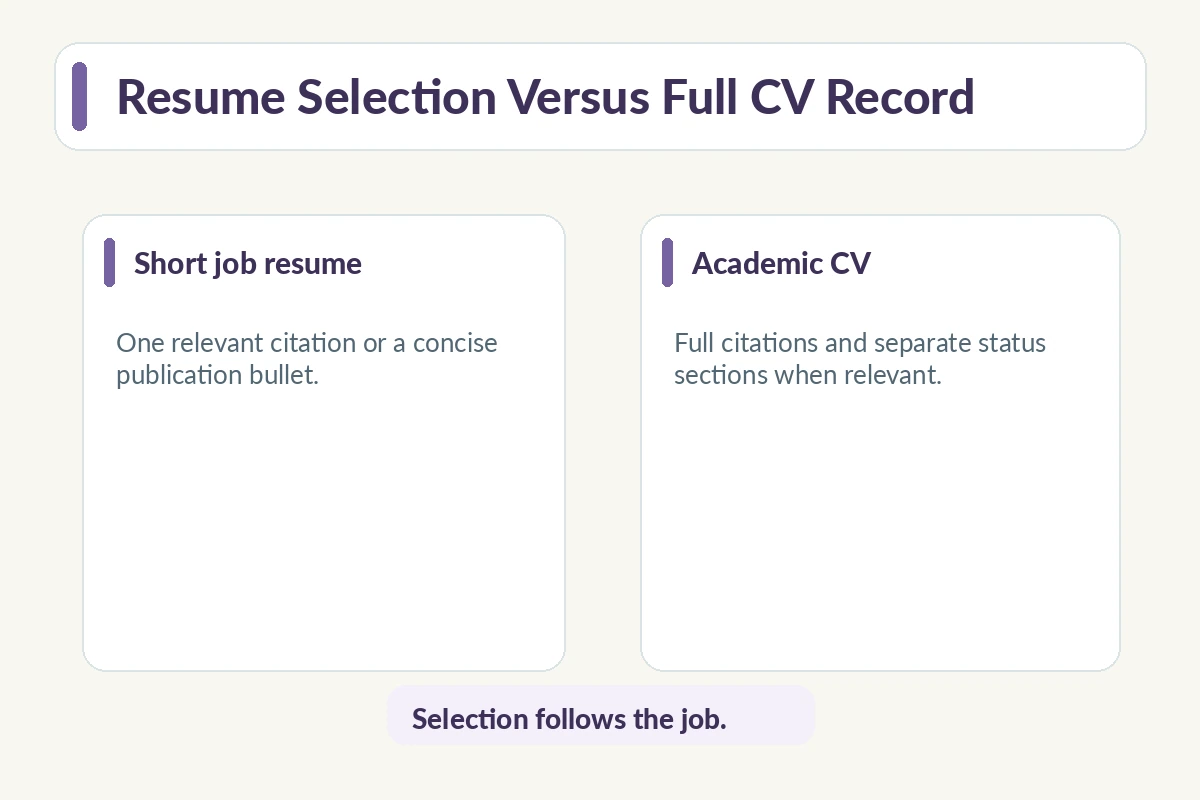
Begin with the audience. A laboratory research assistant application may benefit from one relevant publication with authors, title, outlet, year, and DOI if available. A faculty or research fellowship CV may require a detailed record organized by publication type. For a general operations position, a full bibliography can crowd out stronger evidence; a short bullet about producing a published report may serve better. Universities including Michigan and Washington distinguish resumes from academic CVs for exactly this reason: relevance and expected document length differ by context.
Look at the job description before choosing the section. If the employer asks for a curriculum vitae, research statement, or complete publications list, honor that instruction and the field’s citation conventions. If the employer requests a one- or two-page resume, select only work that demonstrates writing, analysis, or domain knowledge relevant to that role. The answer is not ‘include everything’ or ‘never include publications’; it is ‘show what the reader needs to evaluate.’
Verify Status Before Describing a Work as Published
Use the exact state of the document at the time of application. ‘Published’ means the work has actually appeared through its publishing route. ‘In press’ or ‘accepted’ should follow a formal acceptance, not a hopeful email from a coauthor. ‘Under review’ refers to a manuscript that has been submitted and is being assessed; ‘in preparation’ means not submitted. Academic CV guides commonly provide separate headings for these stages. Do not fill missing publication years, volume numbers, or DOI fields with invented values.
Take a fictional case: a candidate coauthored a methods paper and received a journal acceptance notice. The citation can include the authors, title and journal, followed by ‘(in press)’ if appropriate to the discipline. If the same paper were only submitted, the candidate would write ‘(manuscript under review)’ in a distinct subsection, not name a journal as though publication were secured. For a nonacademic resume, it may be wiser to omit work in progress unless requested or directly useful.

Build a Citation With Fields You Can Check
Collect the full author list and order, publication year or verified status, title, venue, volume/issue/pages if known, and stable DOI or official link when available. Select the citation style standard for your discipline or the application. Consistency matters more than decorative punctuation, but accuracy matters more than both. Do not replace a complex coauthor list with your name alone, or change your position in the list to look more senior. Verify the final version against the public record or acceptance document.
An intentionally fictional example is: ‘R. Chen, A. Rivera, and M. Patel. (2025). Field notes for reusable water-quality logs. Journal of Sample Methods, 8(2), 40–48.’ It is an invented teaching example, not a real publication or a recommended citation style for every field. For a resume with little space, you might show one selected citation and link to the public publication profile, if that profile is accurate and under your control.
| Evidence you have | Suitable label | Avoid writing |
|---|---|---|
| Published journal record | Published citation | “Submitted” as a downgrade |
| Formal acceptance notice | Accepted / in press | “Published in issue 6” without record |
| Submission receipt only | Submitted / under review | “Accepted” or “forthcoming” |
| Unsubmitted working draft | In preparation, if relevant | “Under review” |
Explain Coauthor Contributions Without Inflating Credit
Authorship and task contribution are related but not identical. If you collected data, drafted a subsection, maintained references, or conducted an analysis, you can say what you did in a separate Experience or Research entry. Do not claim to have ‘led publication’ unless you actually led the project or publication process. Conversely, do not bury a documented first-author publication under a vague ‘assisted with research’ label. Tie claims to the work you can explain and the evidence you can provide.
For example, a fictional analyst may write ‘Coauthored a published methods note; verified collection records and drafted the sampling appendix.’ The ‘coauthored’ part must match the author list; the task explanation must match the person’s actual contribution. If the outlet later changes a title or bibliographic detail, update the citation before the next submission. If you signed a confidentiality or authorship agreement, confirm what information can be shared and link only to material already made public.

Format Selected Publications for a Hiring Reader
Put ‘Selected Publications’ under Experience or Education for a short industry resume when it strengthens a clear qualification. For a research CV, split ‘Peer-Reviewed Articles,’ ‘Book Chapters,’ ‘Reports,’ or ‘Works Under Review’ if the categories are meaningful and accepted in the field. Never label a class essay as peer-reviewed publication. Consider whether an organizational report, preprint, commissioned article, or conference abstract has a distinct publication status; give each its actual format and outlet rather than treating all outputs as journal articles.
Keep the entries scannable: plain text, consistent indentation, readable links, and enough room for author names and long titles. Where citation styles use italics or emphasis, ensure they survive PDF export. If a publishing venue has no DOI, an official publicly accessible link may be more useful than a guessed identifier. Protect unpublished documents, peer-review communications and coauthor information according to permissions. A polished resume should not expose confidential drafts merely to prove an achievement.
Run a Citation and Status Audit Before Sending
For each line, ask four questions: Is this the correct version? Is the status current? Is my authorship role stated accurately? Is this relevant to the target position? If the first three cannot be confirmed, pause before including the item. University of Washington and Kansas guidance offers status distinctions worth keeping even when you use a very short resume. In fast-moving fields, check the official publication listing again because a manuscript can move from submitted to accepted between applications.
Make a master list for yourself with supporting links or documents, then select from it for each application. This avoids errors when retitling papers, mixing abstracts with full articles, or counting the same output twice. If you reference publications in a summary bullet, the number must agree with the underlying list. End with a human proofread of author spelling, year, venue and URLs rather than trusting auto-generated bibliography text without checking.
How We Research and Check This Guide
This U.S.-focused article was researched on 2026-11-13 using primary or university career guidance: careers.uw.edu, facultyaffairs.ku.edu, careercenter.umich.edu. Each source is used only for the claims it supports. All sample people, employers, dates, association names, publication titles, credentials, and illustrative outcomes in this guide are hypothetical; they do not describe real applicants or imply any guaranteed hiring result. Review the job posting, issuer records, and any confidentiality requirements that apply to your own case. See the JobAsk affiliate disclosure; none of the examples represents an employer endorsement or paid partnership.
More Resume and Cover Letter Guides
Sometimes on an academic CV in a clearly labeled subsection. It is not a publication, and many short industry resumes do not need it.
No. Select work that proves qualifications for the role and keep a complete list available when a hiring process requests it.
Not before publication. “Accepted” or “in press” is more precise when those statuses are documented; do not invent a final citation.
Keep the verified author order and use a separate experience bullet to describe the tasks you personally performed.
Usually not unless it was actually published through a recognizable venue. A class paper may belong in Projects or Education instead.