
Quick answer. Include an award or achievement if it is genuine, relevant and can be explained. A formal award names a recognizer and the honor received; an achievement describes something you actually accomplished. Put academic honors near education, work-related recognition near the corresponding role, and use a separate section when it makes important, relevant information easier to see. There is no universal minimum number of awards. Guidance on this page does not represent a particular employer’s requirements, hiring results or a certified ATS test.
Tell Recognition Apart from Accomplishment
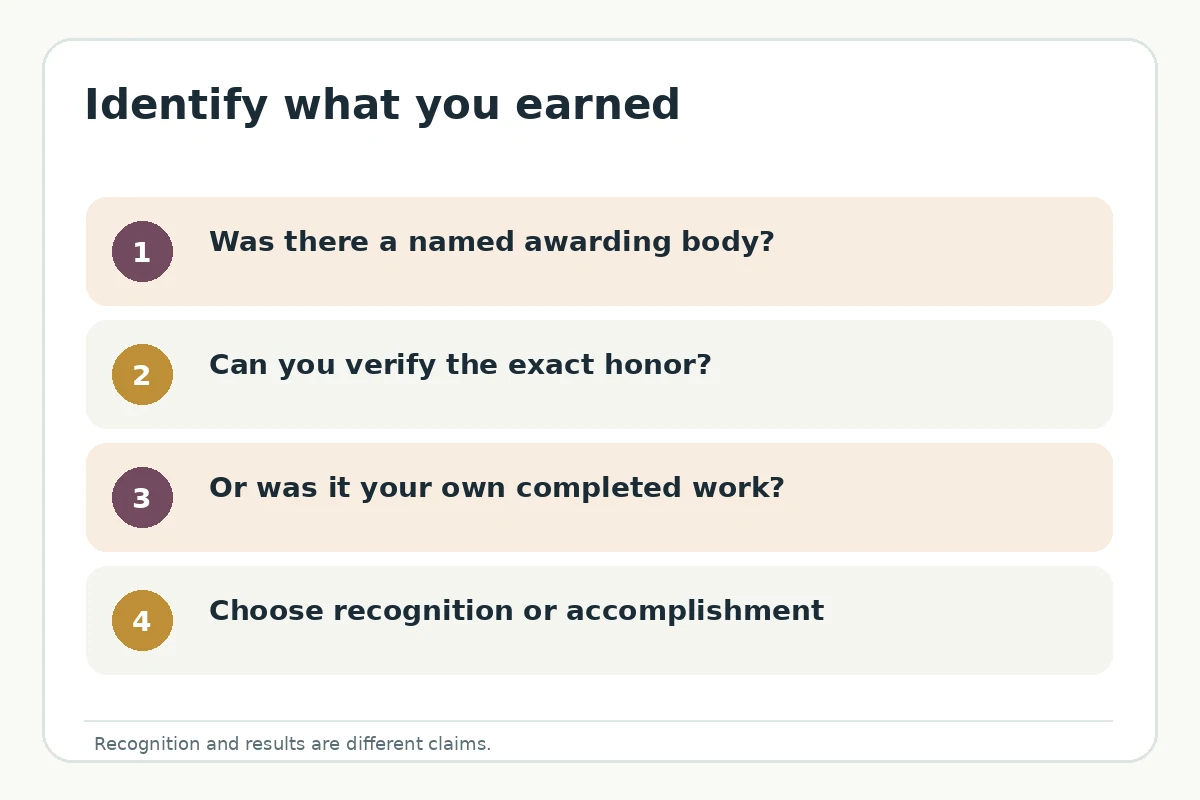
An award is recognition conferred by another person or organization, such as a scholarship, competition honor, professional distinction or documented workplace award. An accomplishment can be a project completed, a problem solved or a skill demonstrated through results, with or without an award. Calling a routine project an award changes what the reader is led to believe. Before drafting, write two separate columns: who recognized the work, if anyone, and what you personally completed. Some experiences may belong in both columns, but do not assume that one establishes the other.
Penn Career Services identifies Honors and Awards as a section that may be combined with Education or separated depending on its importance to the opportunity. Harvard Extension School similarly recommends including awards and honors in context when relevant. That is different from the claim that employers expect a long awards list. A resume may be strong without a single formal award; the experience and skills themselves can provide compelling evidence. If you want the full process, read how to list awards on a resume.
Choose the Section That Provides Context
For an academic honor tied closely to a degree, the education section can be the clearest place. A job-related award may sit under that role so its timeframe, employer and responsibilities are visible together. A separate “Honors and Awards” section can help when you have several distinct recognitions that matter to the work. These are placement options rather than a rigid rule based on an exact number of prizes. A standalone section that crowds out more pertinent experience is not automatically an improvement.
Think from the reviewer’s perspective: if the award name is unfamiliar, what information would clarify its significance? You may specify the issuing institution, year and a short explanation, provided you know those facts. If the honor was a participation certificate, do not present it as an adjudicated national award. Check the official title and dates; a change in organizational naming should not become an invented credential or rank.
Write an Award Entry Without Inflating It
Use a compact structure: award name, issuing body, year or date, and one relevant detail when needed. You can explain the subject of a school prize or the activity recognized without inventing the number of applicants, acceptance rate or selectivity. A claim such as “selected from 2,000 candidates” needs a reliable source for the denominator. If you do not have one, leave that detail out. Avoid using a company name as an awarding body if the recognition actually came from a volunteer association.
Hypothetical example: “Community Event Planning Recognition — Local Volunteer Council, 20XX; recognized for coordinating volunteer check-in materials.” This is an invented illustration of formatting, not a verifiable prize. Another fictional label, “Department Project Showcase Mention — College Program, 20XX,” would require you to know the actual institution and nature of the mention before using it. Replace every teaching label with an authentic honor or omit the line.

Write Achievements as Work, Not as Awards
If the item is an accomplishment rather than a prize, it may work better as a bullet under an experience entry. You can describe a real process improvement, delivered project, completed report or useful service without claiming that it won external recognition. For example, a candidate who documented a handoff procedure should say what they drafted and for whom. Do not write “award-winning handoff process” without an award. The companion resume-bullet guide covers sentence-level action and scope; this page answers where distinct recognition belongs. For a step-by-step method, see how to write resume bullet points with action, scope, and evidence.
Hypothetical comparison: “Prepared a monthly tracking sheet for committee requests” is an achievement description when true; “Received the committee’s annual service award” is a recognition only if the committee actually conferred that honor. Neither example proves an employer result or hiring benefit. Where a project includes group contributions, describe your own part and avoid turning shared credit into sole authorship.
| Item type | Best context | Evidence question |
|---|---|---|
| Academic honor | Education | Who granted it and when? |
| Job-specific award | Relevant job entry | Was it formally awarded? |
| Distinct honors | Short separate section | Are they pertinent? |
| Project result | Experience bullet | What did you personally do? |
Audit Relevance, Dates, and Evidence
If space is tight, ask which awards reveal a qualification the vacancy needs. A research prize may be important for an analytical role, while a dated, unrelated activity honor may not help. More recent is not always more relevant, and an older professional credential can still matter if it directly supports the role. Verify whether a certification is current rather than listing it as active based on memory. Do not disclose restricted award records or a third party’s private details to establish significance.
Before finalizing, check the wording with any certificate, official announcement or personal record you still have. If proof is unavailable, use cautious, truthful language; do not fabricate a citation or a ranking. Consider how you would answer “Who gave the award?”, “What did you do to earn it?” and “Why does it matter for this role?” Those questions are a practical evidence audit, not an employer-authored test. For the basics, see our guide: What Awards to Put on a Resume.

Check Accuracy Before Using Any Sample Wording
The sample scenarios on this page are hypothetical teaching examples. They are not descriptions of real applicants, employers or hiring outcomes. Replace every illustration with your own accurate details, and do not copy an unfamiliar employer name, award, job title or number into your resume. A sentence that sounds impressive but cannot be explained during an interview is not good evidence. If sensitive workplace records are involved, use only information you may share. Our resume contact section guide covers how to make it reachable without oversharing.
Read the target job posting, then ask which verified details best establish your fit. Editing should change emphasis and clarity, not the underlying facts. When deciding between a polished but unsupported claim and a modest account you can substantiate, use the supportable account. Read your exported resume separately from the writing screen so broken layout or outdated contact details do not survive by accident. Neither a checklist nor an online example guarantees any employer response. For a step-by-step method, see how to update your resume after your first job.
How We Research Resume Advice
Reviewed live queries around resume achievements and awards and opened Penn, Harvard and an explanatory Indeed guide. The original recognition-versus-result placement matrix prevents copying generic accomplishment bullets into an invented awards section. This is not an awards-ranking service and contains no real candidate stories.
Reviewed Sources and Affiliate Disclosure
Public reference pages reviewed October 20, 2026: University of Pennsylvania Career Services — Penn states that honors can sit within education or a separate section depending on relevance.; Harvard Extension School Career Resources — Harvard advises selecting relevant academic awards and honors rather than listing everything.; Indeed Career Guide — Indeed differentiates awards by relevance and explains including dates and context.. The sources substantiate stated resume-writing guidance; the worksheets and scenarios are original JobAsk editorial tools, not employer scoring systems.
This article does not claim paid placements, endorsed resume tools, active affiliate approvals or recruiting partnerships. All links above are informational. See our affiliate disclosure; this guide contains no affiliate links.
More Resume and Cover Letter Guides
- GPA on a Resume: When to Include It and How to Label It Honestly
- Resume Sections: Choose What to Include and What to Move Up
- Education on a Resume: What to List and Where to Put It
- What to Include in a Cover Letter: A Content Checklist That Avoids Filler
Not necessarily. Place a relevant award beside the related degree or job when that context is clearer.
Yes, if it is real, relevant and accurately described, often within education or a concise honors section.
No. An accomplishment is your work or result; an award is recognition conferred by another party.
Only when the item demonstrates something genuinely relevant. Do not portray participation as competitive recognition.
Use the exact truthful designation only if you can reliably verify the fact; otherwise avoid unsupported claims.