
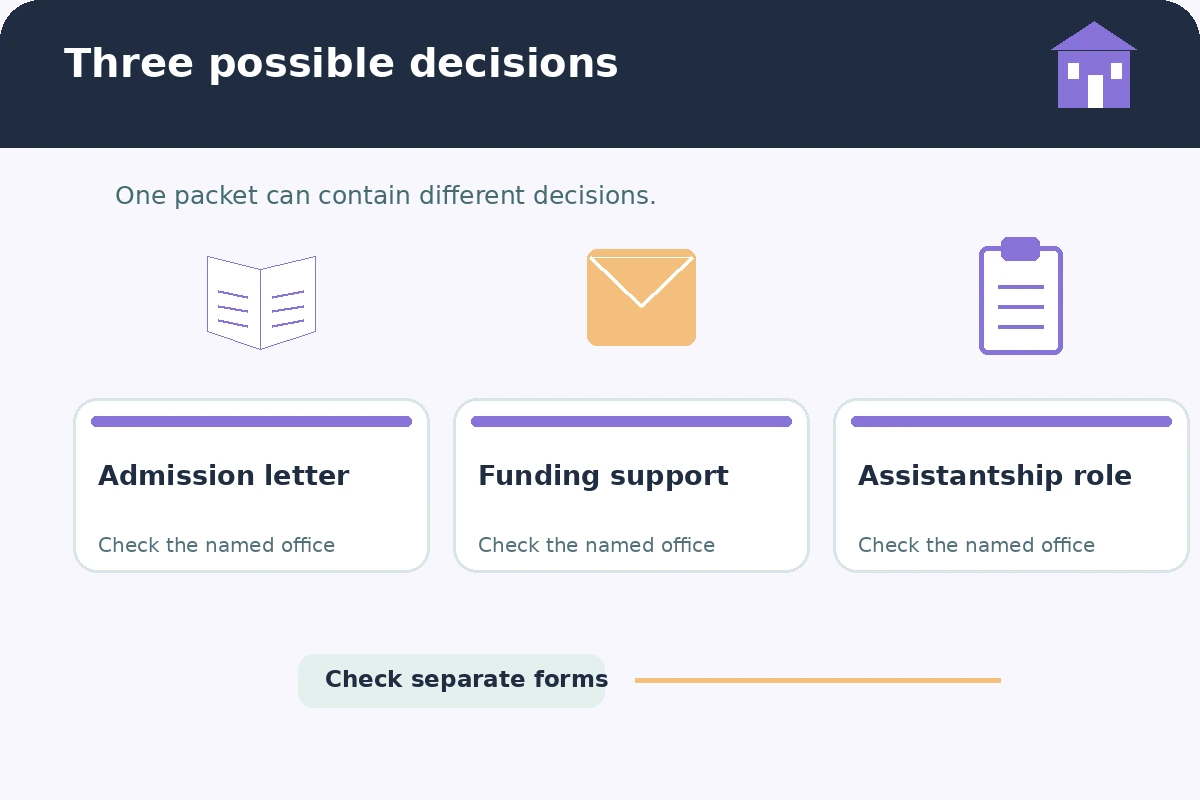
To decline a graduate assistantship offer, identify whether the letter covers admission, financial support, a paid assistantship appointment, or more than one of those. Notify the office named in the offer and follow any separate admissions decision steps. For certain Fall-entry financial-support offers from signatory schools, the Council of Graduate Schools’ April 15 Resolution governs the response window; it does not automatically cover every graduate program, job, or admission-only letter. A clear refusal prevents a department from mistaking a funding decision for a decision about enrollment.
Separate the assistantship, the funding, and admission decisions
Graduate applicants may receive a program admission letter, a funding letter, and an assistantship appointment description in one packet or on separate dates. An assistantship can describe teaching, research, or administrative work, while financial support may include tuition funding or stipends. The administrative owner of each document may differ. Before refusing anything, list each offer, the reply deadline, and the contact named on the letter. Do not assume declining a research assignment automatically cancels admission, or that declining admission automatically resolves an appointment acceptance.
Some packages are inseparable, and the university may make financial support contingent on enrollment or a particular appointment. Ask the graduate coordinator to clarify if the letter does not say. This distinction matters even when the applicant is sure they will attend another institution: the university may need both an admission-portal decision and a separate response about an assistantship. Your goal is to transmit an accurate decision, not to interpret policy from a generic sample email.
Check whether the current CGS April 15 Resolution applies
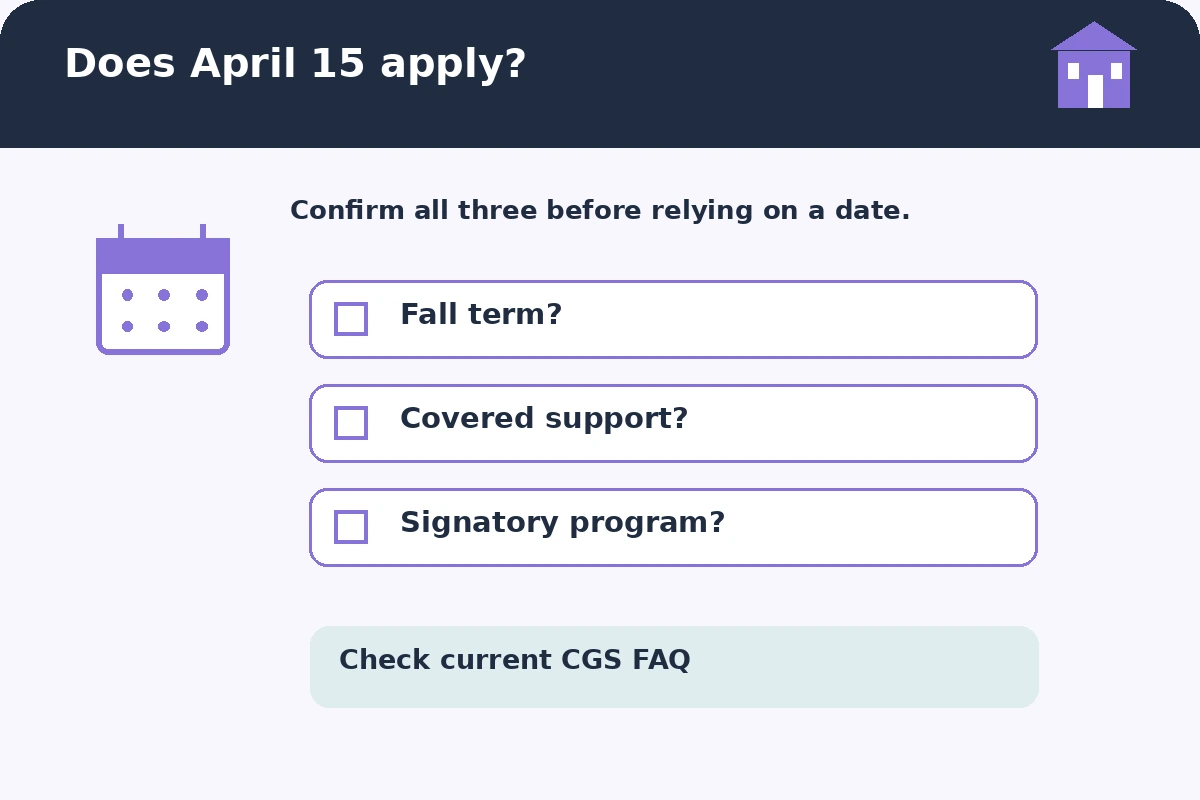
The Council of Graduate Schools updated its April 15 Resolution for Fall 2027 admissions and beyond. The current resolution applies to offers for the fall term that include full tuition support, graduate fellowships, traineeships, or assistantships at participating graduate schools. It is not a blanket deadline for admission-only offers, spring or summer starts, every professional-school program, or institutions that have not signed. A program may request an interim status update, so read the actual offer and the current CGS FAQ rather than assuming that all messages can be ignored until April 15.
If you have questions about a deadline, ask the graduate program or graduate dean’s office to confirm whether the institution and particular program are covered. For signatories, the updated CGS FAQ explains that a student who previously accepted financial support and withdraws after April 15 must inform the program in writing; the current resolution no longer imposes the old blanket requirement to obtain a formal release before accepting elsewhere. Do not use older institutional quotations as a substitute for the current CGS text. Individual enrollment, appointment, and signed obligations may still require separate review.
| Document in your packet | Question before responding |
|---|---|
| Admission offer | Is there a distinct admissions portal response? |
| Financial support letter | Is the CGS resolution applicable to this offer? |
| Assistantship appointment | Who receives the work-appointment decision? |
| Already accepted document | What written notice or other duties apply? |
Notify the correct graduate contact with the exact decision
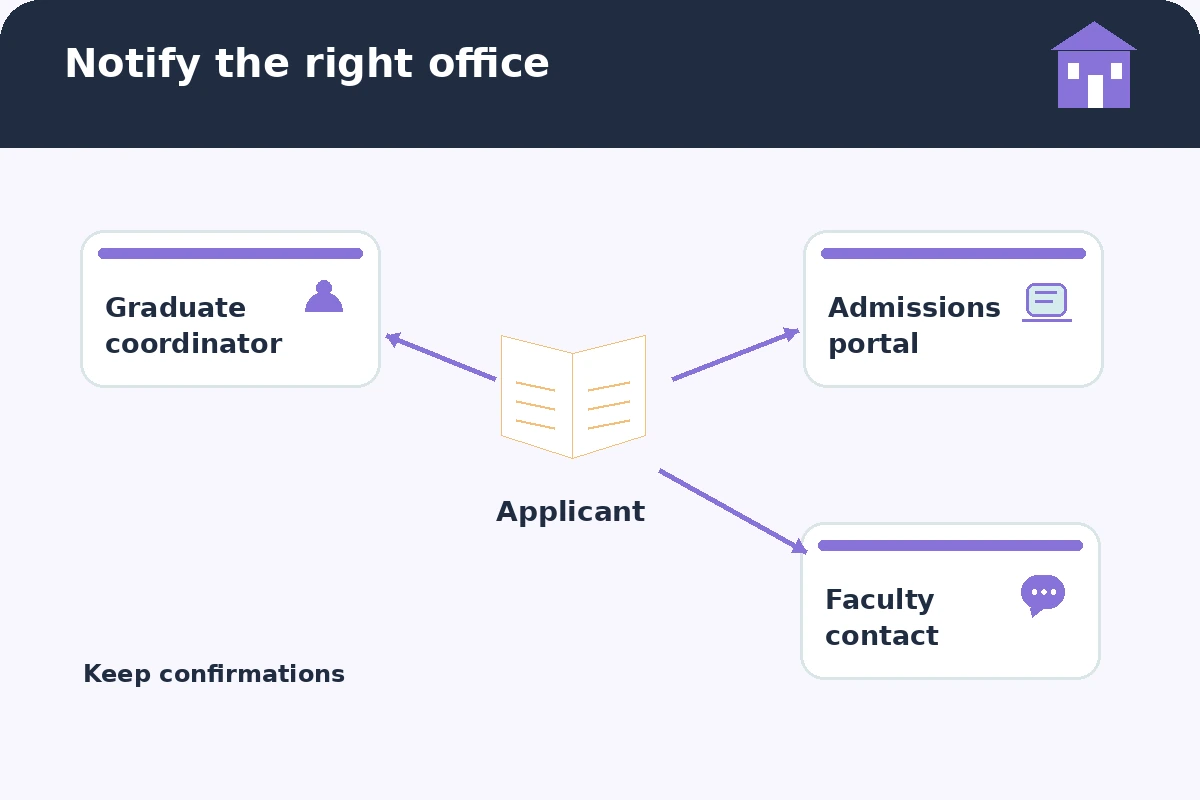
Start with the person or office named for the assistantship: the graduate program coordinator, faculty supervisor, department administrator, or graduate funding office. If the admissions portal also has a required decline button, follow its instructions separately. A hypothetical note might say: ‘Thank you for offering me the graduate research assistantship in the Department of Biology. I have decided to decline the financial-support and assistantship offer for the upcoming fall term. Please let me know if a separate response is needed for the admission record. I appreciate the department’s consideration.’
Do not copy an entire committee or research group unless requested. If you intend to accept admission without this particular assistantship, say that explicitly and ask whether it is possible; do not use the example above verbatim because it describes declining the funding. If you are declining both admission and funding, specify both, and use the official admission decision mechanism. There is no benefit in making the institution guess which letter your response covers.
Avoid ambiguous language about research roles or money
If a lab offered a research assistantship and a separate faculty member discussed a possible project, explain the status of both conversations without disclosing confidential research details. Declining the funded appointment does not require a critique of the supervisor, the lab’s resources, or another university’s stipend. A short and truthful general reason, such as a different academic plan, is optional. State whether the decision concerns a specific appointment, all funding for that academic year, or admission to the program.
Do not assert that every assistantship is a conventional job offer, or that the CGS resolution replaces an employment agreement. Universities differ in how they administer graduate appointments. If you already signed an appointment letter, enrolled in courses, or received an advance, review those specific documents and seek the school’s guidance before making claims about cancellation, repayment, or automatic withdrawal. No universal answer covers every academic contract or funding arrangement.
Manage multiple portals, faculty conversations, and deadlines
A faculty member may have recruited you personally while the graduate school manages the formal funding letter. Make sure the formal administrator receives your decision even if you already spoke with a professor. A polite short reply to the professor may be appropriate when you worked together to plan a project, but it should not replace the designated acceptance or decline form. Keep the job title, program, term, and institution clearly identified so that administrative staff can update the correct record.
Watch for different messages with overlapping deadlines. Some portals accept only a single general admissions decision, while others have funding steps. If the portal shows no appropriate option or you cannot reach the coordinator, contact the official graduate school admissions or funding office through independently verified details. Do not submit multiple contradictory decisions just to make a status screen disappear. Save each acknowledgment privately and follow up when the system appears unchanged.
When you accepted earlier, use the right rule and get advice
A decision to decline before accepting financial support is different from withdrawing an accepted commitment. The current CGS FAQ explicitly distinguishes notice before or on April 15 from written notice after April 15 for covered financial-support offers. Whether the resolution applies depends on the date, term, financial-support type, and signatory program. Some older university pages still reproduce an earlier version of the resolution, so verify the currently applicable official text for your admissions cycle before relying on it.
If you accepted an assistantship and a personal or academic situation changed, contact the program as soon as you can and request clear written instructions. Avoid treating a casual conversation with a faculty member as a complete administrative release or assuming there are no other commitments. Review any appointment conditions, enrollment rules, and campus-specific obligations with the appropriate office. This page explains how to frame the communication, not whether a particular agreement may be terminated without consequences.
Finish with one reconciled record for the academic term
Your private tracker should identify the institution, program, term, admission status, funding status, assistantship status, dates of your messages, and any official acknowledgment. If these records conflict, do not guess which one controls. Ask the program to confirm whether the refusal has been entered and whether any further action is required. Do not include other universities’ confidential funding documents unless necessary for a request you choose to make.
A good closure note is respectful but precise: it closes the exact academic and financial decision that has been made. It does not imply that a program must hold your spot indefinitely, or that a future application will receive favorable treatment. If you later reconsider the program, ask about the then-current admissions cycle rather than assuming that a declined offer can be restored. The most helpful email is the one that leaves no uncertainty about what you did, and did not, decline.
How We Research This Guide
This guide draws on these primary professional resources: Council of Graduate Schools defines the 2026 April 15 Resolution and its financial-support scope.; CGS FAQ updated July 2026 clarifies signatories, term limits, and notices after acceptance.; UNC Greensboro describes the relation between graduate funding commitments and the resolution.. We checked the linked resources on November 16, 2026 and compared the topic against the existing JobAsk collection to avoid duplicating a general job-offer refusal guide. The guidance is a decision and communication framework, not individualized legal, academic, or employment advice. Examples are hypothetical, and employer or program instructions may differ. No paid product, commercial link, or affiliate relationship is recommended. Our affiliate disclosure explains the site policy.
No. The CGS resolution covers specified Fall-term financial-support offers at signatory institutions and covered programs; verify the actual letter.
Possibly, depending on the program and funding relationship. Ask the graduate coordinator rather than assuming the decisions are separable.
Follow the official instructions, and ensure the office responsible for the funding or appointment receives your written decision.
Read the current CGS rules where applicable and the program documents; seek written guidance, especially regarding notice timing.
Not automatically. Verify whether the portal requires a separate admission decision and retain both acknowledgments.