
Prepare for your annual appraisal by collecting evidence, answering questions about the review period, and asking your manager to clarify future expectations and support. Follow your employer’s actual review process, and replace every example below with a truthful account of your own workplace circumstances.
Public guidance from MIT Human Resources emphasizes observable contributions, development goals and a two-way conversation. UC Berkeley People & Culture recommends preparing concrete questions and examples before a review. The scenarios below are explicitly hypothetical, not reports about real employees.
Know Which Questions You Are Preparing to Answer
An annual appraisal is a work conversation about the period under review and expectations for what comes next. It is not a universal exam with one approved list of answers. Obtain the employer’s review form or guidance first and identify what you will actually be asked. Some organizations use ratings and written self-assessments; others emphasize discussion and ongoing check-ins.
Review your job description, last agreed goals, documented check-ins, completed work and significant changes in scope. Prepare a few examples you can explain without disclosing confidential information. Try to distinguish work you completed, results you helped achieve, work that remains open and circumstances that limited progress. This preparation makes the conversation more useful than memorizing flattering phrases.
Prepare Evidence for Questions About Results
Expect questions such as “Which goals did you meet?” “What were your most important contributions?” and “What changed during the year?” A truthful response links the expectation to your specific action and a permitted evidence source. Hypothetical example: “I maintained the weekly handoff list for the operations team, recorded decisions and identified unresolved items at check-ins.” This is only suitable if the work actually happened.
If your results were shared with a team, describe the joint outcome and what you personally owned. If a project stalled, explain which milestone was completed, which dependency remains and what action you took. Avoid inventing a productivity number to make the answer sound substantial. It is acceptable to ask your manager whether they have additional evidence or a different interpretation.

Ask About Expectations and Evaluation Standards
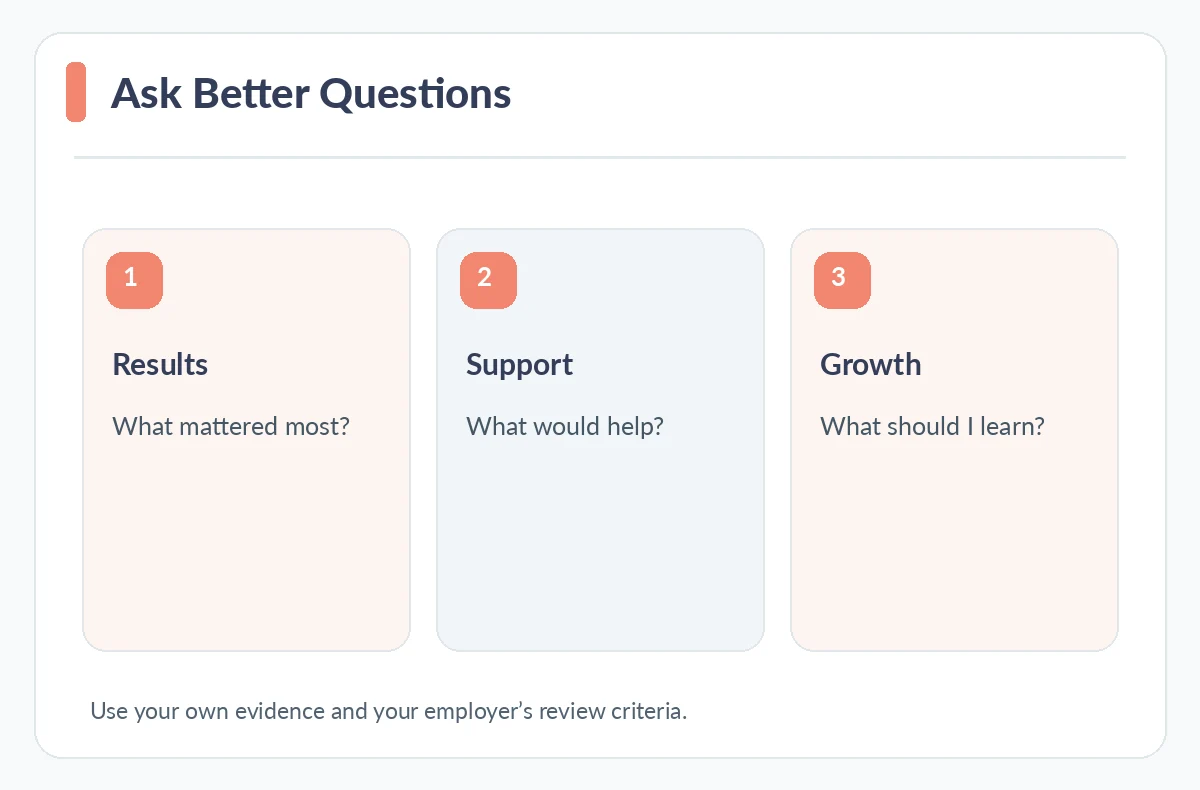
Useful employee questions include: “Which results mattered most in this review?” “Where did my work meet expectations?” “What would stronger performance look like in the next cycle?” and “Which changes in priorities should be reflected in my goals?” These questions invite specific criteria rather than an ambiguous compliment or criticism. Our guide “Work Goals Examples for Evaluations With Clear Measures” goes into more detail.
If you receive a rating, ask which published or internal definition was used and which examples support it. Listen for a gap between the written goal and the manager’s expectations. You do not need to argue immediately if the evidence is unfamiliar; request the relevant context or a follow-up conversation. Ratings, documentation rights and timelines depend on the employer’s actual process. For the fuller picture, see our guide “Employee Self-Evaluation Examples With Evidence You Can Adapt”.
| When to ask | Useful question | Prepare in advance |
|---|---|---|
| Past results | Which contributions mattered most? | Two documented examples |
| Clear standards | What does strong work look like? | Current goals and role |
| Obstacles | What support would help? | Specific work constraint |
| Next cycle | When will we review progress? | Draft goals and milestones |
Discuss Challenges Without Turning to Blame
You may be asked “What could you have done differently?” or “Which obstacles limited your progress?” Prepare one honest example where your action mattered and one reasonable improvement. A hypothetical answer could be: “I underestimated time needed for a cross-team approval. Next cycle I will confirm dependencies at the planning stage.” Do not claim that a new process fixed the issue unless it has been tested.
Ask what support would have made success more likely: clearer priorities, training, earlier decisions or access to required tools. Keep constraints grounded in verifiable events and distinguish them from complaints about other individuals. Avoid sharing private coworker details. The aim is to understand which changes are within your control and which require a shared decision.
Ask About Development and Future Responsibilities
Specific questions include: “Which skill would most improve my contribution?” “Is there a project where I can practice it?” “How will we know I am ready for additional responsibility?” and “What resources are available for this development goal?” These requests can lead to actionable planning without implying that training automatically results in a promotion.
If you want to broaden your role, name the kind of work and why it fits team needs. Ask how priority changes would be handled rather than simply agreeing to new tasks. Where a goal depends on another person or budget, make that dependency clear. Development conversations can be valuable even if staffing or advancement decisions have not been made.
Plan the Two-Way Conversation in Advance
Bring a short agenda: one or two strongest contributions, one honest challenge, two questions about expectations and one development request. Leave space to hear the manager’s perspective. Hypothetical opening: “I brought a brief summary of this year’s work and would like to confirm which contributions mattered most and what I should prioritize next.” Avoid treating the meeting as a rehearsed speech. Our guide “Feedback About Your Manager” goes into more detail.
Managers also have a role in preparing and clarifying feedback. If an important concern emerges, ask what evidence or process applies and agree on a sensible time for follow-up. Do not assume that the review meeting is the only available opportunity for feedback. Regular check-ins may be more helpful for resolving small issues before the next annual conversation. Our guide “Employee Evaluation Comments Managers Can Write Fairly” goes into more detail.

Confirm Next Steps After the Appraisal
At the end, ask “What are the agreed priorities?” “What evidence should we track?” “When should we check progress?” and “What support or training is needed?” Summarize the answers in your own words to confirm mutual understanding. If you receive a written form, follow the employer’s instructions for comments, signatures or corrections; do not infer legal consequences from generic internet advice.
Keep your own appropriate notes, respecting confidentiality and recordkeeping rules. A short follow-up through an approved channel can capture agreed actions and open questions. If compensation, disciplinary or employment-law issues arise, consult the relevant employer policy and qualified guidance separately. This guide offers conversation preparation, not a promise about how a formal appraisal must end.
How We Research These Performance Review Questions
Source-specific employer rules are described as examples of practice, not binding policies for every workplace. All model comments, scripts, and work situations are hypothetical; readers must verify their own records, employer procedures, confidentiality limits and local context.
Sources, Boundaries, and Relationship Disclosure
Research sources: UC Berkeley HR; MIT HR; University of Minnesota HR. Checked 2026-10-21. These references inform general communication and evidence practices; the official standards of a particular university or federal agency are not universal rules for U.S. employers. This guide contains no affiliate links. Read the site’s affiliate disclosure for its relationship policy.
Related Guides
- Annual Performance Review Questions: Ask About Evidence and Priorities
- Common Interview Questions: What They Ask and How to Prepare Real Answers
- Job References: How to Ask, Prepare and Share a Reliable List
- Continuous Learning Self-Appraisal: Show Applied Skills and Next Steps
- Questions to Ask Future Coworkers in a Peer Interview
Prepare to discuss completed work, challenges, growth needs, changing responsibilities and priorities for the next cycle.
Ask which contributions mattered, what stronger performance would look like and what support or development is needed.
Ask for the criteria and supporting examples, document your perspective through approved processes and follow your employer’s policy.
Yes. Bring permitted work samples, agreed goals, milestone notes and specific observations that support your statements.
Record agreed priorities, next steps and follow-up timing under your employer’s actual process; an appraisal alone does not guarantee a raise or promotion.