
You can look for office jobs without direct office experience by targeting duties you already understand or can realistically learn with training: maintaining records, answering routine questions, preparing documents, and keeping schedules accurate. The most useful starting title is often general office clerk rather than a specialized assistant role with a long list of software and regulatory demands.
The BLS General Office Clerks describes general office clerks as workers who answer phones, type documents, and maintain records; it says the occupation typically requires a high school diploma or equivalent and often includes training on the job. That is a broad occupational description, not proof that every vacancy accepts an applicant with no work history.
Identify Beginner-Friendly Clerical Titles
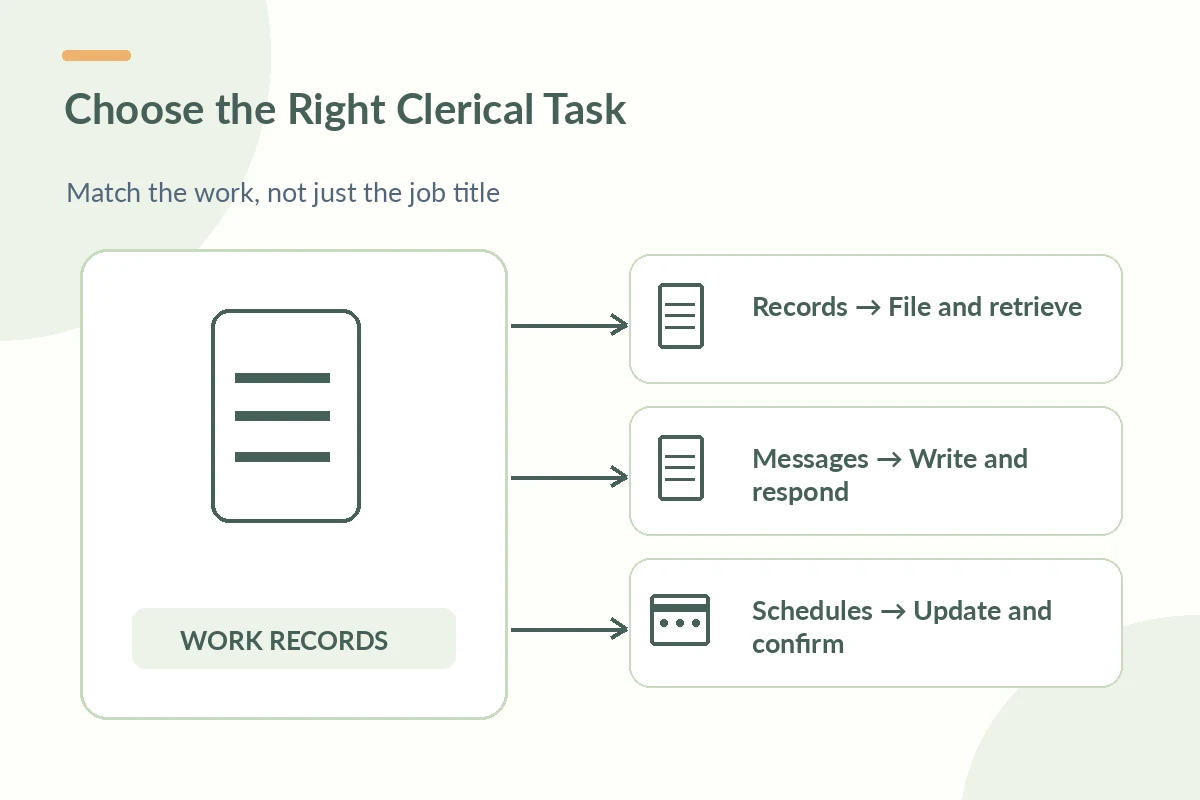
Search by actual duties instead of only “office jobs.” General office clerk, file clerk, mail clerk, front-office support, and administrative support can describe very different work. A file clerk may handle paper or digital retrieval, while a receptionist may handle visitors, phones, and calendar questions. The BLS Information Clerks outlines several information-clerk functions, illustrating why title-based guesses are unreliable.
Read the qualifications line by line. Some postings focus on punctuality, routine software, and accurate processing; others demand industry experience, specialist systems, or supervision of staff. Do not call a position entry-level only because its job title sounds junior. Save descriptions of suitable openings and note which responsibilities you can support with real evidence. Our guide “Hospital Jobs With No Experience” adds more detail on this.
Build a Five-Task Office Skills Inventory
Check your ability to organize files, write clear messages, enter information accurately, answer a routine question, and follow a schedule. Give yourself a specific example for each. Perhaps you maintained a club roster, prepared a school presentation, sorted invoices in a family project, or scheduled volunteers. Separate what you personally did from what a teacher, parent, or teammate handled.
Software labels require the same honesty. If you can format a basic spreadsheet, say that; do not claim advanced Excel or database administration. A short practice document or fictional practice spreadsheet made from invented data can demonstrate learning, but mark it as a practice project. Never upload another person’s contact records as an example of your work.
Choose Evidence for Each Posting Requirement
Map the role’s first three core tasks to one concrete action you actually performed. If the posting emphasizes correspondence, show a real example of clear writing, such as coordinating a club message. If it emphasizes record accuracy, describe how you checked names and dates in a legitimate exercise. Avoid the generic claim “I’m detail-oriented” when a small example is stronger.
Hypothetical resume line: “Updated a shared volunteer schedule and checked changes with the event coordinator.” Replace every detail if your background differs. The goal is not to disguise nonemployment activities as paid experience. An employer can assess the relevance of a school or volunteer task when the context is explicit.

Read Education and Training Language Carefully
A high school diploma or equivalent is a typical entry requirement for general office clerks in the BLS General Office Clerks, and training commonly covers local office procedures. Yet an employer can require prior employment, specific applications, or a credential. Distinguish mandatory qualifications from preferences. If a posting states that a license, language level, or software skill is essential, do not mark it complete unless you can substantiate it.
For basic tools you lack, practice appropriate functions using nonconfidential sample information before applying. Learn to save files clearly, revise a short email, sort a simple table, and verify dates. Claim only the level you can demonstrate. Practice does not ensure hiring, but it can make your interview discussion more precise and honest.
Build a Focused Office Application Package
Use a clean resume that puts the most relevant genuine examples high enough to notice. A beginner may lead with education, skills demonstrated through projects, or volunteering; a person transferring from another field can show relevant communication and routine recordkeeping. Use a concise application note, when allowed, to explain the clerical tasks you can already perform and why the schedule fits.
Do not imply you worked for a fictional company. If a sample task was hypothetical practice, label it “self-directed practice exercise” and describe the tool, not an invented business outcome. Reuse the same factual history consistently across resume, application fields, and interview notes. A targeted explanation is better than inserting every keyword in a job description without understanding it.

Prepare for Routine Task and Accuracy Questions
Expect practical questions about balancing interruptions, checking details, clarifying unclear instructions, and communicating politely. Choose a real scenario where you recorded information, fixed a mistake, or followed through on a task. Explain your actions and boundaries: you can take a message accurately without pretending that you managed an office, and you can check a spreadsheet without claiming audit experience.
Hypothetical response: “In a school event, I compared the attendee list against sign-ins and asked the coordinator about missing entries before changing anything.” This describes a repeatable checking process, not a real candidate’s accomplishment. If asked about software you have not used, say that directly, identify related tools you know, and ask about training.
Screen the Employer and Compare the Working Terms
Confirm the employer from its official website, particularly for advertisements offering surprising pay for minimal data entry. The FTC consumer guidance describes fake recruiters who obtain personal information or demand payments under the appearance of employment. Do not buy a promise of a job or follow unknown payment instructions. Verify the listing before giving sensitive details.
When an offer appears genuine, compare the assigned tasks, working hours, expected pace, training support, and workplace location. Ask who handles customer data and what privacy procedures apply. An ordinary clerical role can become a useful foundation, but it should be chosen for actual fit rather than a vague promise of quick advancement.
How We Research Entry-Level Job Routes
We checked official occupational descriptions and public career or consumer guidance on October 22, 2026: BLS occupational guidance, BLS occupational guidance, FTC consumer advice. These sources explain common tasks and general training patterns; they do not verify an individual opening, selection outcome, pay offer, or every employer policy. All sample candidates, application phrases, and activities labeled hypothetical are invented teaching examples, not actual placements.
Requirements must be checked on the employer’s current posting. No affiliate product is promoted; see our affiliate disclosure.
Related Job Search Guides
- Film Production Assistant Jobs With No Experience: Set vs. Office Routes
- Clerical Jobs With No Experience: Prove Record, Phone, and Office Skills
- Entry-Level IT Jobs Without Experience: Start With Support Skills You Can Show
- Apprenticeship Jobs With No Experience: Find Real Paid Training
- Virtual Assistant Jobs With No Experience: Verify Tasks and Build Proof
General office clerk and file clerk are useful search terms, but compare each description and its qualifications.
Not for every entry-level office role. Demonstrate only the spreadsheet skills the posting actually requires and you can perform.
Yes, when you describe the real task, context, and your contribution without calling it paid office employment.
Check whether experience is explicitly mandatory, look for training-focused alternatives, or build relevant real practice before applying.
No. Verify the employer and avoid advance fees, unsolicited payment requests, or early requests for sensitive banking information.