
Your first day at a new job is largely about getting oriented, knowing who to ask and understanding the next useful task. It is not an audition where you must demonstrate complete mastery of the workplace on arrival. Different employers organize orientation differently, so use their actual onboarding instructions as the source of truth. This guide focuses on practical communications and note-taking rather than employment-law deadlines or pay requirements. The sample messages and situations are hypothetical; ask your own employer which forms, systems and procedures apply to your role.
Confirm first-day logistics before leaving home
Check the confirmed start date, reporting time, work location or remote login instructions, the name of your initial contact and any dress or equipment requirements. If something is missing, ask the coordinator through a verified channel rather than guessing. The University of Oregon’s new-employee checklist begins with confirming arrival details and preparing the requested documentation. Its own paperwork requirements belong to that institution; do not assume every workplace uses precisely the same checklist. Your goal is to arrive ready to follow the employer’s actual process.
A fictional message: “Hello Alex, I’m confirming that I should report to the main reception desk at 9:00 a.m. on Monday for my first day. Please let me know if there is a particular person or item I should ask for on arrival. Thank you.” Replace every detail with your actual offer or welcome information. Remote workers can similarly confirm which approved platform and contact to use. For a delay or access problem, contact the designated person promptly rather than silently waiting or sharing a password with a stranger.
Complete orientation without guessing policies
New-employee orientation may include introductions, workspace access, work equipment, training, information about safety and review of internal procedures. UC San Diego’s supervisor checklist names introductions, computer access and responsibilities among first-day tasks. Those are illustrations of common organizational needs, not an assertion that every employee must finish identical steps before lunch. Write down which tasks are yours, which are handled by HR or IT and which are pending an administrator’s approval. Do not try to resolve a restricted access problem by using a coworker’s account.
When forms or identity documents are requested, follow the employer’s official guidance and trusted systems. This article does not interpret federal verification deadlines, worker rights, payroll obligations or benefits eligibility; such details can require current authoritative instructions. Ask who owns each step and how you will know it is complete. If a person posing as the employer asks you to send private documents to an unexpected personal account, independently confirm the request through known contact information before sharing. Being cautious with access is part of professional onboarding.

Ask what success looks like during the first week
A practical question for your supervisor is: “What should I be able to complete or understand by the end of my first week?” The University of Pennsylvania career-services discussion highlights early objectives as a useful topic. Ask which tasks are priorities, what training is expected and who can approve work when the manager is unavailable. You do not need to demand a complete 90-day strategy on the first morning. Make a short note of tangible expectations that can be clarified in the first check-in.
If you receive several possible tasks, ask about ordering before treating all of them as emergencies. A hypothetical new assistant may be asked to review an internal directory and observe a scheduling process; that does not mean they are immediately authorized to edit live records. An appropriately cautious answer is to confirm access permissions, the expected learning outcome and the person who will review the first attempt. The point is to convert a vague welcome into concrete next actions without pretending that the entire job can be learned in one day.
Learn communication norms and where help lives
Ask which channel should be used for routine questions, urgent problems, approvals and schedule changes. The University of Pennsylvania recommends discussing communication preferences with a new manager. Also ask about meeting etiquette, who maintains shared instructions and how to report a blocker. Avoid assuming your former employer’s practices apply. A team may reserve email for external matters while using an internal system for task requests, or it may use a formal ticket tool for every access issue.
Introduce yourself simply and avoid overpromising. A fictional message for an internal chat might be: “Hi, I’m Sam, and I’ve joined the operations support team. I’m learning the intake process this week and look forward to working with you.” Do not claim a job title or reporting relationship you were not given. Notice how people share information and which documents are appropriate for the group. If you are unsure whether a file contains confidential details, seek guidance before forwarding it. Good first impressions include respecting boundaries, not performing constant availability.
| Question | Responsible contact | Next action |
|---|---|---|
| What is my first-week priority? | Direct supervisor | Confirm task and due date |
| Where is the approved work guide? | Team trainer | Save correct internal location |
| Training account is pending | Authorized IT contact | Use approved support channel |

Handle confusion, a missing login or unclear task
A first-day obstacle is not automatically evidence of poor preparation. Suppose your account cannot open the assigned training page. First, check the instructions you were given. Then contact the designated IT or onboarding person with a concise description of the problem, keeping passwords and private tokens out of the message. Tell your supervisor if the issue blocks your assigned activity and ask whether there is another approved task. Do not install unapproved software, use someone else’s credentials or promise that the access system will be repaired by a specific hour.
Another hypothetical scenario: two coworkers give different instructions for updating a shared document. Clarify which person owns the procedure and confirm the version or approval path before editing. Avoid treating a colleague’s informal suggestion as overriding a written safety or security policy. If the disagreement is minor, record the question for a scheduled check-in; if it creates a real operational risk, escalate appropriately. The goal of first-day problem solving is accurate communication, not winning a debate or proving you can act without supervision.
End your first workday with a useful record
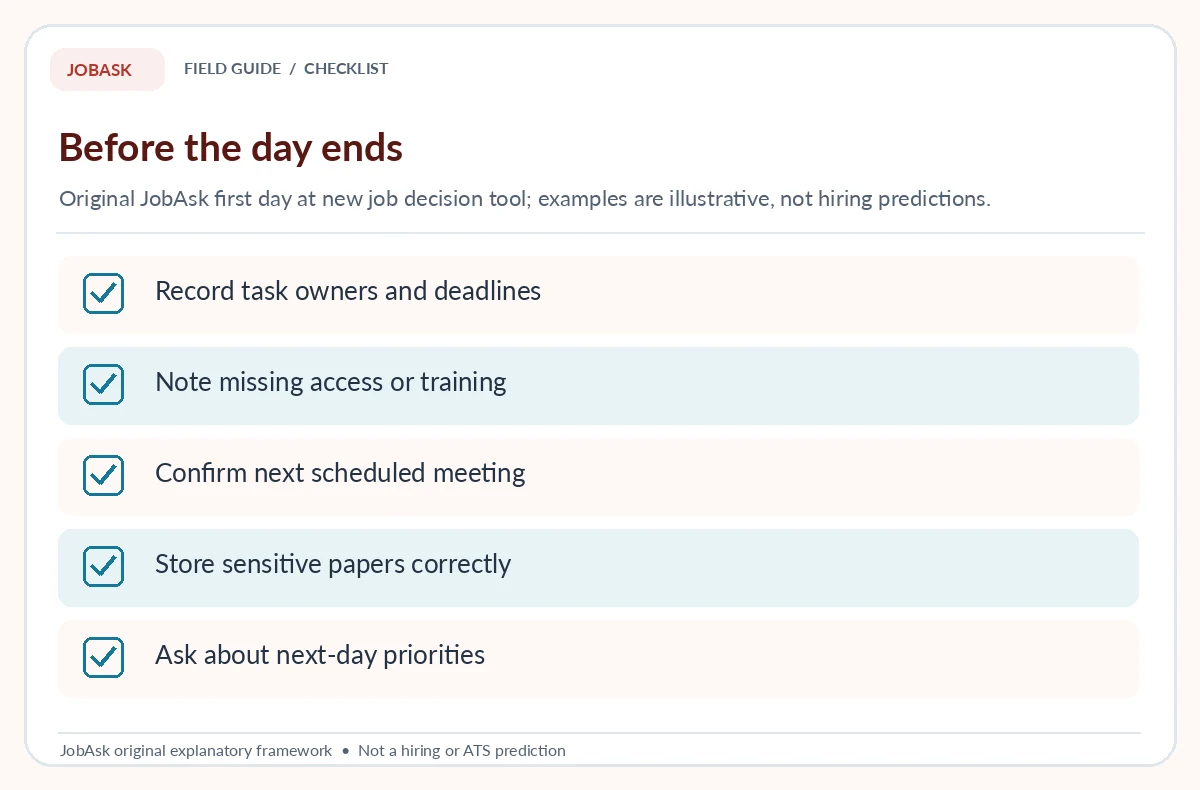
Before you finish, note who you met, where the approved resources are stored, which systems are active, what training is incomplete and your next assigned step. Keep this record in a secure work-appropriate location rather than sending internal information to a personal account. A five-minute check with a supervisor can confirm whether priorities changed or tomorrow begins with a particular meeting. The University of Oregon checklist spreads onboarding across the first month, a useful reminder that many questions will not be resolved on day one.
Use a modest follow-up message when appropriate: “Thanks for today’s orientation. I’ve completed the account setup and reviewed the introductory guide. I’m waiting on access to the training workspace and will check with IT through the approved process. My understanding is that tomorrow’s priority is the supervised practice exercise; please correct me if that changed.” This is a fictional template. It communicates status without overstating progress. A strong first day ends with accurate next steps and safe questions, not claims of instant expertise.
How We Research and Limits of This Guide
We compared the first-day intent with JobAsk’s offer acceptance and longer-term career-development content. University of Pennsylvania and institutional HR onboarding checklists support questions about first-week objectives, access, contacts and orientation. We authored hypothetical messages, a first-day decision path and a follow-up log without claiming to represent any employer’s HR process.
Sources reviewed October 19, 2026: University of Pennsylvania careers guidance suggests discussing first-week objectives and communication preferences. University of Oregon provides a concrete checklist of arrival and first-month onboarding steps. UC San Diego first-day supervisor checklist includes introductions, setup and work responsibilities.
Affiliate disclosure: No onboarding tool, HR platform or training service is promoted as an approved affiliate. Read the JobAsk affiliate disclosure for the site-wide policy.
Related Guides
- 90-Day Self-Evaluation for a New Job: Show Learning and Progress
- 30-60-90 Day Plan for a New Job: Goals and Checkpoints
- After Accepting a Job Offer: An Onboarding Checklist Before Day One
- All-Day Job Interview Preparation: Plan Sessions, Breaks, and Follow-Up
- Job Interview Preparation Checklist: Research, Evidence, and Interview-Day Details
Follow your actual employer’s onboarding instructions for documents, equipment and access; verify unusual requests through an official contact.
Clarify your first-week objectives, communication preferences, initial training and the person responsible for answering questions.
New tools and procedures often require orientation. Ask for approved guidance rather than inventing answers or using another person’s account.
No universal expectation applies. Confirm priorities, complete authorized tasks and identify what reasonably continues into the first week.
Arrive or log in as instructed, listen carefully, communicate accurately, respect procedures and document realistic next steps.