
If a job posting asks for organizational skills, show how you kept work visible, chose a realistic next action, and handed information to the right person. “Highly organized” is an opinion. A resume bullet about maintaining a schedule, identifying a conflict, or recording an owner and deadline is evidence. The strongest example also states what was within your control.
This article focuses on organization as a transferable work process, not generic “teamwork,” leadership titles, or a recipe for claiming project management. The examples are hypothetical. Use only details that match your real experience, whether paid employment, school, community activity, or a personal project.
Identify the Kind of Organization the Role Requires
An office assistant may maintain calendars, files, and visitor information; a warehouse employee may organize a pick list within a safety process; a student worker may coordinate class and shift availability. All involve organization, but the evidence is not interchangeable. Read the employer’s responsibilities and choose the nearest actual task. Prioritization, records accuracy, sequencing, and handoffs are four useful families of examples.
O*NET identifies organizing, planning, and prioritizing work among activities for administrative assistants; BLS also describes schedules, files, and document preparation as recurring administrative work. Neither source proves that all jobs require the same software or that every candidate may direct colleagues. Match your wording to what you did rather than projecting an occupational profile onto yourself.

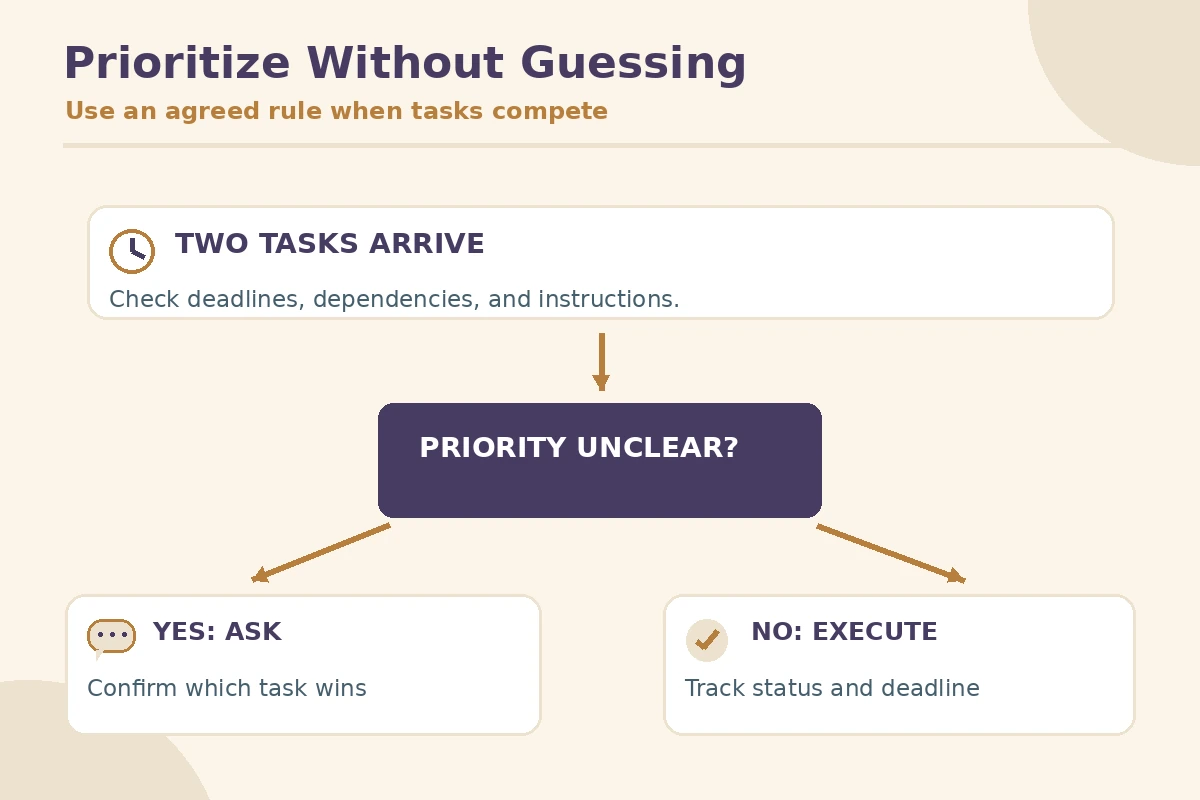
Explain How You Chose What Came First
A useful bullet names the competing tasks and the rule used to sequence them. For a hypothetical student-event task, you might say: “Tracked room requests and submission cutoffs; flagged a conflict to the event coordinator before confirming the revised schedule.” The role is support, the step is clear, and the coordinator retains approval. Avoid asserting you “led event operations” unless that was your responsibility.
Ask yourself what you used to prioritize: a fixed deadline, an agreed service level, a safety procedure, an explicit manager request, or the dependency between two tasks. If competing instructions arrived, did you ask for clarification or decide within delegated authority? Stating the rule is often more informative than writing “worked well under pressure.” If you missed a deadline, do not rewrite history; choose a different real example or explain the corrective system you put in place.
Prove Handoffs With Owners, Status, and Next Steps
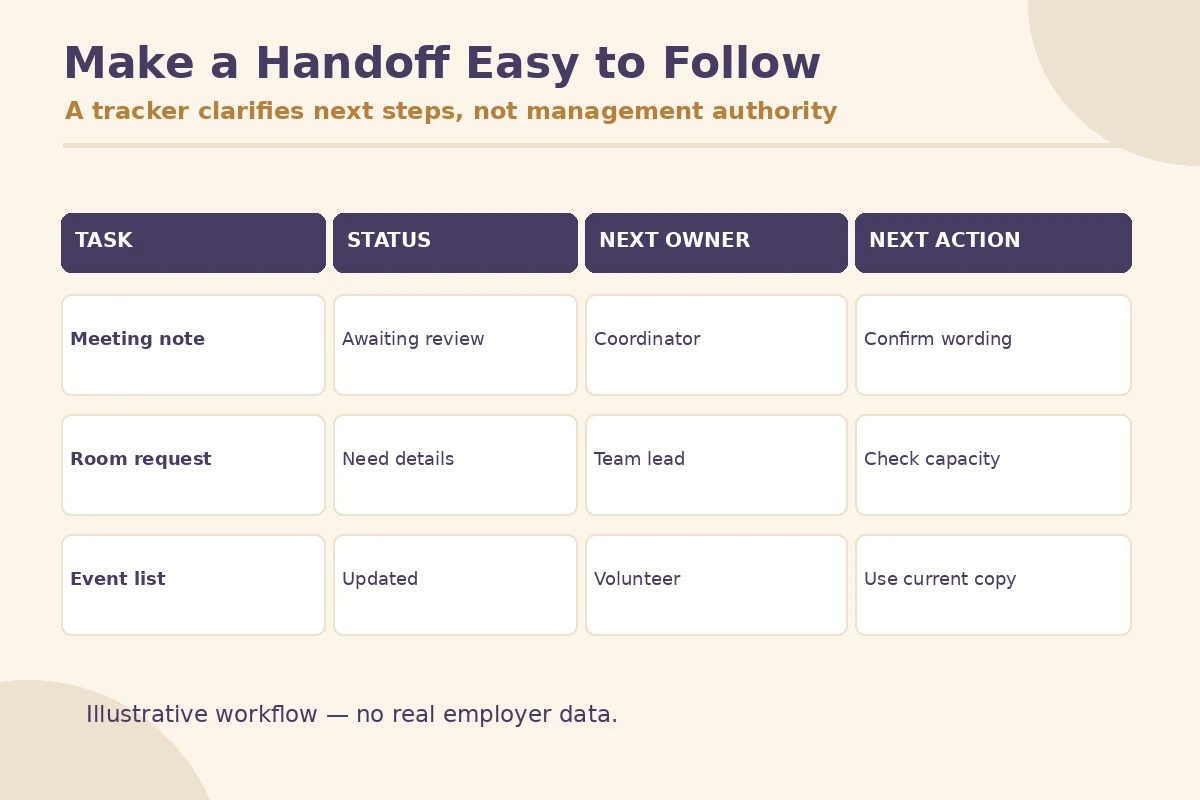
Many tasks fail not because nobody started them, but because nobody knew who owned the next step. A strong organizational example can show a simple tracker with an item, current status, named owner, due date, and outstanding question. The tracker is a thinking aid, not a claim that you managed a formal project management office. If you prepared meeting notes, describe what you recorded and who distributed or approved them.
A hypothetical resume line might be “Updated an event task list after weekly check-ins and sent unresolved items to the volunteer lead.” This does not claim you personally completed those items. An alternate line for real retail work could describe restock requests or shift handoffs, but only when your responsibilities included them. Do not include private names or workplace records in a portfolio sample; replace sensitive details with a clearly fictional template.
Describe Scheduling Without Inflating Authority
“Managed schedules” can be misleading if you only entered your own availability. Compare “Submitted weekly availability ahead of the roster deadline” with “Coordinated appointment changes with two staff members and confirmed updates after supervisor approval.” These describe different work. The first may still be valuable for an early-career job; the second is appropriate only when the coordination actually happened.
Before writing a calendar bullet, identify whose calendar it was, which decisions you could make, how conflicts were surfaced, and whether confirmation belonged to someone else. If a role asks for multi-person scheduling and you have only organized a study group, say “coordinated study-group sessions” and explain how. There is no need to invent executive-assistant experience to show you understand deadlines and communication.
Improve a Weak Claim With a Small Honest Example
Weak: “Excellent multitasking and time-management abilities.” Stronger, hypothetical: “Maintained a course-project action list, noted open dependencies, and reminded the group of agreed submission dates.” The improved wording does not claim the project earned a prize or finished early. A second hypothetical example could be “Organized a volunteer supply list by event date and sent missing-item questions to the site coordinator.” Use your actual facts to make either sentence authentic.
According to the CareerOneStop resume guide, good work descriptions show task, context and what resulted. If a measurable outcome is available in your records, include it. If no verified metric exists, “kept the list current,” “escalated a conflict,” or “confirmed the updated date” may still communicate responsible behavior. Never add fabricated percentages to make a simple support task sound strategic.
Place Organizational Evidence Where It Has Context
For experienced applicants, a specific bullet under the relevant position usually tells more than a “Skills: organization” tag. For a student, the proof might live under a campus activity or a clearly identified group assignment. In a short skills section you could use precise phrases such as “calendar coordination,” “action-item tracking,” or “filing conventions,” provided you have done those things.
Do not duplicate the same adjective in summary, skills, and every job entry. Choose one primary example that fits the vacancy and a second if it shows a different form of organization. If the job emphasizes inventory, a meeting-notes example may be less relevant than an actual restocking or records workflow. The skill is transferable but the employer still needs to see the bridge between old context and new task.
Run a Final Organizational-Scope Audit
Check every management verb on the resume. Did you coordinate, track, propose, approve, or direct? Those verbs are not synonyms. Change “owned all schedules” to “updated assigned entries in a shared calendar” if that was the truth. Also verify dates, quantities, people involved, and handoff decisions. Your example must withstand a basic interview question: “What happened when the plan changed?”
For a hypothetical interview preparation exercise, write down one interruption, one decision rule, and one communication step. Keep the example private until it accurately reflects your experience. If you cannot remember a dramatic result, you can still explain the method. A reliable, bounded account of organized work is stronger than a sensational achievement invented for a job application.
How We Research These Resume Skill Claims
Used O*NET and BLS descriptions to distinguish coordination, calendars, and files from supervising staff, then applied CareerOneStop resume guidance to task-specific bullets. Illustrative handoff templates and examples are explicitly hypothetical rather than employer data.
This is independent resume-writing information, not a hiring or ATS-pass guarantee. The sample candidates and exercises are hypothetical and do not describe actual employers or measurable results. Check requirements on each current job posting and keep confidential work records private. Read the JobAsk affiliate disclosure; no paid partnership is implied.
More Resume and Cover Letter Guides
- Hard vs. Soft Skills on a Resume: Choose Both and Prove Each One
- Teamwork Skills on a Resume: Prove Collaboration and Your Role
- Communication Skills on a Resume: Prove Writing, Listening, and Speaking
- Scheduling Skills on a Resume: Prove Calendar Accuracy and Conflict Resolution
- Skills for a Resume: Choose Relevant Abilities You Can Prove
Choose the skill shown by a real relevant task: scheduling, prioritization, record organization, tracking deadlines, or handoffs.
No. Organization may mean sequencing work and clarifying priorities instead of trying to do several tasks simultaneously.
Yes. Name the school or hypothetical context, your actual task, and the limit of your authority.
Explain the process and a verified next step, such as a conflict flagged, an updated schedule, or a handoff completed.
Not unless you actually managed people. Task tracking, coordination, and supervision are distinct responsibilities.