
For a communication skills self-evaluation, describe who needed information, what you communicated, how you checked understanding and what happened next. “I communicate well” is an opinion; a work example shows whether you gave timely status updates, clarified an ambiguous request or documented a useful handoff. Acknowledge missed messages without turning every sentence into self-criticism.
This article covers the communication portion of a self-evaluation, not an entire annual self-assessment. The examples are hypothetical, with no invented employers, results or performance ratings. MIT’s performance-review guidance recommends specific work examples and honest recognition of development needs rather than vague or exaggerated claims.
Separate Listening, Writing, Updates, and Handoffs
Communication is not one skill. Listening means checking the meaning of a request; writing means making instructions or records usable; updates mean sharing progress at the agreed time; handoffs mean passing responsibility to the next owner with enough context. Choose the channels you actually use in your role. A team that depends on written ticket updates may evaluate different behaviors than one that handles face-to-face customer inquiries.
Before drafting, make a four-column worksheet: audience, information needed, action you took, and evidence of follow-through. Include one recent example for each relevant channel. If you have no example for a channel, do not claim mastery. Instead, describe a method you plan to practice and the support you need, without disguising learning intent as established performance.

Write About Listening Without Taking Credit for Others
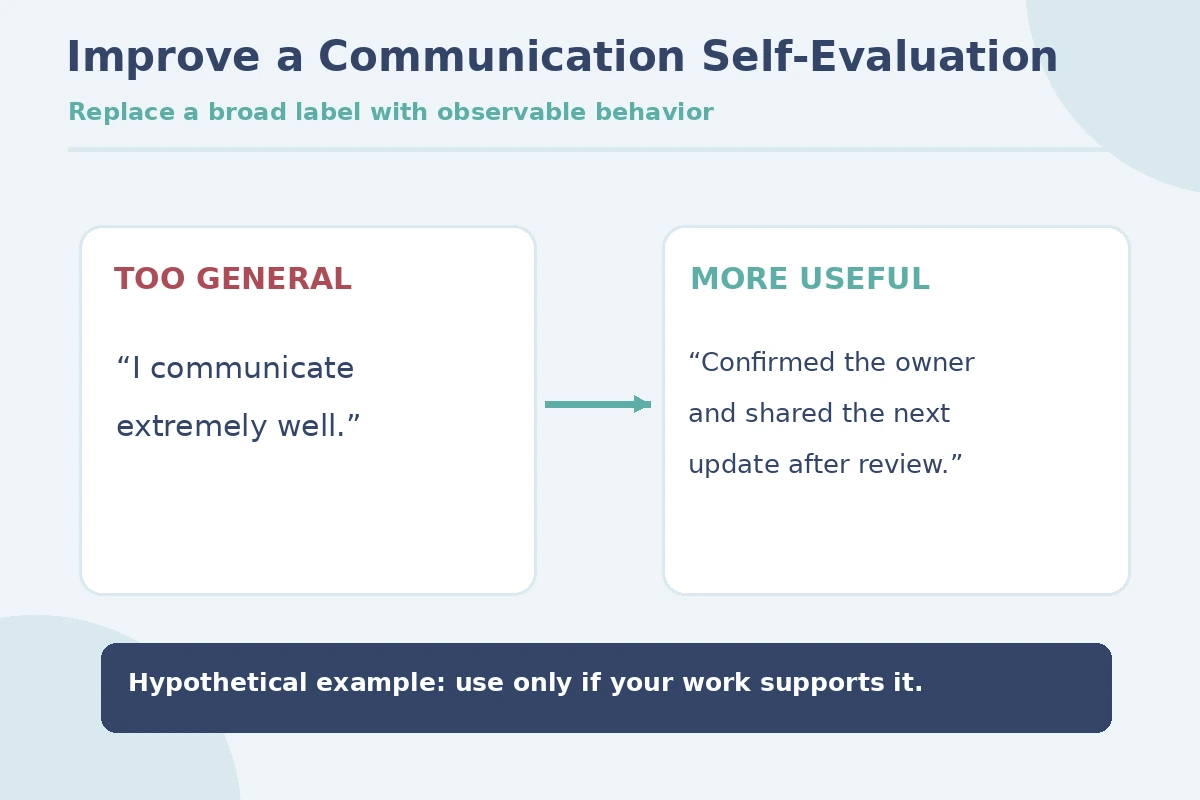
A weak comment is “I always listen actively.” A more useful hypothetical alternative is “I repeated key requirements back to the requester and confirmed the deadline before updating the task list.” The second identifies a repeatable behavior, but it becomes a factual self-evaluation only if the employee performed it. If you merely attended a meeting, do not say you resolved the group’s misunderstanding.
Listening evidence can include clarifying an unclear request, noting a correction, asking who had final approval, or recording a customer’s problem in agreed terms. If a later colleague resolved the issue, credit that person’s role. You might write that you captured the details accurately and routed the request; do not claim the final solution unless you delivered it.

Explain Written Clarity Using a Work Product
For email, documentation or shared notes, describe the audience and the purpose. For example: “Prepared a concise meeting summary with action owners and sent it for review before distribution.” That is a hypothetical illustration of drafting and review, not a claim of authorizing decisions. Where confidentiality matters, describe the document type without exposing employee details, customer names or sensitive records.
If a colleague had to request clarification, the self-evaluation can say what you changed: “After feedback that my update lacked an owner, I started including the next responsible person in project notes.” Use this only if true. A comment about improvement often shows more professional judgment than a blanket claim that all your writing is clear. The evidence is the revised practice, not an assumed productivity increase.
Show Whether Your Status Updates Arrived When Needed
Communication includes timing. A detailed update can still be unhelpful if the recipient needs a decision before the deadline. A self-evaluation might explain which regular check-ins or escalation triggers you followed. Distinguish routine status reporting from raising a risk or requesting approval; these are different messages with different urgency.
For a hypothetical scheduling task, an employee could write, “Flagged an unresolved room conflict to the event coordinator before final confirmation, then updated the shared calendar after approval.” This respects the approval boundary. Do not imply the employee prevented a major disruption or saved a quantifiable amount unless verified. The useful evidence is an early escalation and an accurate follow-through.
Describe Difficult Conversations Without Rewriting Their Outcome
If you gave corrective information or handled a disappointed requester, focus on the observed behavior. “I explained the current process and asked what information was still unclear” is more defensible than “I persuaded everyone.” A difficult conversation does not necessarily end in agreement. Record whether you listened, stated a limitation, referred the issue or followed up, not an invented change of mind.
In a self-evaluation, tone matters but does not replace accuracy. Avoid calling colleagues uncooperative to explain your own missed update. You can say that a request changed and describe how you confirmed the revised scope. If the change exposed a communication gap, note a practical fix such as confirming action owners before closing the thread.
Include One Honest Improvement Area and a Test
A credible self-evaluation can say, “My written handoffs were usually complete, but I sometimes waited too long to flag an open dependency.” Then propose a specific practice: identify pending approvals at an agreed check-in. This is a hypothetical sentence; do not adopt it if your actual issue was different. Avoid false precision such as “100% improvement” without a defined measure and supporting records.
UW–Madison HR guidance for managers recommends comments tied to observed behavior and clear expectations. Employees can apply the same discipline to their own drafts. Ask what acceptable performance looks like, how you will know whether the change helped, and whether the manager agrees with the proposed channel or escalation point.
Finish With a Compact Communication Self-Review
Build a short paragraph in this order: the communication task most relevant to your role; one verified example; a limit, obstacle or improvement; and a next step. For a hypothetical office worker: “I used shared status notes to clarify open requests and forwarded decisions to the appropriate owner. I will make pending approvals more visible at weekly check-ins.” Make sure every completed action is real before copying the structure.
If the form has separate ratings for communication, collaboration and leadership, do not reuse the same example as proof of all three. Communication may support teamwork without proving you managed a team. Use the employer’s period and scale, refer to known examples, and seek clarification if the rating definition is unclear. A self-evaluation is your account of your work, not a guarantee of the manager’s rating.
How We Research This Performance Review Advice
Focused on communication self-assessment rather than general accomplishment lists. Compared MIT and Berkeley review preparation with UW–Madison’s evidence-based writing advice; all sample statements are hypothetical and do not represent real outcomes. Sources reviewed: University human resources guidance University human resources guidance University human resources guidance.
This is general educational guidance, not legal or human-resources advice for an individual case. Follow your employer’s written review procedures and handle confidential performance records only through approved channels. Every example is hypothetical and must be replaced by real, authorized facts. See the affiliate disclosure; no affiliate endorsement or employment outcome is claimed.
Explore Related Career Guides
- Continuous Learning Self-Appraisal: Show Applied Skills and Next Steps
- Nurse Self-Evaluation Examples: Patient Safety and Practice Scope
- Customer Service Self-Evaluation Examples: From Request to Follow-Up
- Employee Self-Evaluation Examples With Evidence You Can Adapt
- Administrative Assistant Self-Evaluation: Calendars, Records, and Follow-Through
Choose the channels your role uses: listening, written clarity, timely updates, customer communication, or handoffs, each backed by a real task.
Only if you can explain the criteria and evidence; specific actions are more informative than an unsupported adjective.
Name the behavior you are improving, a realistic method and how progress could be observed without inventing results.
Use them when relevant and clearly identify their context; do not describe a hypothetical exercise as paid employment.
Only if the measure and time period are defined, the figures are accurate, and you may disclose them.