
Technical interview preparation is more than memorizing coding solutions. First find out whether your assessment involves live code, a written exercise, a design conversation, or role-specific troubleshooting. Then practice explaining how you define the problem, choose a method, verify the result, and handle an assumption that changes. Your goal is to show accurate reasoning and the skills required for that particular position, not to pretend you have mastered every technology.
This US-focused guide is practical preparation, not an employer-specific assessment rubric or a guarantee of hiring. All example candidates, work situations and quotations explicitly described as hypothetical are illustrative; replace them with true personal evidence. Follow the employer’s actual instructions, including limits on tools, confidentiality, documents and accommodations.
Choose the Right Preparation Route
For related guidance on question practice and interview stages, explore the JobAsk interview resources. This article focuses on a role-to-assessment matrix and five-stage answer trace that helps candidates distinguish coding, systems, data, and troubleshooting interviews while checking assumptions and limits rather than presenting memorized solutions. It should be used with the role description and invitation, not instead of them.
Identify the Assessment Before Choosing Practice
Read the job description and invitation side by side. A software engineering role mentioning data structures may involve live coding, whereas an IT support role might emphasize troubleshooting or documentation. A data role could ask for SQL, data interpretation or validation. Do not assume a generic algorithm practice site covers all those tasks. Write down the advertised technologies, responsibilities and any assessment format the recruiter has disclosed.
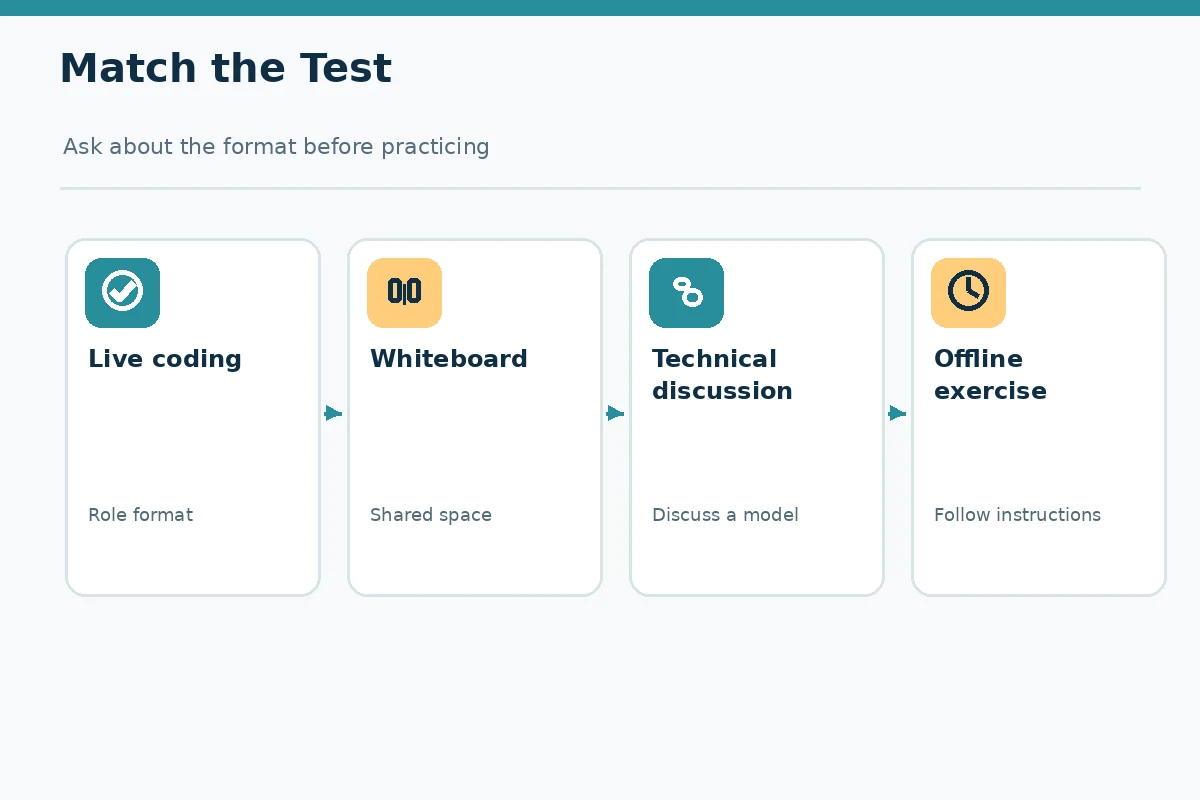
If the invitation is vague, ask which format and tools to expect: a collaborative editor, a whiteboard, take-home instructions, or a technical discussion. This is a logistics question rather than a request for confidential interview questions. UT Austin technical interview guidance distinguishes coding, whiteboard and conversational formats. Match your preparation to the role and use only tools permitted by the employer.
Review Core Skills Through Real Projects
For each job requirement, prepare a short evidence card: the skill named, a relevant project or task, the exact part you completed, and a limitation you can discuss. For example, a hypothetical student may have written unit tests for a small class project but not deployed the system. The project demonstrates testing practice, not professional production engineering. Be prepared to explain what failed during development and how you found the cause.
Refresh fundamentals that support the advertised work: input validation, data structures, queries, debugging, network basics or design constraints as appropriate. Spend less time on topics the role does not mention. An excellent candidate can say, “I have used this tool in a supervised project; I would need to verify the production environment.” Do not convert self-study into an invented certificate or claim you owned another person’s code.
Use a Five-Stage Problem-Solving Trace
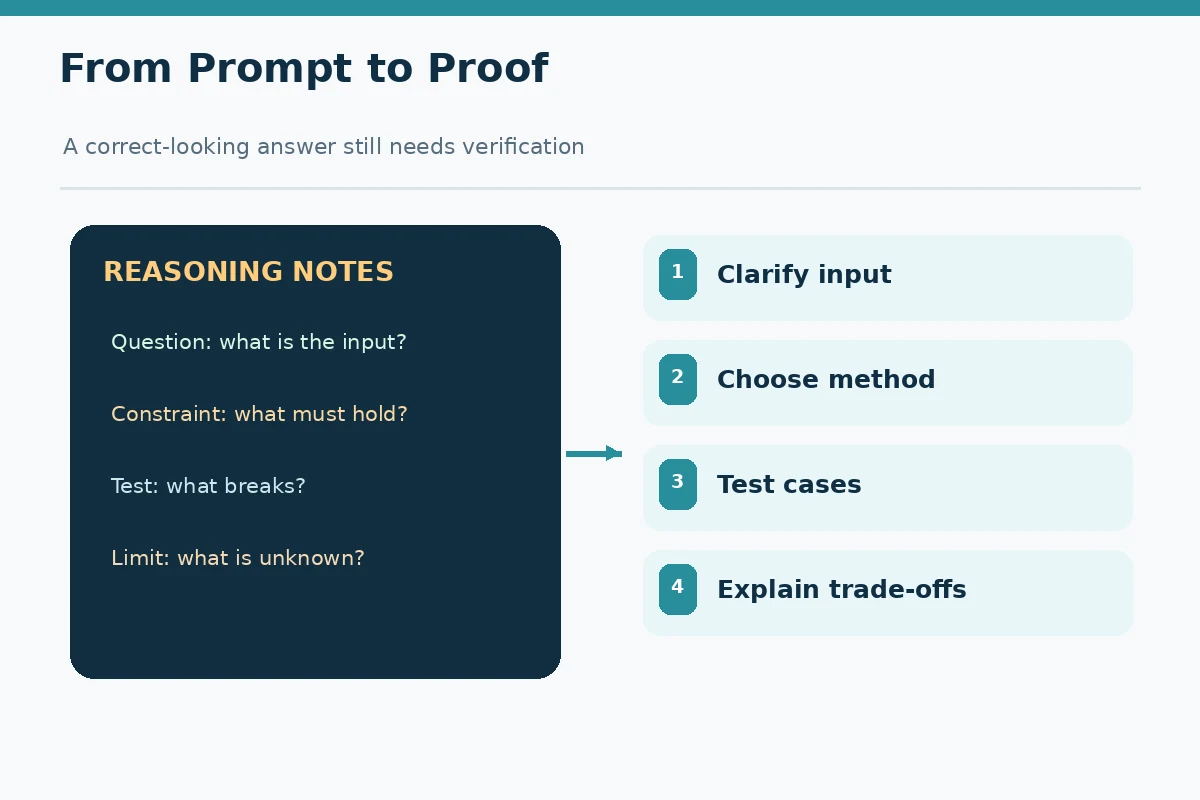
A useful sequence is clarify the goal, list constraints, propose an approach, test with small examples, and explain trade-offs. Suppose a hypothetical problem asks you to find duplicate IDs in a list. Ask whether the list fits in memory, whether input can be empty and whether order matters. State a straightforward approach before discussing an alternative. Only then code or outline the steps that follow from the clarified requirement.
While working, speak in concise checkpoints rather than narrating every keystroke. Tell the interviewer what invariant or assumption you are relying on. If you spot a mistake, acknowledge it and revise your approach; covering it up is less informative than showing a sound correction. Northeastern’s technical interview guidance discusses clarifying inputs, edge cases and performance trade-offs before and after implementation.
Practice Verification Instead of Guessing
Use deliberately awkward test cases: empty input, duplicate entries, a boundary value and malformed input where relevant. Explain which case your approach handles and which would require a changed specification. A statement such as “This works for all inputs” is unsupported unless you can justify it. In interviews about security or production systems, do not imply that a toy solution constitutes a security review or operational approval.
When time runs short, prioritize an accurate explanation of what you verified. For a coding task, walk through a small example and describe how you would test further. For troubleshooting, clarify symptoms, isolate a plausible cause and indicate when the issue should be escalated. Princeton’s coding interview resources describe how employers use live and offline tasks to evaluate both problem-solving and discussion of the approach.
Rehearse Under the Expected Conditions
Practice once using the actual interaction style, where known. For a live shared editor, type and speak at the same time. For a whiteboard, practice readable variable names and a concise explanation. For an asynchronous task, follow the instructions on allowed resources, time limit and submission format exactly. Do not assume you may use AI assistance, external libraries or another person unless those tools are expressly allowed.
Ask a practice partner to challenge one assumption or request an alternative. The goal is to adjust calmly rather than defend an incorrect first answer. Record which part stalled—requirements, syntax, reasoning or explanation—and focus the next practice session there. Retesting your own code can reveal gaps that running through a memorized answer never exposes. Keep practice artifacts free of confidential employer material.
Handle an Unknown Question With Clear Boundaries
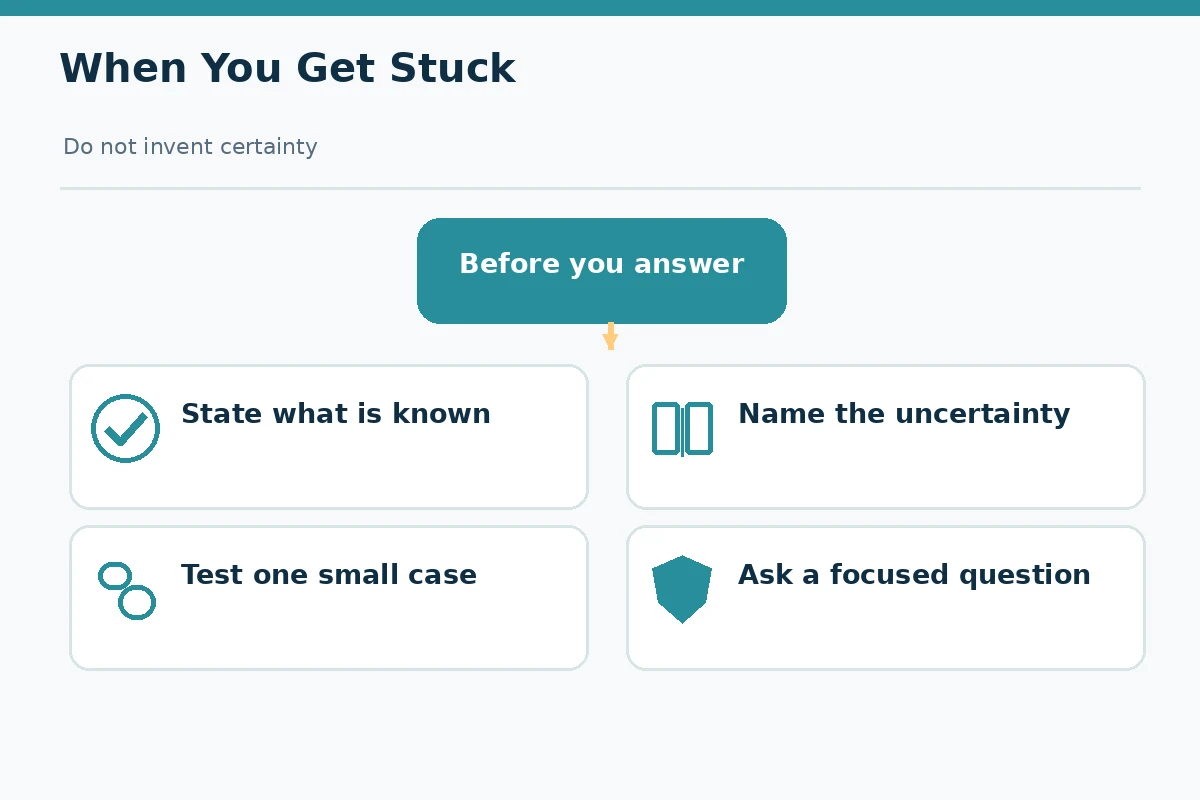
If you cannot solve a prompt, say precisely what you understand and where the uncertainty begins. Propose a smaller valid case, ask one clarifying question and walk through a reasonable next step. It is acceptable to know an approach only partially. Avoid inventing a performance number, claiming a tool has guarantees you have not tested or presenting pseudocode as a completed production-ready implementation.
For example, a hypothetical candidate may say, “I can outline the data validation and logging steps, but I have not personally configured this cloud service. I would check the provider documentation and ask the system owner about permitted settings.” That is a defensible scope statement. Separate what you did, what you would test and what an authorized team would need to approve.
Run a Role-Specific Final Readiness Check
Before the interview, review the job requirements, prepare one project example and confirm the time, format, tools and permitted aids. Test your device and access arrangements if there will be live online work. On your practice sheet, include questions about inputs, constraints and ownership; do not write a canned speech that disregards the interviewer’s actual problem. Have a short explanation of a decision you changed after discovering a flaw.
Immediately after the interview, note the kinds of problems covered, what you handled well, and any genuine gaps to study. Do not share proprietary questions or code in public repositories if the employer restricted them. A technical interview is an assessment with company-specific standards, not a certificate of competence or a promise of hiring. Keep the focus on truthful evidence and improvement.
How We Research Interview Preparation
Checked on 2026-10-27: we reviewed the cited public career-service and professional guidance for interview formats, preparation and candidate responsibility. Those sources support the particular practices described but cannot establish a private employer’s undisclosed interview questions, recruitment policies or outcomes. We compared this topic against JobAsk B092, B109, B114 and other previous interview pages to reduce overlapping intent. Any hypothetical example is original illustration, not a sourced real-life success story.
Source guidance: UT Austin identifies different technical interview formats and recommends communicating problem-solving reasoning.
Source guidance: Princeton describes remote, live and asynchronous coding formats and the importance of showing thought process.
Source guidance: Northeastern outlines constraints, trade-offs, test cases and communication in technical problem solving.
No employer endorsement, hiring guarantee or paid relationship with the cited institutions is claimed. See the affiliate disclosure. Adjust instructions to the actual employer and never submit another person’s work as your own.
More Interview Preparation Guides
- Walk-In Interview Preparation: Verify the Event and Be Ready to Talk
- Group Interview Preparation: Contribute Clearly Without Dominating the Room
- All-Day Interview Preparation: Manage Multiple Meetings and Your Energy
- Interview Presentation Preparation: Follow the Brief and Defend Your Ideas
- Virtual Interview Preparation: Test Your Setup and Build a Backup Plan
Practice understanding and explaining methods instead. Memorized solutions can fail when assumptions or inputs change.
Yes. Technical assessments may focus on data, systems, troubleshooting, design or role-specific knowledge.
State your experience accurately, clarify what the question requires and explain how you would verify an unfamiliar area.
If relevant to the problem, state trade-offs and constraints accurately; do not add unsupported complexity claims.
Only when the employer explicitly permits the particular assistance or tools. Follow the provided instructions.