
Do not choose resume bullet counts in isolation. For each relevant position, write enough bullets to demonstrate the specific responsibilities and results the target job requires; give less space to older or unrelated roles. The quality of each line matters more than hitting an arbitrary quota of three, five, or eight. Start with a complete draft and remove repetition.
All names, organizations, dates, and personal examples identified as hypothetical in this guide are invented demonstrations, not real employment claims. Replace them only with your verifiable experience. A resume can be selectively relevant, but forms requiring a complete employment history must be answered according to their instructions.
Treat Bullet Counts as a Space Decision, Not a Rule
CareerOneStop’s work-experience guide suggests a relatively detailed set of bullets for many jobs, while other resume styles use fewer. The same source also says to omit less relevant duties rather than inventory everything. Those are practical editing suggestions, not a mandatory number or an ATS pass threshold. A role requiring a broad technical explanation may deserve more bullets than a two-week support placement.
Before counting lines, ask: what must the reader learn about my fit? Name the required process or skill, identify a relevant role, and write the clearest verified example. A short strong entry can be more useful than a longer list of ordinary tasks. Candidates early in their careers may also devote space to coursework, projects, or volunteering rather than trying to create extra work bullets.
Draft One Bullet for Each Distinct Qualification
Take a target posting and circle three to five independent responsibilities. For a scheduling position, those might include calendar updates, customer communication, record accuracy, priority changes, and handoff documentation. For each ability you genuinely have, write one bullet that names a concrete action. If two bullets both say you helped customers, decide whether they show different evidence; if not, combine them.
The University of Michigan resume resources teach an action-plus model: what you did and how, why, or with what impact. For example, “Recorded appointment changes and notified the assigned coordinator before schedules were finalized” is a hypothetical but specific line. “Hardworking self-starter with excellent customer service” does not tell the reader which task you completed.

Make Routine Work Specific Without Fabricated Numbers
Not every useful contribution produced a measurable percentage. Explain the workflow, checks, tools, customer need, or decision boundary you actually handled. Replace “Responsible for documents” with “Compared incoming forms with intake requirements and flagged missing information for review.” That example demonstrates attention to detail without claiming total error elimination. Never insert a fictional count to make a bullet look quantifiable.
The Harvard career guide provides varied action verbs that can help a writer avoid vague repetition. But the verb must match responsibility: “approved” is incorrect if you only prepared or reviewed documents; “managed” is too strong if you simply assisted a team. In interviews, you should be able to describe what the verb meant in your real job.

Allocate More Room to Closely Related Jobs
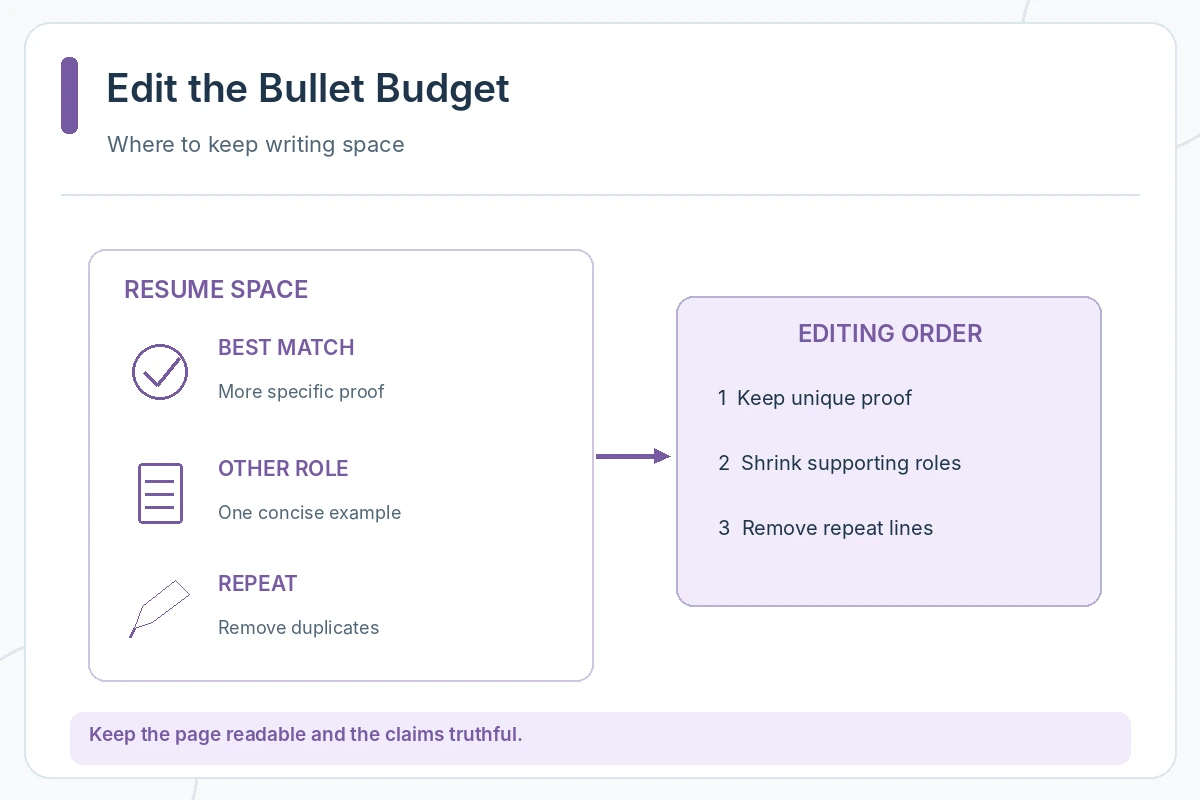
A current position sharing most requirements with the target may merit several distinctive lines. An older unrelated role might only need employer, title, dates, and one useful transferable example. A job with a long tenure does not automatically need more bullets, and a short project may deserve a prominent specific result when it is central to the application. Avoid giving equal space to every position purely for visual symmetry.
Imagine a hypothetical applicant seeking an inventory coordinator role. Three bullets from a recent stockroom job could cover record validation, exception handoffs, and location updates. One bullet from a prior cashier job may establish payment-record accuracy. There is no reason to add two weak cashier claims just so both entries have three bullets. The layout should reflect evidence priority.
Edit Each Line for Verb, Object, and Checkable Context
Read each bullet as three possible pieces: an action verb, the work object, and the method or outcome. Remove empty adjectives and repeated phrases such as “responsible for various tasks.” Specify the audience, tool, or review step when it improves meaning. If the result cannot be verified, stop before exaggerating it. Detailed context is often stronger than a broad unprovable superlative.
Keep most lines concise enough to scan without relying on microtype. A long bullet can occasionally be justified, but if it carries several unrelated actions, separate only the important pieces. Check parallel grammar and punctuation, and make sure that a bullet does not claim another team member’s result as your sole achievement. Job titles and dates must remain visible rather than buried in dense text.
Run a Last-Pass Redundancy and Truth Audit
Highlight every bullet that maps directly to a requirement. Next, mark duplicates, unsupported numbers, tools you only watched someone else use, and duties outside your authority. Cut weak lines first. If the page remains crowded, reduce details under less relevant jobs rather than squeezing the font or margins to make everything fit. CareerOneStop formatting guidance favors readable, consistent presentation.
There is no honest universal promise that a particular bullet count will bypass screening software or win an interview. Use the target posting and your verified record to decide. Your final check is simple: each bullet should help a real reader understand something distinct about the work you did and can explain.
A Practical Work-History Worksheet to Save
Before editing a real application, make a private worksheet with six fields: official employer or organization, actual role title, start and end dates, work arrangement, two or three tasks you can personally describe, and which target-job requirement each task proves. For temporary placements, record the staffing relationship and assignment dates separately. For an active role, distinguish completed work from ongoing work. If any item is uncertain, check records rather than filling the gap from memory alone.
Read the finished resume as a first-time reviewer. Is the role you want apparent? Can the reader find the most relevant proof quickly? Are the dates credible and consistent? Have you avoided copying sensitive records, claiming another person’s result, promising an ATS score, or turning example numbers into actual achievements? The worksheet helps you make decisions; it cannot certify an employer’s selection criteria or ensure an interview.
How We Research Resume Work Experience
We reviewed professional U.S. career resources for work-history selection, honest dates, and bullet construction. These explain useful writing conventions; they do not guarantee a particular employer outcome. Source pages below were checked on October 27, 2026:
cloudfront.careeronestop.org — Relevant responsibilities and accomplishments in the work-history section.
careercenter.umich.edu — Bullet Plus approach based on action, how, why, and impact.
careerservices.fas.harvard.edu — Professional resume action verbs and description guidance.
cloudfront.careeronestop.org — Readable resume presentation rules.
This is editorial career information, not a claim about specific employers or applicant-tracking systems. No affiliate agreement or paid partnership is represented here. Read the JobAsk affiliate disclosure and check individual employer instructions.
More Resume and Cover Letter Guides
- How to Write Resume Bullet Points With Action, Context and Honest Proof
- How to Write Resume Bullet Points That Prove Your Contribution
- How to Write Resume Bullet Points with Action, Scope, and Evidence
- How Many Jobs Should You List on a Resume? Select Relevant Work
- Resume Layout for a First Job: Put Education and Real Proof First
No. It is a common layout choice, not a universal hiring standard. The entry should provide enough relevant, distinct evidence.
Yes, especially an older supporting job. Keep the title, employer, and dates clear.
Often it may deserve more space if it provides the strongest relevant proof, but recency alone is not a sufficient reason.
No. Use verified counts where relevant and authorized; otherwise describe tools, checks, process, and outcomes honestly.
Repeated or crowded lines make key evidence harder to find. Remove redundancy and keep formatting consistent.