
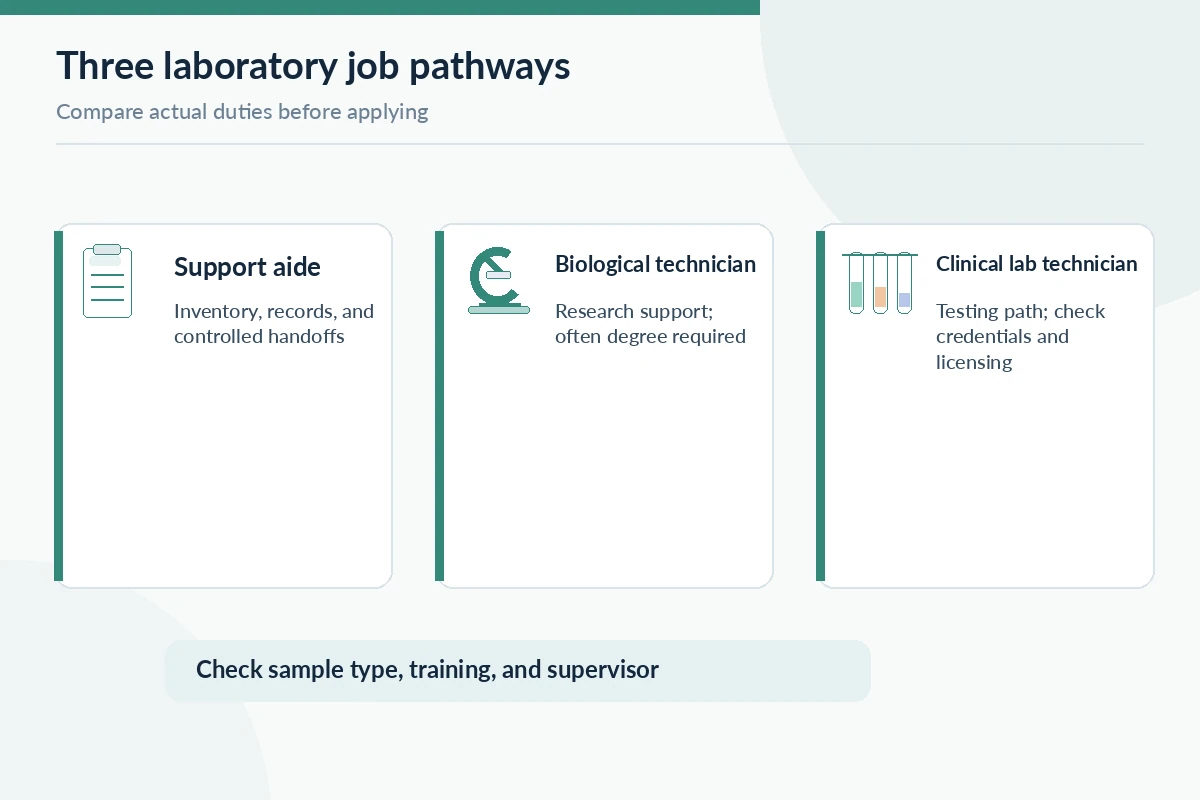
Entry-level laboratory assistant jobs can describe several different types of work. A sample receiving aide, school lab support worker and clinical laboratory technician do not have the same duties or qualification path. Begin with the specimen type, worksite and permitted tasks. Some support openings emphasize inventory, labeling and basic records. Biological technician roles typically require a bachelor’s degree, according to the BLS; clinical laboratory testing roles may have additional education or state licensing requirements.
Do not assume that “entry level” means “no lab safety training” or that a basic assistant can test patient specimens. This guide shows how to screen advertisements, demonstrate careful record work with fictional materials and ask who supervises samples and equipment. The most persuasive beginner story is a precise, safe handoff rather than a claim to perform regulated testing.
Distinguish Lab Aide From Technician and Clinical Testing
The words assistant, technician and technologist may appear in advertisements with very different duties. A nonclinical support position might prepare clean supplies, maintain inventory or label approved containers. A biological technician may collect data or support experiments, typically with related education. A clinical laboratory role can involve testing patient samples with formal preparation and sometimes licensure. The BLS explains these differences. Do not apply to a credentialed testing role while assuming a short orientation alone will qualify you. Check the exact task and state.
Read the Specimen and Safety Requirements First
Ask whether the lab handles environmental samples, food, plants, research material or clinical specimens. Those materials require different approved procedures. A posting should identify safety training, supervision and equipment use; do not handle biological, chemical or patient samples on the basis of a generic blog instruction. In an interview, show that you would ask about the relevant protocols, protective equipment and incident reporting. Never propose doing a home demonstration with real biological material merely to prove motivation.
Create a Safe Fictional Labeling Exercise
Use five empty, clean, nonbiological containers or paper cards as a practice example. Give each a fictional identifier and a documented handoff time. Compare the label to a matching simulated intake sheet, then flag a mismatch rather than rewriting the source record without authorization. The purpose is to demonstrate attention to identifiers, not a chain-of-custody certification or real specimen handling skill. State plainly on your resume that this was an educational practice exercise if you choose to reference it.
Record a Handoff Rather Than Invent Test Results
For a demonstration log, capture the fictional item ID, origin label, date, receiving status and reviewer. If a sample ID does not match, mark “hold for verification” and ask the assigned person. Do not fill in test results or say a sample is clinically valid. In a professional setting, the lab’s procedure may require different steps; follow that procedure over any example online. This distinction is especially important when the work can affect research integrity or patient care.
Check the Entry Credential for This Exact Worksite
Read mandatory qualifications separately from preferred ones. A supply or accessioning support role may have a different training pathway than biological technician work, for which BLS reports a typical bachelor’s-degree entry route. Clinical testing can require an associate degree, bachelor’s degree, certification or state license depending on the occupation and jurisdiction. Ask who provides worksite instruction and whether the role includes instrument calibration, testing or result release. Avoid calling a short online course a professional license.
Understand Inventory and Documentation Duties
Stocking clean consumables, logging lot information and locating expired supplies are examples of support activities that may appear in laboratory settings. Yet even disposing of used materials or replacing reagents can require specific training. If the advertisement emphasizes inventory, build a fictional stock sheet with part numbers, quantities and reorder flags, clearly labeled as a demonstration. Explain how you would report damaged packaging or missing documentation rather than using a product anyway. Accurate records are useful; unsupervised experimentation is not.

Convert Classwork Into Verifiable Skills
A supervised chemistry or biology class may provide evidence of following written instructions, labeling materials and recording observations. State only the instruments and procedures you personally used, and whether the setting was educational. A school science fair does not automatically qualify you for clinical testing. A credible bullet might read: “Maintained a dated log of observations during supervised coursework and checked labels against a class worksheet.” Avoid invented sample volumes, testing accuracy and laboratory certifications. Relevance matters more than exaggerated scope.
Ask About Supervision and the Next Handoff
In an interview, ask: “Which tasks can a new assistant perform after training, and which require a licensed or senior technician?” Follow up with “How are incomplete labels or damaged containers documented?” and “Who reviews my first records?” These questions reveal whether the role has an appropriate learning path. If the employer cannot describe safe training for hazardous materials or patient samples, do not agree to improvise. The person accepting a handoff should be identifiable through the approved workplace process.
Verify the Employer and Protect Personal Records
Review the official laboratory or institution careers page rather than trusting an unsolicited message. A job application should not require buying specimen kits from a stranger or supplying financial records to an unverified recruiter. The FTC warns that impostor hiring messages may ask for bank or identity data early. Do not email patient records, actual lab data or confidential university research as proof of skills. Use descriptions of permitted work or thoroughly fictional demonstration materials instead.

Use a Training-Limits Application Checklist
Before submitting, compare the posting’s material type, minimum education, safety responsibilities, hours and permitted task scope with your real background. Choose one evidence example that shows careful observation, recordkeeping or handoff. State what you need to learn and who would supervise it; ask about required certifications without assuming they are universal. If a posting is actually for clinical lab testing or a credentialed technician, pursue the stated pathway instead of trying to relabel it as an assistant opening. That protects both the applicant and the work.
How We Research Entry-Level Job Requirements
This guide compares official occupational descriptions from BLS Occupational Outlook Handbook, BLS Occupational Outlook Handbook, O*NET occupation profile, and Federal Trade Commission job-scam guidance. These sources describe typical tasks, education routes and recruiting risks; they do not confirm that a specific employer has an open job or grants a particular permission. Always read the current employer posting and applicable workplace requirements. Examples in this article are hypothetical unless explicitly stated otherwise. Read JobAsk’s affiliate disclosure for site transparency.
Related Guides
- Laboratory Assistant Cover Letter With No Experience: Labels, Logs, and Safety
- Entry-Level Payroll Clerk Jobs: Verify Time Records and Approval Limits
- Entry-Level Legal Assistant Jobs: Organize Files and Protect Deadlines
- Entry-Level Purchasing Assistant Jobs: Compare Quotes and Track Orders
- Entry-Level Research Assistant Jobs: Match Methods and Data Duties
Some support roles may be accessible, but biological technician and clinical testing positions often have specific educational requirements.
Not automatically. Clinical testing requires appropriate role qualifications, training, supervision and any applicable licensing.
Use safe fictional label or inventory exercises only; do not handle hazardous or patient materials to create portfolio samples.
Follow the laboratory’s approved exception and escalation procedure instead of guessing or silently changing information.
No. Research, educational, environmental and clinical laboratories have distinct materials, standards and workplace requirements.