
Resume sections answer different questions: how can an employer reach you, what can you demonstrate, when did you do the work, and what education or qualifications support it? There is no need to stuff every possible heading into one document. Use a core structure and add optional sections only if their evidence is relevant and true. This page helps you choose and order those sections; it does not repeat the Simple Resume Format article’s typography and one-column layout instructions, or the separate deep dives on resume summaries and work experience.
Give every section a clear job for the reader
Begin with a contact header so a recruiter can identify and reach you. Then consider experience, education and relevant skills as the backbone of the evidence. A professional summary can connect unusual experience to a new target but is optional when it adds nothing. The University of St. Thomas lists header, education, experience and several optional sections, explicitly noting that some can be combined. CareerOneStop likewise presents familiar resume elements and stresses relevant qualifications. None of these guides requires every heading for every applicant.
Write a one-sentence purpose beside each planned section. ‘Experience: shows activities I performed and results I can explain.’ ‘Education: gives completed or correctly labeled in-progress study.’ ‘Skills: lists tools or capabilities evidenced elsewhere.’ If the purpose of a section is merely to fill blank space, reconsider it. If a short portfolio section links to accessible work samples you are allowed to share, it may earn a place; if it contains broken links or confidential content, remove it.

Order sections by the strongest relevant proof
For someone with recent directly relevant employment, Experience usually deserves prominent space. A current student may reasonably put Education and significant course projects above unrelated part-time roles. Someone changing careers may place a focused summary and relevant projects before a longer history, while still preserving dates and truthfulness. The choice is not about hiding employment chronology: it is about making the evidence for the target job easy to find. Maintain conventional, understandable heading names even when you reorder the sections.
Consider two hypothetical candidates. Avery has three years coordinating community events and seeks similar roles: Experience should be near the top. Blake is finishing a data-analysis program and has substantial documented projects but unrelated retail work: Projects or Education may move higher. Neither person should portray coursework as paid employment or replace old titles with desired titles. The reader should be able to tell what was performed, when and in what setting.
Decide whether a summary adds any real information
A summary can be useful when it quickly explains the intersection of relevant skills, background and the role being pursued. It does not have to appear on every resume, and a string of adjectives without evidence is not a meaningful opening. In a hypothetical career-change resume, ‘Retail supervisor with inventory coordination and staff-training experience seeking logistics operations work’ communicates a target and factual experience if those claims are true. ‘Visionary results-driven expert’ says almost nothing unless supported by a real scope of work. If you want the full process, read how to put volunteer experience on a resume without Overclaiming.
Keep the optional Objective separate from the Summary concept: an objective often states the role sought, while a summary highlights demonstrated qualifications. If you have little to say beyond the job title already visible on the application, you may omit both and let the strongest section follow your contact details. JobAsk has separate detailed pages for Resume Objective and Resume Summary; this article only helps decide whether those blocks deserve space.
Promote optional sections only when they supply evidence
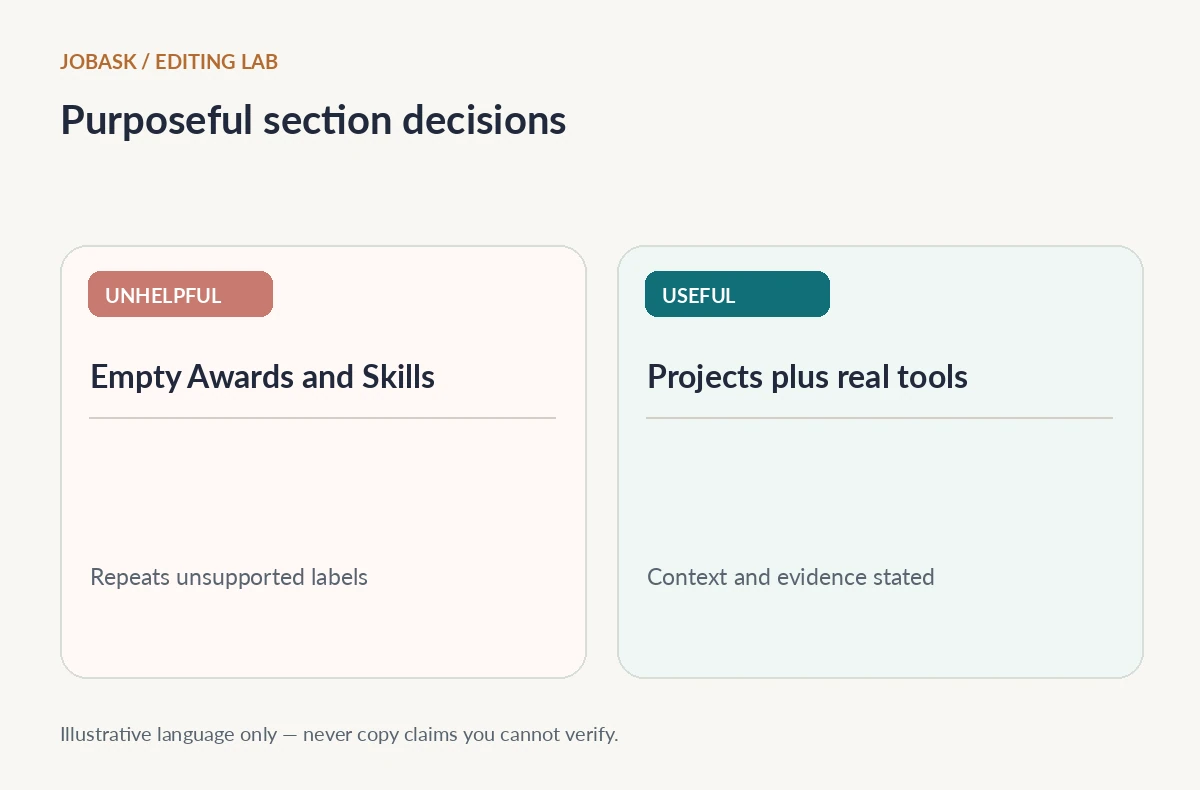
Projects may be useful for an early-career applicant or someone with recent specialized work outside formal employment. Certifications matter when they are valid and relevant; distinguish earned credentials from classes you merely attended. Languages should reflect honest proficiency, not an invented fluent label. Volunteer experience can demonstrate responsibility if you name the organization and actual duties appropriately. Publications and awards may be relevant in research or creative fields but can distract in an unrelated role.
Create an ‘evidence card’ for every optional heading: which job requirement does it support, what work or credential backs it, and can it be verified without revealing confidential details? If there is no answer, remove or combine the section. Some job seekers combine Leadership and Volunteer Experience into one heading; others place projects inside Experience with a clear label. University of St. Thomas notes that overlapping activities can be grouped. Consistency and truth matter more than having an impressive number of headings.
Avoid redundancy and unsupported claims across sections
A frequent problem is listing ‘project management’ as a skill, repeating it in a summary and then showing no project-management work. Another is copying the same course project under Education, Projects and Experience as though it were three achievements. Instead, select the best home for each substantial fact, and refer to it elsewhere only where a brief connection helps the reader. Use experience bullets to show a tool in action, and a skills list to make it easy to locate a tool you genuinely know.
For a hypothetical volunteer registration project, describe the coordination work once under Projects or Volunteer Experience and list the actual software used under Skills if relevant. Do not write a new title implying it was a salaried operations role. A section hierarchy can help readers, but it cannot compensate for inflated evidence. Before applying, compare the material with the actual role description and trim unrelated honors, old activities or repeated adjectives that bury your strongest true evidence. Our guide “Resume With No Experience” adds more detail on this.
Finish with a section-by-section keep or move audit
Print or view the full resume and mark each heading Keep, Move, Combine or Remove. Keep essential contact and factual experience/education evidence. Move a section if a stronger piece of proof belongs higher for the specific application. Combine overlapping activities when the combined heading remains understandable; remove empty Awards or Certifications blocks rather than adding invented entries. Ask whether a recruiter could describe your strongest qualification from the top portion without guessing at your background. If you are starting from scratch, read What to Put on a Resume.
Next, confirm correct dates, non-sensitive contact details, functional links and accurate titles. Follow the employer’s stated document rules and any special occupational resume requirements. This section-priority audit is separate from visual formatting and sentence-level editing; use the other JobAsk guides for those tasks. The deliverable is a shorter, more purposeful section outline, not a claim that a particular order tricks an ATS or guarantees an interview. Different applications may justify different arrangements of the same genuine record.

| Situation | Practical next step | Important limit |
|---|---|---|
| Header with reachable contact | Keep first | Avoid unnecessary sensitive details |
| Summary with only buzzwords | Remove or rewrite with real evidence | Optional section, not a requirement |
| Relevant project with tangible work | Keep; move higher if strongest proof | Label as project, not paid job |
| Empty awards or duplicate activities | Remove or combine | Never fabricate achievements |
How We Research and What Remains Unverified
We compared University of St. Thomas’s resume-section advice with CareerOneStop’s basic-elements and formatting guides. The Keep/Move/Combine/Remove exercise and two hypothetical candidate scenarios are JobAsk editorial tools. The guidance does not claim an ATS-preferred universal section order. Public topical search results and the listed source pages were reviewed on October 19, 2026.
Sources reviewed October 19, 2026: University of St. Thomas explains necessary and optional sections and combining relevant activities. CareerOneStop describes the basic elements and purposes of resume sections. CareerOneStop guidance supports readable, familiar organization of real qualifications.
Affiliate disclosure: No job board, recruiter, employer or cited source is represented here as an approved paying JobAsk partner. No commercial affiliate approval was verified. Read the JobAsk affiliate disclosure before using paid services. Confirm current rules, dates and terms directly with the responsible organization.
More Resume and Cover Letter Guides
- Hobbies and Interests on a Resume: When They Help and When to Skip Them
- Awards and Achievements on a Resume: What to Include and Where
- How to List Awards on a Resume: Include Only Recognition You Can Verify
- GPA on a Resume: When to Include It and How to Label It Honestly
- What to Include in a Cover Letter: A Content Checklist That Avoids Filler
A clear contact header and relevant evidence of experience, education and skills are common foundations; exact requirements vary.
No. Use one only when it connects real qualifications to the target job.
Yes, if authentic projects are stronger relevant evidence for this application and their context is clearly labeled.
Only those earned and relevant enough to help the reader judge your qualifications.
Often yes, when clear labels and descriptions preserve the true context of each activity.