
Quick answer: Once you have genuinely accepted a different job, notify employers whose outstanding offers you will not take. Thank them, state that you are declining, and briefly say you have accepted another opportunity if you wish. Do not call their offer inferior, invent details of the other position, or keep an offer open simply to preserve a backup. If you have not yet accepted another role, do not write as though you have.
Verify What You Have Actually Accepted
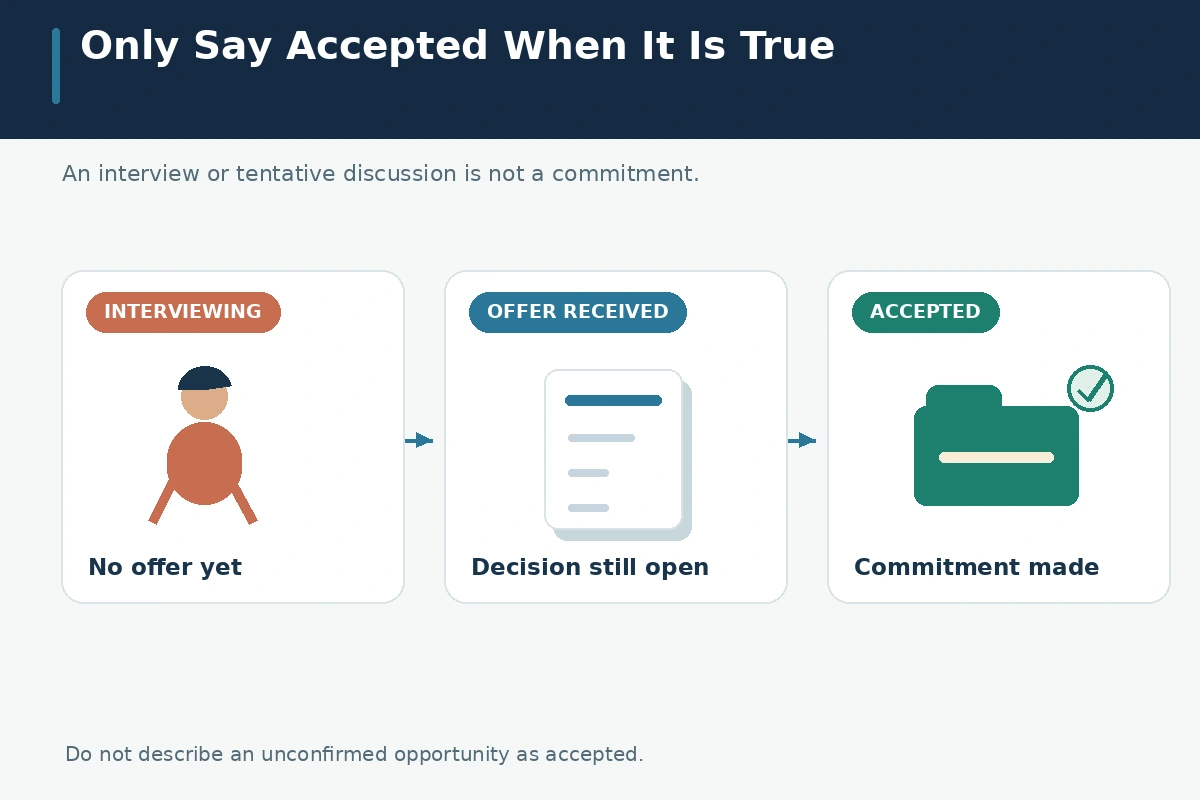
An invitation to a final interview, a verbal hint of an offer, and an accepted job offer are different statuses. Before telling Employer A that you accepted Employer B, check that the statement is true and that you understand what you committed to. Read the written terms, conditional steps, start date and any outstanding items. Do not assume an offer is unconditional or guaranteed simply because a recruiter sounded enthusiastic.
This article covers declining a still-unaccepted offer from one employer because you have accepted a different position. It is not about withdrawing a promise you already made to the employer you are now rejecting. If you have also accepted Employer A’s offer, you face a separate commitment issue; the universities’ career guidance warns that reneging can harm relationships and may involve actual contractual questions. Seek qualified advice on documents rather than treating a template as legal guidance.
Tell the Other Employer Without Playing Offers Against Each Other
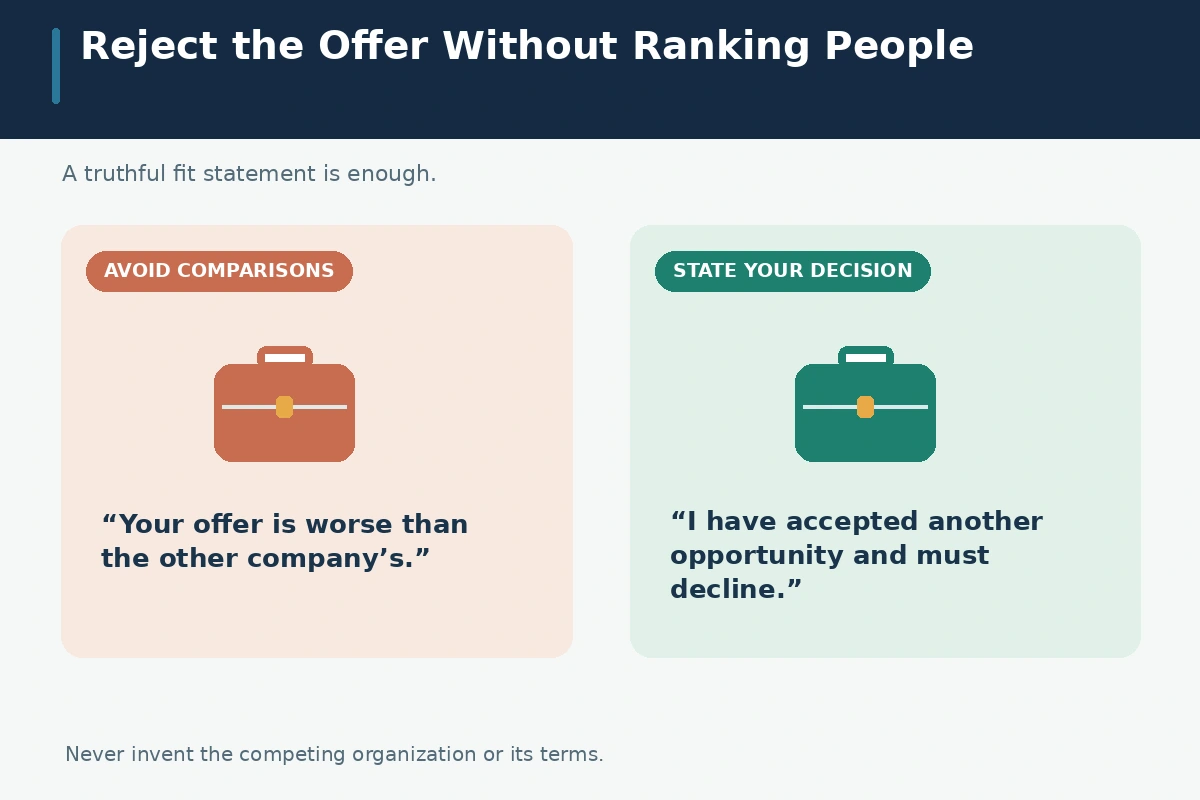
UW–Madison SuccessWorks advises informing other employers after accepting an opportunity and framing the choice around professional fit, not claiming the new job is “better.” The practical task is to close an outstanding decision, not to rank recruiters publicly. You can truthfully say, “I have accepted another opportunity that aligns with my current goals.” If you prefer not to identify the destination, you need not disclose it in the refusal unless an existing agreement requires something specific.
Do not invent a competing employer or offer merely to speed up an interview process. If you still prefer the outstanding offer and have not committed elsewhere, the right task may be a deadline request or a question—not a refusal. Once your decision really is final, communicate it in a way that gives the other organization accurate information for its hiring process.
Decide Whom to Contact and How Soon
Reply to the recruiter or hiring representative named in the formal offer. If there were several interviewers, the recruiting contact can coordinate internal updates; you may thank others individually if appropriate and within the organization’s contact practices. Do not send the same decline email to a large list of staff whose participation was only incidental. Use the channel they requested, and give your decision promptly once it is settled.
UConn’s career guidance includes a sample refusal for candidates pursuing a different opportunity; it emphasizes gratitude and a clear response. Nebraska provides phone and email examples too. These sources differ on preferred channels because professional contexts differ; neither establishes a universal rule. A brief phone call followed by written confirmation can work for a close relationship, while a concise email can be suitable when the offer arrived by email.
Use a Clear Email Instead of a Comparison
Illustrative sample: “Subject: Decision on the [Job Title] Offer. Hello [Recruiter Name], Thank you for offering me the [Job Title] position and for the time your team spent speaking with me. I have accepted another opportunity and will not be accepting this offer. I appreciate your consideration and wish the team well. Best, [Your Name].” This sample does not claim a specific salary, workplace, hiring outcome or employer. Replace bracketed information with genuine facts.
A weaker approach is “Your offer was not nearly as good as the other company’s.” It invites an argument, reveals details you may not wish to discuss, and does not help the employer understand the decision. The neutral alternative makes the final status unambiguous. If someone asks whether you might reconsider, do not suggest you are undecided if you have accepted elsewhere and do not intend to change course.
Withdraw Other Pending Applications Carefully
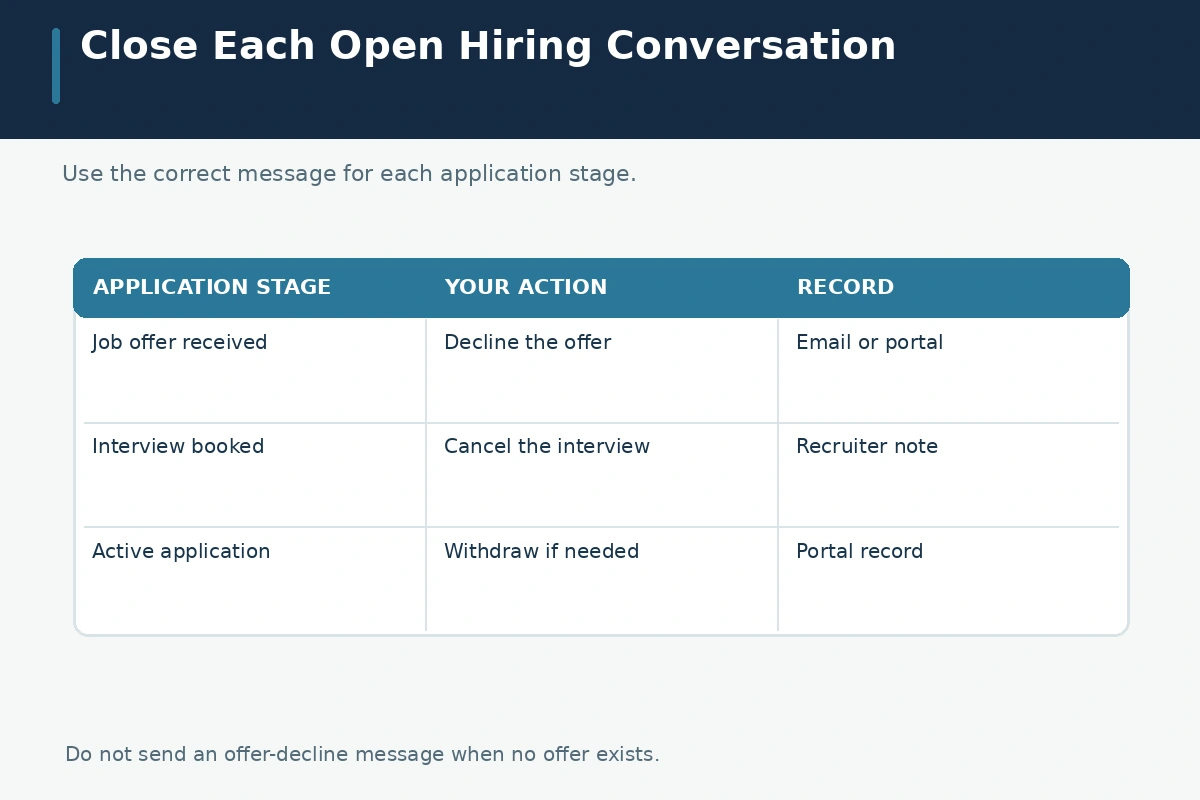
An accepted offer may leave you with interviews and applications still active elsewhere. Follow employer instructions for withdrawing from those processes; do not send a job-offer decline to a company that never issued an offer. A pending applicant can write a short withdrawal note thanking the team and saying they are no longer pursuing the position. Use the correct subject and stage so the organization is not confused about whether it ever made an offer.
If you are required to complete a portal action, do that too and keep its confirmation where available. Avoid multiple accounts or unexplained disappearance. You do not need to contact every company that never responded to an application, but it is courteous to notify active recruiters and cancel scheduled interviews. Do not send unnecessary personal data to demonstrate that your new role is real.
Preserve Goodwill Without Claiming a Future Promise
A sincere “I appreciated the conversations” is enough. You can mention a positive aspect of the interaction that genuinely occurred, such as the chance to learn about the role, but do not flatter a team you never met or promise that you will reapply. UConn and Wisconsin both support brief, respectful language. You may choose to remain connected professionally if the relationship already exists; that does not guarantee another interview or an invitation later.
If you previously negotiated with Employer A, do not reuse your negotiating message as a rejection: remove requests for changed compensation and make the final decision clear. Avoid oversharing about the accepted position or claiming it is more prestigious. The purpose is to close a current commitment honestly and allow both parties to plan their next steps.
Keep a Reliable Decision Record
Track the employer, role, recipient, date, and final decision privately. Save a copy of the email or portal acknowledgement; do not treat an email send timestamp as proof the employer read it. If the recruiter follows up with logistical questions, respond accurately rather than ignoring them. If an offer contained equipment, relocation or onboarding arrangements already underway, carefully check whether any obligations were created and seek advice as appropriate.
The final check is simple: Did I actually accept the other job? Does this employer still have an outstanding offer to me? Am I declining clearly, promptly, and without fictitious comparisons? If all three are true, a short notice does its job. No script can remove every disappointment, but a professional refusal does not need to become a debate.
How We Research and Verify Job Offer Guidance
How We Research: We checked original university career-center guidance on October 28, 2026, including UW–Madison SuccessWorks; University of Connecticut Center for Career Readiness; University of Nebraska–Lincoln Business Career Center; Harvard Mignone Center for Career Success. These sources support general communications and decision-making guidance, not individual employer policies or legal conclusions. We compared each intent with the historic JobAsk topic index and public search results; that does not prove unpublished WordPress URLs are unused. All sample messages, roles, names and outcomes are hypothetical and must be adapted to true circumstances. We have not established any paid partnership with the cited institutions. See the affiliate disclosure before deciding whether an offer fits your situation.
Related Workplace Guides
- How to Decline a Job Offer by Phone and Confirm It in Writing
- How to Decline a Job Offer After Accepting Without Misleading Anyone
- How to Decline a Job Offer by Email Before You Accept It
- Decline a Job Offer by Email: Clear Templates and a Decision Checklist
- Decline a Job Offer Due to Location: Explain the Commute or Move Briefly
Usually not necessary in a standard refusal. You can state that you accepted another opportunity without sharing its identity.
Avoid a value judgment. Say the other opportunity is a better fit for your goals if that is true.
Do not claim that you have. Ask about timelines or evaluate the remaining offer while your status is still open.
Notify active interview contacts promptly and cancel scheduled meetings according to their process.
That is no longer a simple pre-acceptance decline. Review commitments and obtain appropriate individual guidance.