
Quick answer: To put active listening skills on a resume on a US resume, name the specific task you performed, the limits of your responsibility, and the evidence behind it. A skill label by itself is rarely as useful as an accurate work, volunteer, or project example. Choose wording from your actual experience, not a hypothetical achievement that only sounds impressive.
All resume bullets and scenarios marked as examples in this guide are hypothetical wording patterns. Adapt them only to experiences you can explain. No statement here guarantees an employer response, a particular ranking in screening software, or an interview. Do not put confidential employer or client information in a portfolio or resume.
Define Active Listening Beyond a General Communication Label
Active listening is not simply being friendly or remaining quiet while someone speaks. O*NET describes it as giving another person full attention, working to understand their points, asking appropriate questions and avoiding interruption at the wrong moment. For a resume, the important part is the observable behavior. An employer can reasonably evaluate whether you captured a request accurately, checked an ambiguity, and explained what would happen next; a claim that you are naturally empathetic is much harder to verify.
Choose an example in which understanding changed your action. In a customer-facing role, this might be confirming which order was affected before opening a service ticket. On a team, it might mean restating a changed requirement during a handoff. In volunteer work, it could be checking whether a visitor needed directions or assistance from a qualified staff member. These examples demonstrate listening without pretending that you provided advice outside your role.
Use the Listen Clarify Confirm Evidence Filter
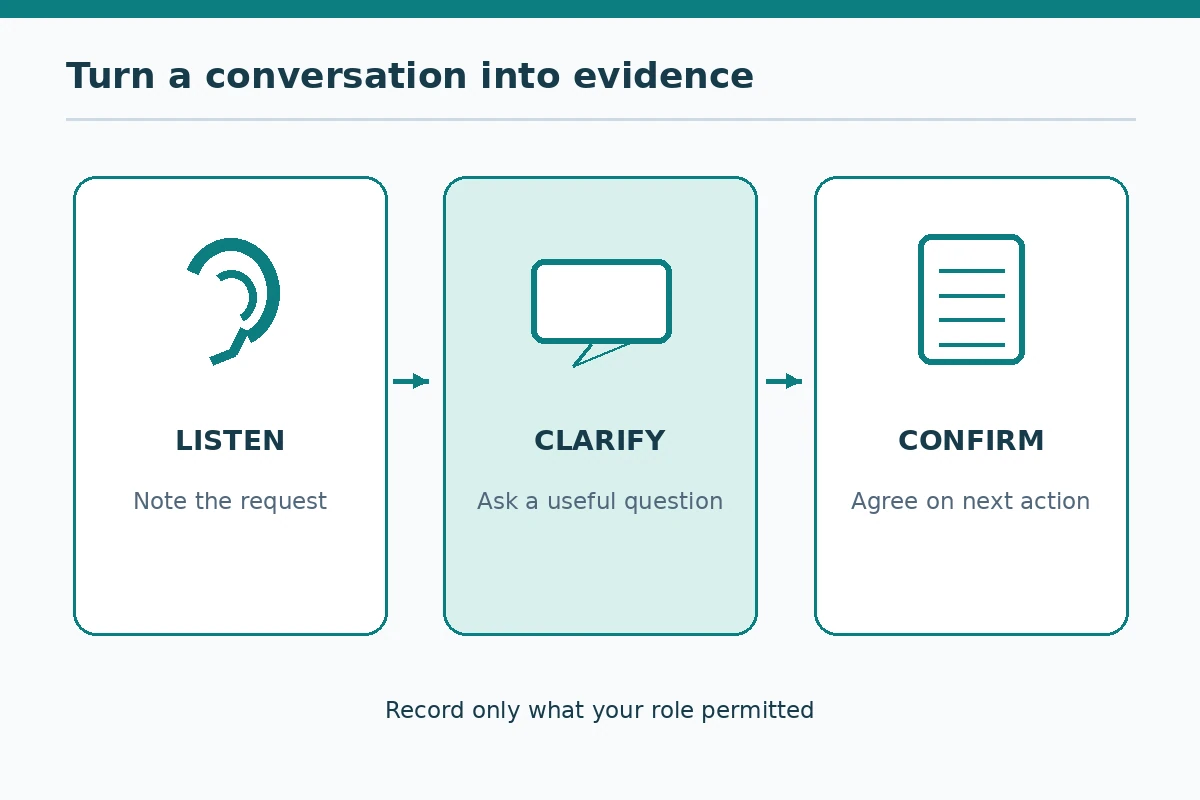
Write down one real conversation from a job, project, placement or volunteer shift. First, what did the other person actually report? Do not include names, private details or a transcript. Second, which question did you ask to resolve uncertainty? Third, how did you confirm the next step, such as repeating a deadline, updating a shared record or passing the issue to the correct owner? If you can answer all three, you have material for a convincing work-experience bullet.
For example, “Clarified customer requests, confirmed the requested service and documented next steps for the service team” is a hypothetical wording pattern. Use it only if it matches your genuine responsibilities. If you only observed another employee handle the issue, write about observation or training, not independent ownership. A precise, modest claim is more valuable than a dramatic story about preventing a mistake you cannot substantiate.
Choose the Right Resume Section for Listening Evidence
For customer service, healthcare administration, community support and coordination roles, the skill can be named in a short summary when it is among the posting’s priorities. The stronger proof still belongs in the job or project entry that explains where you applied it. CareerOneStop recommends job-specific skills and concrete descriptions of what you did. If you use a skills list, “Active listening and request clarification” can be more informative than five near-synonyms for being personable.
A candidate with limited paid experience might describe a student team meeting, campus information desk or supervised volunteer intake, provided the heading makes that setting clear. Keep the timeline and organization accurate. If the employer expects a specialized duty such as counseling, medical triage or formal complaint investigation, active listening alone does not establish professional authorization. Name the escalation or supervision boundary instead of quietly implying a regulated credential.
| Situation | Evidence you can identify | Avoid claiming |
|---|---|---|
| Customer request | Clarifying the request and logging an agreed response | Guaranteed customer satisfaction |
| Team handoff | Restating the decision and recording the next owner | Single-handedly solved every issue |
| Volunteer intake | Listening, confirming needs, and routing questions | Provided professional counseling |
Rewrite Soft-Skill Claims as Task and Follow-Up Bullets
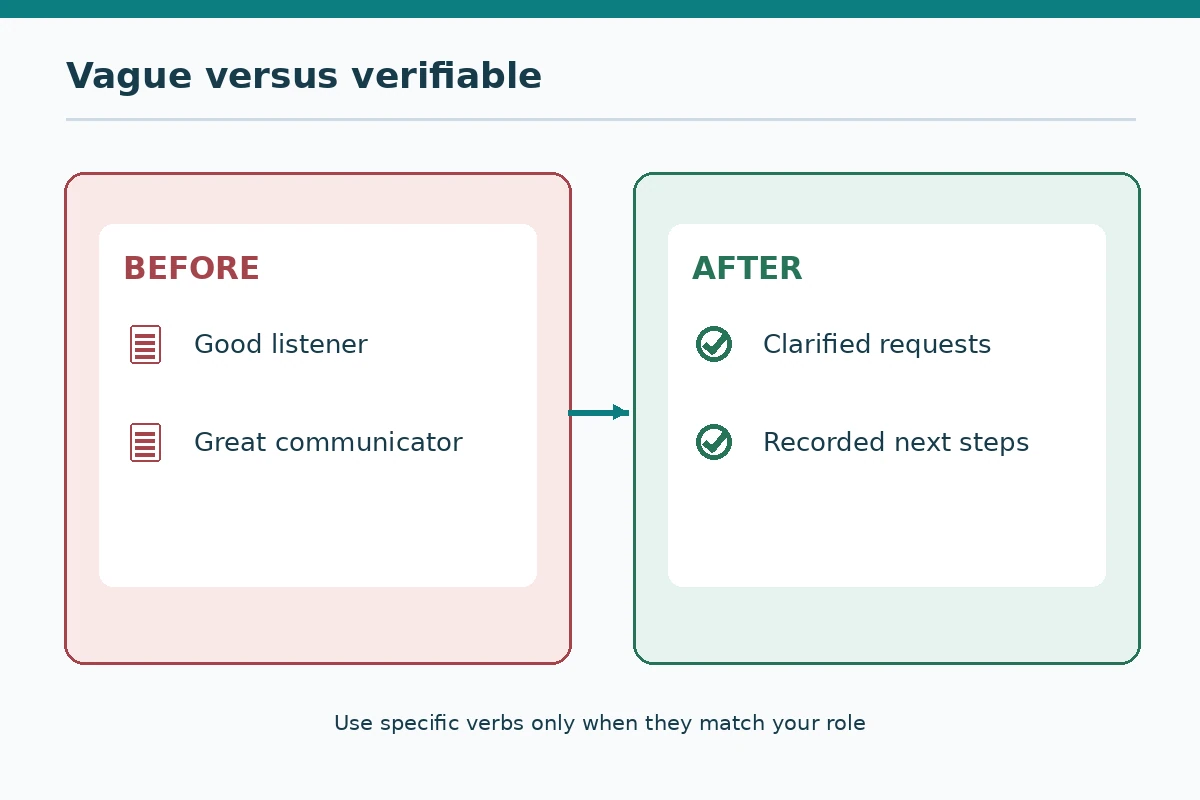
Compare “Excellent listener and team player” with a work-based statement: “Confirmed incoming requests with team members and updated the shared handoff notes before the next shift.” The second version communicates the action, the setting and the artifact. Another conditional example is, “Asked clarifying questions during volunteer registration and routed unclear requests to the event coordinator.” Neither requires invented percentages, impossible claims of perfect accuracy or glowing customer testimonials.
Build one bullet around the person you supported, the question that mattered and the way you closed the loop. Where truthful, say “documented,” “restated,” “confirmed,” or “escalated.” Avoid “resolved” when another person made the final decision. Even if your old supervisor praised your communication, include their exact feedback only when you have a reliable record and permission. You can show the workflow clearly without borrowing confidential conversations.
Distinguish Listening From Persuasion and Conflict Resolution
Listening can support negotiation or de-escalation, but it is not proof that you negotiated a contract or settled a complaint. A front desk employee might collect details and route an urgent concern; that does not mean they approved a refund or made a medical judgment. An internal meeting note might document a stakeholder request without proving you controlled the budget. Strong resume wording respects the decision rights attached to each real role.
Read the vacancy’s language: “gather requirements,” “understand customer needs,” “document calls,” and “coordinate follow-up” describe different observable activities. Select the one you performed. If the target job asks for advanced phone support and your only experience is face-to-face volunteering, show the transferable listening behavior while being transparent about the channel. That honesty makes the distinction between readiness and training needs visible.
Check the Proof Without Sharing Sensitive Conversations
You may be able to verify your experience using blank forms, a generic process description, work schedules, supervisor-confirmed responsibilities or a sanitized portfolio example. Do not upload customer recordings, private messages, protected information or a former employer’s incident logs. If the record cannot be shared, describe the kind of documentation you maintained rather than its confidential contents. The reader only needs to understand what you did.
Review each verb against your actual authority. “Advised customers” can suggest decisions you were not permitted to make; “listened, clarified and referred” may be both more accurate and more useful. Keep the original employer, role and dates visible. You should be able to explain your example in an interview using a fictionalized or anonymized scenario without needing to disclose a specific customer’s identity.

Tailor the Evidence to a Specific Posting
Mark the parts of the posting that require understanding needs, precise communication, record handling or follow-through. Match one or two real examples to those tasks. If the job prioritizes speaking with callers, use a genuine phone-based example where available; if it requires careful team handoffs, show recorded decisions and the responsible next person. Do not copy every phrase from the listing into your skills section.
Before sending the final resume, read the bullet aloud: would a supervisor recognize the activity, can you explain the setting, and is the outcome phrased modestly? Remove unsupported claims like “never misunderstood a customer.” Save the document in the required format and preview the actual upload so the words remain clear. The goal is not to score points for a buzzword; it is to make reliable collaboration visible.
How We Research Resume Skills and Evidence
Our source review on 2026-10-29 compared the role-specific reference material with the US Department of Labor-sponsored CareerOneStop resume guidance on showing verifiable work and selecting relevant skills. Sources: Reference 1, Reference 2, Reference 3. Occupational descriptions and examples are not evidence of your individual qualifications. Employers, access rules, credential requirements and job postings vary.
We distinguish resume advice from firsthand occupational experience and use hypothetical bullets only as editable patterns. You should verify any specific claim, permission, outcome, project or credential before submitting. The affiliate disclosure explains site relationships; this informational article does not claim a paid placement or a guaranteed hiring result.
More Resume and Cover Letter Guides
- Cash Handling Skills on a Resume: Show Drawer Checks and Authorized Transactions
- SQL Skills on a Resume: Specify Queries, Joins, Validation, and Real Projects
- Scheduling Skills on a Resume: Prove Calendar Accuracy and Conflict Resolution
- Adaptability Skills on a Resume: Explain Changed Plans Without Vague Claims
- Communication Skills on a Resume: Prove Writing, Listening, and Speaking
You can, when the role values it, but a short example of clarifying requests and documenting next steps is stronger evidence than the adjective alone.
Yes, if you label the project accurately and explain what you actually clarified, confirmed or documented during teamwork.
Not necessarily. If someone else made the decision, explain that you listened, recorded the concern and routed it appropriately.
Name the situation, your question or confirmation process, and the resulting handoff or record without inventing performance numbers.
Place brief wording in a relevant summary or skills section, then support it in experience or project bullets tied to real activities.