
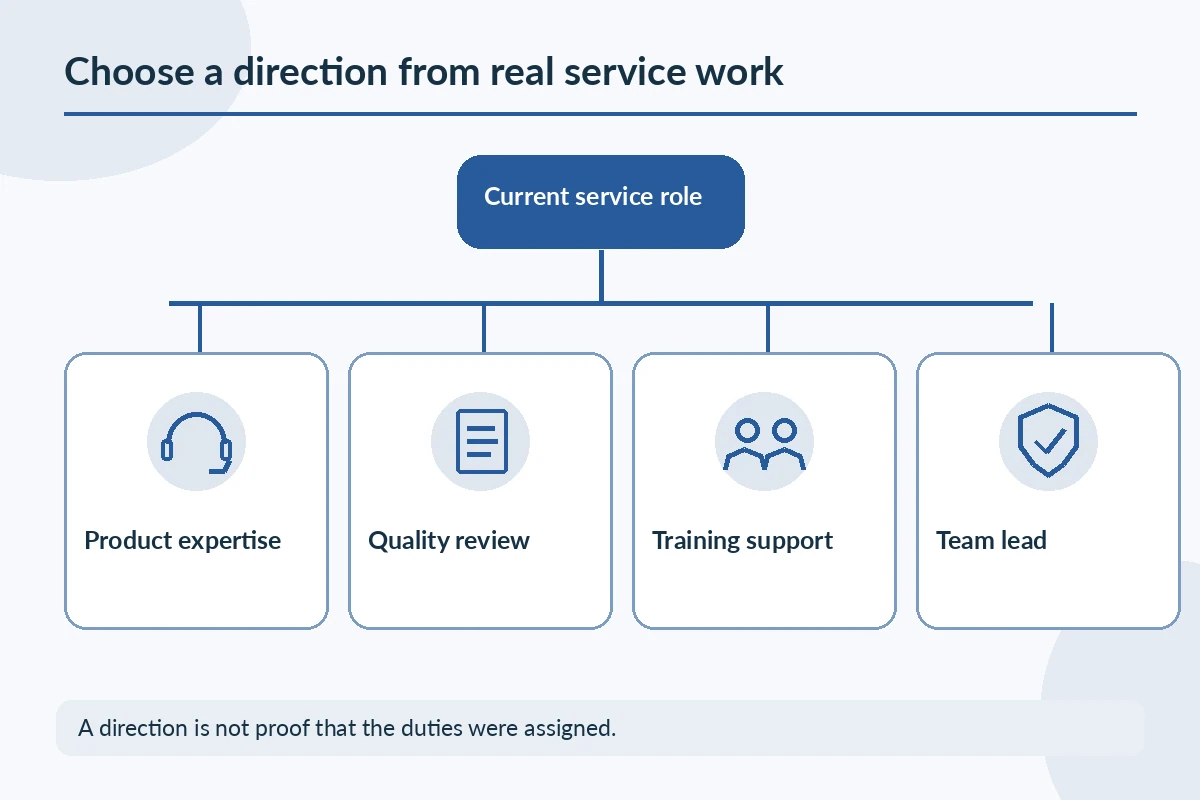
A strong customer service career goal points to a specific kind of next work: quality review, training support, product specialization, or a team-lead pathway. Start with current service tasks you can describe truthfully. “I want to improve the quality of case notes and learn the approved escalation process” is more actionable than “I want to become successful in customer service.”
The goal should not depend on a title opening immediately. You can build skills while staying in the front-line role, provided you respect company rules, customer privacy, approval limits and the workload you are actually assigned.
Compare quality, training, specialist, and lead routes
Quality work may involve checking whether records are complete and procedures were followed. Training support can involve explaining an approved workflow or developing practice examples. Product specialists often focus on deeper knowledge and complex questions. Team leads may coordinate coverage or escalation, but the meaning of that title varies by employer.
Read internal position descriptions if available, then compare the real duties. The BLS notes that customer service representatives answer questions, document interactions, address complaints, and refer cases to supervisors or experienced staff. That does not mean every representative is permitted to issue exceptions, coach coworkers formally, or evaluate their performance.
Build evidence from work you were authorized to do
A service worker might improve the clarity of their own case notes, follow a provided troubleshooting sequence, or identify that an approved help article is confusing. Describe the task and how a supervisor assessed it. If you cannot verify a customer-satisfaction improvement, do not claim one simply because your notes became more detailed.
For a quality route, ask whether you can review a fictional or sanitized case with a trainer. For a training route, propose a practice guide based only on approved public or internal material you have permission to use. For leadership exploration, request a discussion about coverage coordination, not unsanctioned control over colleagues’ schedules.
Pick one useful goal instead of competing metrics
An illustrative quality goal is: “For the next approved review cycle, compare my own case notes to the team checklist, identify recurring omissions, and ask my supervisor for feedback on two examples.” The number is a practice choice, not a universal performance target. Use your employer’s official standards and actual baseline wherever they exist.
A training support goal might be: “Draft one workflow explanation for internal review, test whether a new colleague can follow the approved steps in a practice scenario, and revise wording based on the reviewer’s comments.” Do not distribute unapproved instructions as company policy.

Understand authority when considering lead work
Leading a queue review or explaining a procedure is not the same as having formal supervisory responsibility. Some decisions about refunds, pricing, customer identity, financial adjustments, security, and privacy require designated approval. An ambitious development plan should specify where your contribution ends and another role takes over.
If your goal is to move toward a lead role, build habits that help authorized decision-makers: accurate handoffs, clear prioritization, respectful coaching within your remit, and timely exception escalation. Ask which duties can be practiced under supervision and which require formal assignment.
Protect customer information in your portfolio
Never copy real account screens, recordings, contact details, ticket IDs, or sensitive support transcripts into a public résumé or a personal career-goal file. Use a hypothetical request and clearly label it as illustrative. An anonymized pattern may still be identifying if the situation is unusual, so check the organization’s disclosure rules.
A permitted work sample may be a blank template, a reviewed explanation of a process, or a personal list of capabilities without customer data. If you have evidence of accuracy or timeliness from an official report, check whether you may share the figures externally and avoid implying that the results were achieved by you alone.

Use a review conversation to choose the next test
Bring one existing contribution, one skill to learn, and one small request. For example: “I am interested in quality support because I enjoy identifying unclear handoffs. Would it be appropriate to review a training example against the official checklist, with someone from quality checking my notes?” This makes room for a safe yes, alternative, or no.
Set a review date that matches business operations. If the next opportunity is not available, ask what a realistic prerequisite looks like and whether product knowledge, communication or record accuracy would be the best first step. Update the goal rather than exaggerating your present authority.
Prepare for a move without inventing a success story
If you apply for a quality, training, or team-lead position, explain your interest using a real example of careful service work. An effective answer could describe how you noticed a recurring documentation question, asked for the correct policy, and adjusted your own notes after feedback. Do not say you redesigned a company-wide process unless you were actually authorized to do so and can substantiate it.
For job applications, compare the posting with a short evidence inventory: systems you used, communication channels you supported, problems you escalated appropriately, and examples that a supervisor could verify. Use accurate scope words such as “assisted,” “reviewed,” and “escalated.” These descriptions can reveal transferable skills even without a new title or a statistical achievement.
How We Research These Career Goals
We checked Bureau of Labor Statistics CareerOneStop MIT Human Resources on October 29, 2026, for goal-setting methods and the role-specific facts in this guide. Examples are hypothetical and intended to be adapted to actual duties, employer rules, and available opportunities; they are not evidence that a promotion, assignment, credential, or clinical authority is guaranteed.
JobAsk prioritizes practical informational guidance and internal reading paths. Read our affiliate disclosure; links here do not indicate a paid partnership or a verified employment outcome. Confirm any internal eligibility, training, or access requirements with the relevant organization.
Explore Related Career Guides
- Career Advancement Goals Without a Promotion: Grow Your Scope
- IT Career Goals: Choose a Skill Path and Demonstrate Real Work
- Career Goals for Managers: Improve Delegation, Coaching, and Decisions
- HR Career Goals: Choose a Specialty and Prove Your Next-Step Skills
- Nursing Career Goals: Plan Development Within Your Licensed Scope
Sometimes. Compare the company’s quality role requirements and build approved evidence from record accuracy, standards and feedback.
No. Product expertise, training support and quality work can be separate directions depending on the employer.
Describe verified workflows, approved deliverables and supervisor feedback. Do not invent satisfaction or resolution metrics.
Do not publish customer records or internal tickets without explicit authorization. Use fictional scenarios and permitted templates.
Choose a goal within your present assignment, such as more accurate documentation or deeper approved product knowledge, and review it later.