
Classes that support an application can provide useful context when you have limited paid experience or when a specific course directly addresses a job requirement. It should not become a transcript copied into a job application. CareerOneStop says recent students may feature particularly relevant courses and projects, while Berkeley sample resumes show different ways to present academic work. Here you will use a job-to-course-to-proof test to select only classes that help the reader assess your abilities. The course and project examples below are entirely hypothetical, not real transcripts, certificates or claims of experience.
Decide whether your coursework adds evidence
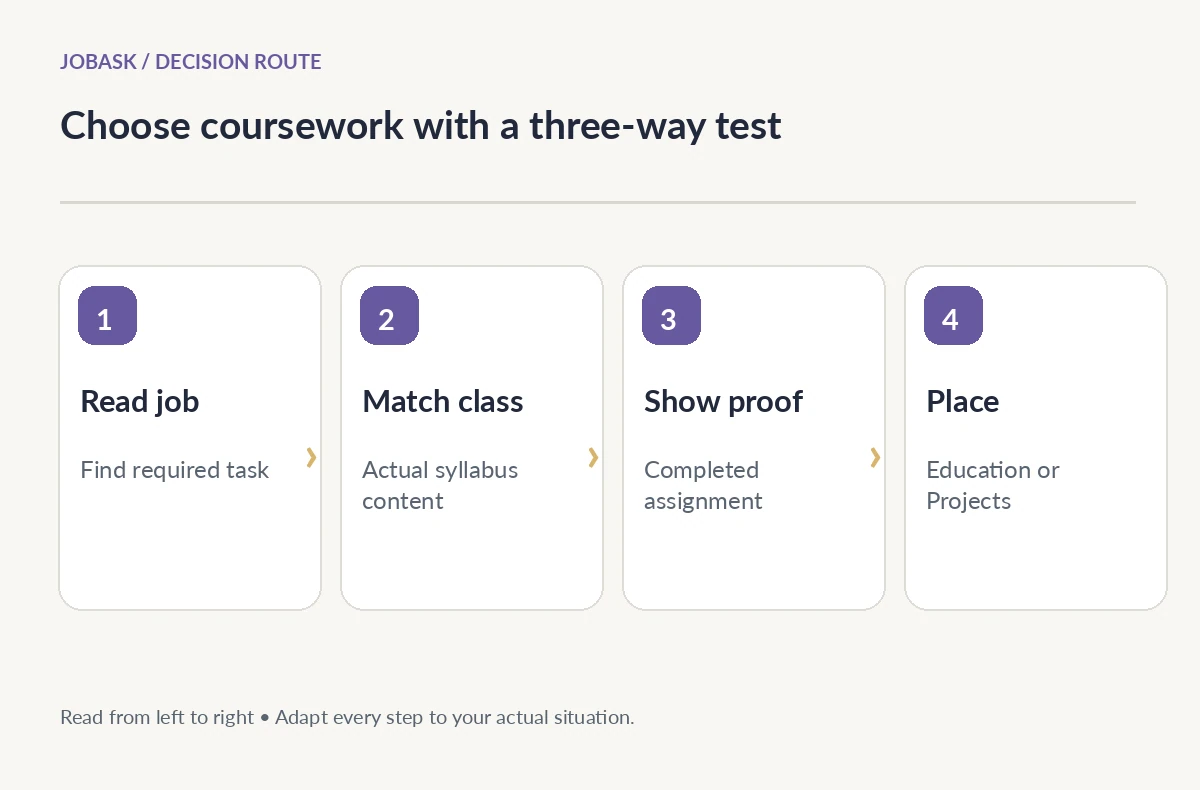
Start with the posting rather than your course catalog. Underline one or two required skills for which you can show real academic work. A marketing coordinator role may call for writing, while a data-entry role might emphasize accuracy and spreadsheet use. Ask if a class you actually completed taught a relevant technique, and whether you produced a project you can explain. If the employer primarily needs extensive professional experience, listing basic introductory courses probably will not outweigh that requirement. Coursework is contextual evidence, not a shortcut past a required credential.
Use an original three-column worksheet: job task, real course topic, and completed assignment or exercise. If you cannot fill the third column, the course title alone may add little. Do not include a course because its name happens to share a keyword with the posting while the content was unrelated. For a fictional student interested in research support, “Introductory Statistics” could be relevant if they actually conducted a class analysis. The fictitious study is not evidence about a real graduate or labor market.
Identify the strongest classes rather than every class
Select two to four substantial subjects only when they contribute information missing from your other sections. CareerOneStop notes that recent graduates may mention a small number of special courses or research projects; this is conditional, not an instruction to fill the page. Courses in general study skills may be valuable to you personally but less relevant to a technical posting. Compare each candidate course with a concrete duty. Rank by usefulness, then consider whether a project, internship or paid role already proves the same thing more convincingly.
Write exact or easily recognizable course names without upgrading their level. “Business Data Fundamentals” is not “Advanced Financial Modeling” unless the official syllabus warrants that characterization. If the institution uses a cryptic abbreviation, you may explain it in plain language without changing the credential. A fictional student who completed one design fundamentals module should not claim a specialization. When a program is unfinished, identify it accurately; never represent an ongoing class as a completed degree or a professional license.
Put classes in the right resume location
For a current student or new graduate, coursework may sit on a single line in Education, just after the degree program and expected graduation date. If coursework led to a substantial project with demonstrable deliverables, a Projects section may be more useful. For an experienced applicant, a short Relevant Training line can work when a recent course addresses a genuine skills shift. The section should be proportional to the resume. Berkeley’s examples show that education, projects and experience can be arranged to fit an applicant’s circumstances.
An imaginary Education entry could read “Relevant Coursework: Applied Statistics; Database Fundamentals,” but only if those classes are real and relevant. Avoid elaborate formatting that makes academic courses look like employer positions. If you participated in a team assignment, describe your own contribution under Projects and identify it as course work. Do not fabricate a project sponsor, paying client or production deployment. Each line should let the reader distinguish study from employment without needing a lengthy disclaimer.
Convert an assignment into defensible evidence
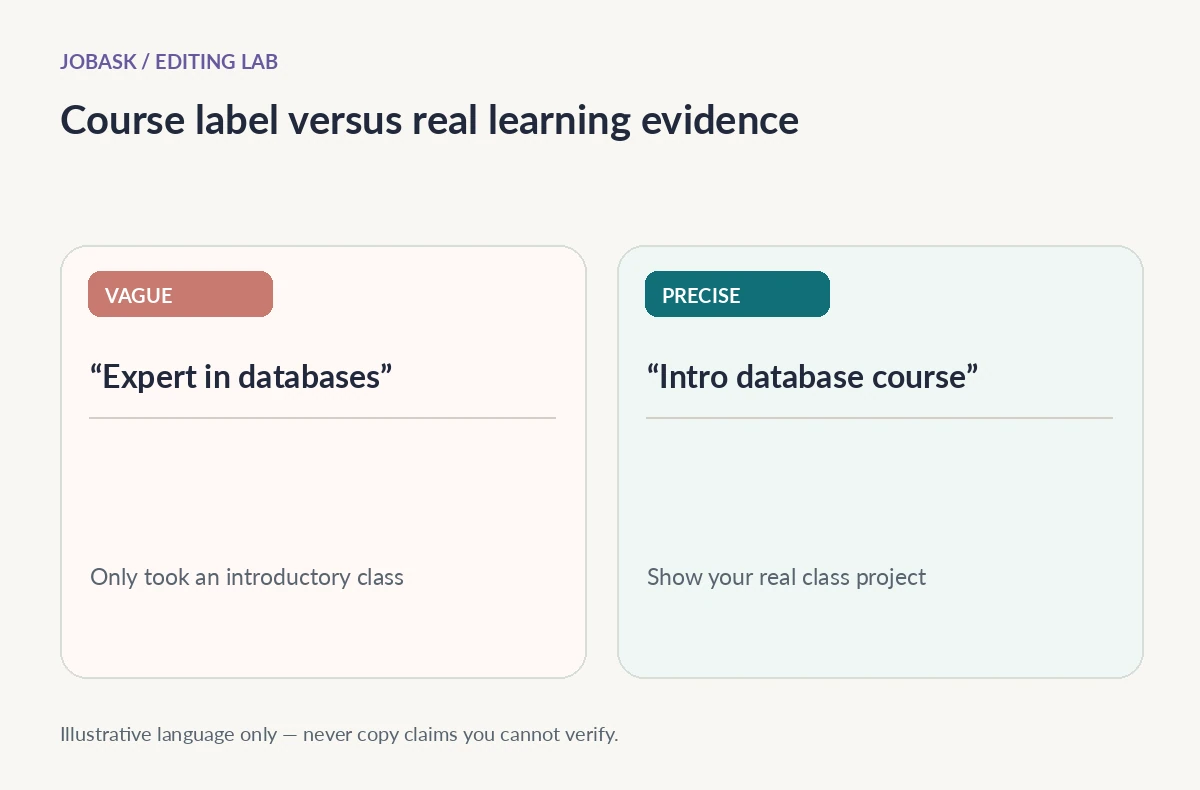
A class title can be vague. An accurate project description explains the task, what you personally did, the method and the deliverable. In a wholly hypothetical assignment, a student cleaned a small synthetic dataset and described their formulas in a short report. That is a learning exercise, not analysis for a real employer. The model line “Built a classroom spreadsheet to check missing entries in a simulated inventory list” should never be copied as a factual achievement unless an equivalent project actually happened.
Do not add dramatic numeric results solely to impress. A grade, audience size or performance metric belongs only if it is verifiable and relevant; an assigned mark does not automatically translate into operational impact. Keep any sample dataset clearly synthetic and avoid exposing classmates’ information or unpublished institutional data. If a project was collaborative, state your own responsibility. Berkeley highlights the value of presenting research and project contributions clearly, not merely naming impressive disciplines.
Avoid mixing coursework with job credentials
A course may teach a concept without qualifying you to perform a regulated duty. For example, studying accounting basics does not create a professional accounting credential, and an introductory health-science course does not substitute for the license a job requires. Review each employer requirement independently. If a job asks for a degree or certification, the accurate resume should show whether you have it. If the course is in progress, mark that status plainly instead of presenting an expected completion as an achieved qualification.
Similarly, learning a software tool through one class does not prove expert production experience. State what you actually practiced and what remains to learn. A fictional student who used SQL for a single assignment should not claim years of database administration. Keep a short personal proof note with the syllabus topic, your own submitted work and a clear statement of limits. That record can support an interview explanation without inflating the resume. Honesty is especially important when the tool has permissions, safety or privacy implications.
Finish with a course-to-role relevance check
Before sending, remove every course whose relevance you cannot explain in one sentence. Recheck official spellings, completion status, degree details, and whether the line duplicates evidence already given in Projects or Work Experience. Ask a reader to point to the job duty that each class supports. If they cannot, consider deleting the entry. Make sure any external work-sample link leads to a public, authorized, non-confidential version of your own work rather than a group file you do not have permission to distribute.
The strongest final resume may omit coursework entirely when substantial relevant work experience already tells the story. If you retain it, place it where a reader can find the specific qualification quickly. Keep the master list of classes in a private document and select anew for each genuine job opportunity. A good relevance test does not guarantee an interview; it prevents an unfocused academic list from displacing clearer evidence of skills and results.

| Situation | Practical next step | Important limit |
|---|---|---|
| Recent student, matching completed class | Add concise line under Education | Only name courses actually taken |
| Strong completed classroom project | Describe own role under Projects | Label it academic, not client work |
| Experienced candidate, unrelated electives | Omit the course list | Preserve space for work outcomes |
| Class still in progress | Mark current or expected status | Do not claim credential completion |
How We Research and What Remains Unverified
We read CareerOneStop education and special-tips guidance alongside Berkeley undergraduate resume samples. The course-selection rubric and synthetic-classroom examples are original educational demonstrations, not academic credential checks. Public topical search results and the listed source pages were reviewed on October 19, 2026.
Sources reviewed October 19, 2026: CareerOneStop explains where education belongs and when special courses or research projects can be relevant. Source 2 — Berkeley resume samples demonstrate how student coursework, projects and research can be presented. CareerOneStop describes how coursework and project work may contribute to evidence of qualifications.
Affiliate disclosure for relevant coursework on a resume: the resources linked in this guide are editorial sources, not verified paid endorsements or approved JobAsk partnerships. This guide contains no affiliate links. Read the JobAsk affiliate disclosure before considering a commercial service. Verify current conditions with the organization itself.
More Resume and Cover Letter Guides
- How Many Jobs Should You List on a Resume? Select Relevant Work
- Internship Resume: Turn Classes and Projects Into Relevant Proof
- Skills for a Resume: Choose Relevant Abilities You Can Prove
- Recent Graduate Resume Summary: Use Coursework and Project Evidence
- Certifications on a Resume: Show the Issuer, Status, and Relevant Dates
Only a small set with direct relevance; none may be appropriate for an experienced applicant.
Yes, if its in-progress status is accurate and useful to the employer.
A substantial project may deserve its own clearly labeled Projects entry.
No. Describe the coursework accurately without inventing an employer or client.
Only if true, relevant and allowed by the application context; the project itself may be stronger evidence.