
Before accepting a remote job offer, confirm three separate things in writing: where you may physically work, when the team expects you to be available, and how equipment and secure access will be provided. A job advertised as “remote” may still restrict states, countries, travel, or required office visits. Accepting before those details are clear creates a preventable mismatch.
A work-from-home offer is not a promise that any address, schedule, or personal laptop will be approved. A candidate might live in one state, support a team in another time zone, and still need to attend a particular office for onboarding. Each of those constraints deserves its own question. Remote eligibility, physical location, and work hours belong in separate fields so one answer is not mistaken for another.
Identify what the written offer actually promises
Start with the actual offer and any referenced policy or schedule. Highlight the role title, employer, reporting contact, start date, work location, regular hours, and conditions mentioned in the document. Separately record anything said in an interview that was not confirmed. Where documents disagree, ask for one clear answer before you sign or send an unqualified “I accept.” A warm conversation is helpful, but a reliable decision depends on the terms the employer confirms.
Do not rely on a generic acceptance template without checking who has authority to answer questions. The recruiter may coordinate the process; the manager may know the schedule; another department may handle onboarding. Keep your request short and specific. If the issue changes what you are agreeing to, ask how it will be documented, rather than treating a casual message as an automatic amendment.
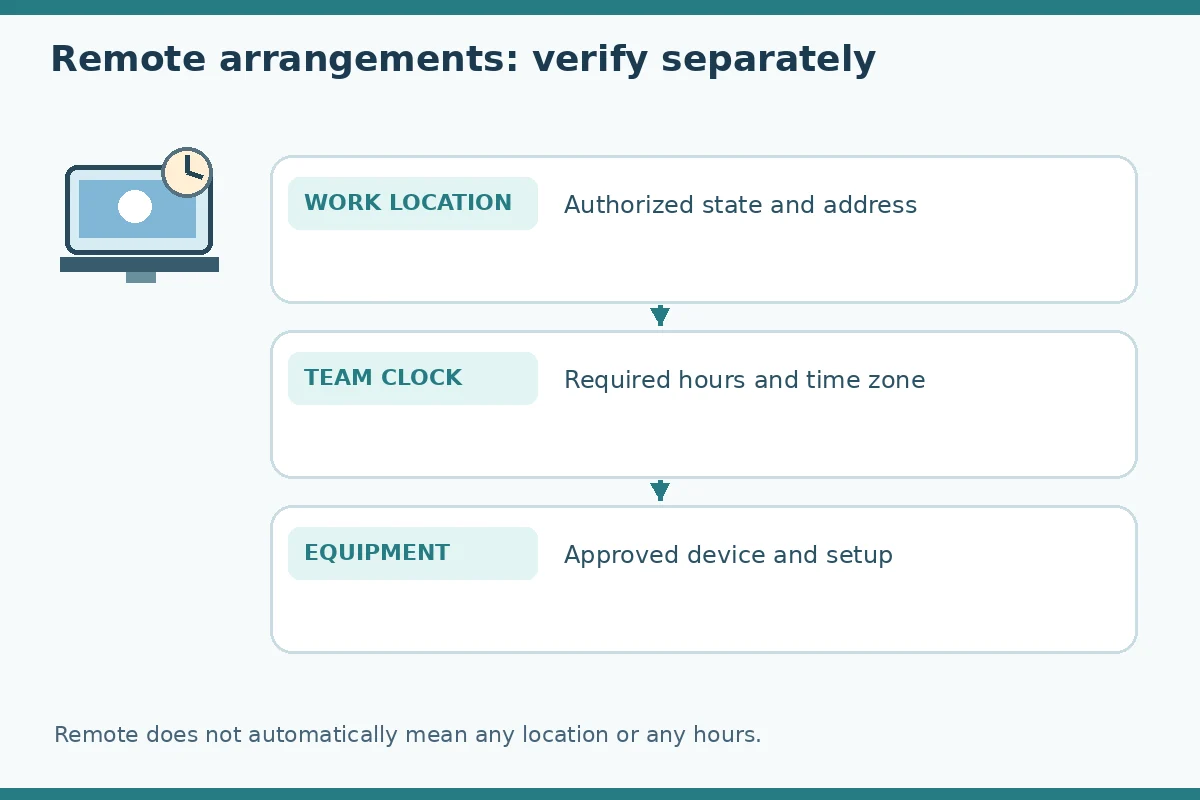
Five offer details to confirm for this position
Approved work location. Ask: “Which states or addresses are approved for regular work and travel?” Do not assume working from anywhere means overseas work or interstate relocation is allowed. Record the answer beside the corresponding line of the written offer. If two people describe the rule differently, follow up with a precise question rather than guessing which explanation governs.
Time-zone coverage. Ask: “What are the required overlap hours, meeting windows, and response expectations?” Ask whether posted hours refer to your local time or the employer team’s time zone. Record the answer beside the corresponding line of the written offer. If two people describe the rule differently, follow up with a precise question rather than guessing which explanation governs.
Equipment ownership. Ask: “Does the employer ship devices, approve personal hardware, or provide a process?” Never purchase hardware on instructions from an unverified recruiter or forward fake-check money. Record the answer beside the corresponding line of the written offer. If two people describe the rule differently, follow up with a precise question rather than guessing which explanation governs.
Access and privacy. Ask: “Who sets up accounts, identity verification, help desk support, and secure documents?” Use official onboarding channels; never email passwords or ID documents to an unknown contact. Record the answer beside the corresponding line of the written offer. If two people describe the rule differently, follow up with a precise question rather than guessing which explanation governs.
Office visits. Ask: “Are there onboarding days, quarterly travel, or required onsite meetings?” Clarify who arranges visits and what notice is usual; get the answer in the revised offer if material. Record the answer beside the corresponding line of the written offer. If two people describe the rule differently, follow up with a precise question rather than guessing which explanation governs.
Make a simple comparison sheet with four columns: what the posting described, what the written offer says, what the employer clarified, and whether the final arrangement works for you. This helps distinguish a real condition from a preference or an unconfirmed possibility. You do not need to send this private comparison sheet to the employer. It is a decision aid for you to make an informed response.
Consider realistic scenarios before saying yes
A candidate in a different state. An employer says the position is remote, but the proposed employee lives outside the states in the job posting. The safe move is to check the location requirement before accepting, not to assume a home address can be added later. This is a hypothetical situation for planning purposes, not an account of a real employer or worker. The point is to test the arrangement against specific facts rather than rely on a broad promise.
A distributed customer-support team. The interview describes flexible hours but the written offer references Eastern Time coverage. Ask for the actual schedule, weekend rotations, and the process for changing shifts. Avoid promising unrestricted availability. This is a hypothetical situation for planning purposes, not an account of a real employer or worker. The point is to test the arrangement against specific facts rather than rely on a broad promise.
An equipment reimbursement request. A stranger sends a check and asks you to buy devices from a named vendor. Do not deposit or spend it; verify the vacancy and recruiter using contact information found independently on the official employer site. This is a hypothetical situation for planning purposes, not an account of a real employer or worker. The point is to test the arrangement against specific facts rather than rely on a broad promise.

Use a clarification email before accepting
The following message is fictional and illustrative. It is deliberately not a binding acceptance: it gives the recruiter a chance to confirm material details first. Replace bracketed details with your own facts and send only to a verified hiring contact. If the offer deadline is close, ask about timing instead of assuming the deadline will be extended.
Subject: Questions about the [position] offer
Thank you for offering me the remote [job title] position. I am excited about the work we discussed and appreciate the written offer.
Before I confirm acceptance, could you please verify that my work location in [state] is eligible, specify the normal [time zone] coverage window, and explain how approved equipment and account access will be provided?
I would also appreciate confirmation of any required onsite onboarding or recurring travel and whether those details will be reflected in the final offer or onboarding instructions.
Once these points are clear, I can respond by [agreed decision date]. Thank you for helping ensure we begin with the same expectations.
This hypothetical message is a clarification request, not an acceptance. It does not claim that the employer approved a location or promise the candidate can buy equipment. Once terms are confirmed, send a separate clear acceptance identifying the role and agreed start date; keep the updated offer with your records.
If the recruiter answers only one question, send a concise follow-up listing the remaining items. Avoid opening unrelated negotiations unless they genuinely affect the decision. If the answer changes a core term, request the final text or written confirmation before accepting. Keep copies of the final version, the date of your decision, and the communication channel used.
Separate clarification, acceptance, and onboarding
An acknowledgment such as “Thank you, I received the offer” is not the same message as “I accept the offer for [role], with [confirmed terms], starting on [date].” Ask unresolved questions first. After reviewing the response, give a clear decision according to the employer’s instructions. Only then work through onboarding tasks such as account setup, training schedules, and forms in the verified employer system. Do not imply that you have already accepted when your response is still conditional.
When the decision is positive, reference the correct job title and start date, and express appreciation without adding new conditions by accident. When the offer still has a problem, negotiate that specific matter or decline courteously. If a signed document is requested, check that you are using the final copy and follow the authorized submission channel rather than attaching a draft containing conflicting terms.
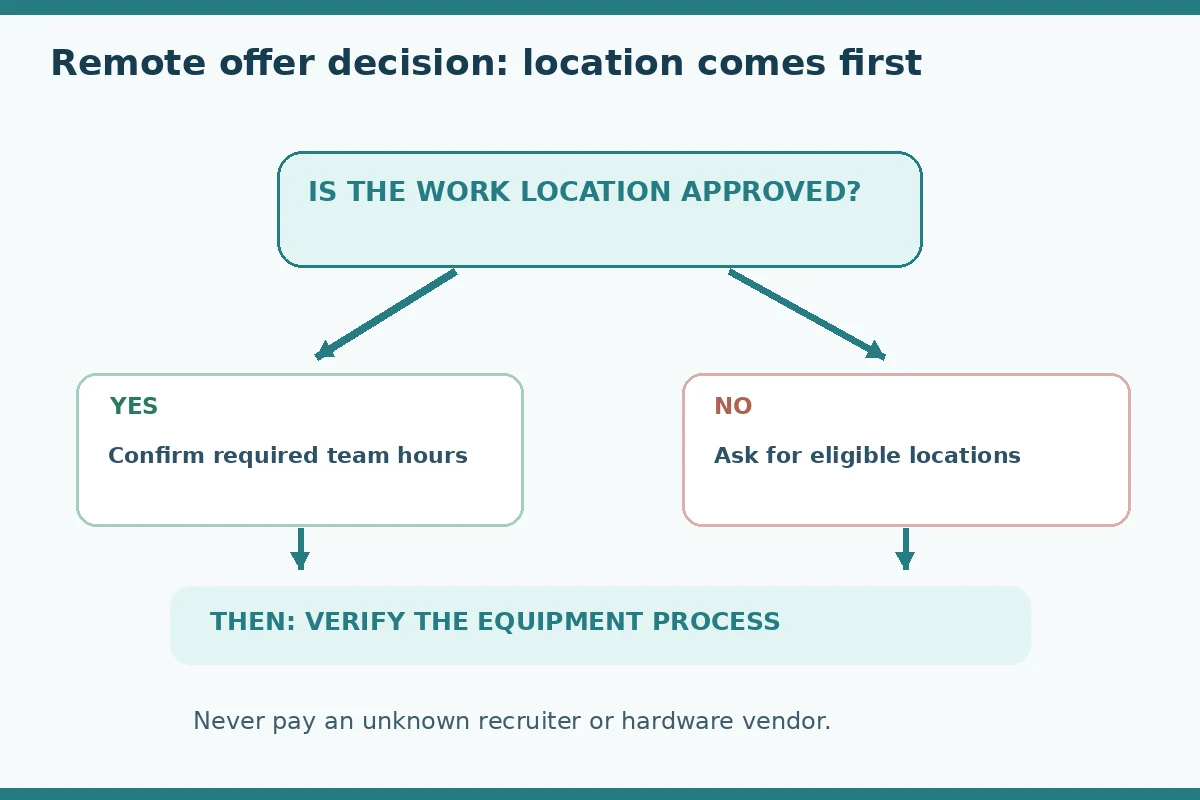
Watch for risky promises or missing boundaries
Treat a remote role as a specific operational arrangement rather than a lifestyle label. If the employer confirms your location and schedule, verify that the written document matches. If the recruiter refuses to identify the company, requires payment for equipment, or will not let you independently validate the hiring contact, stop and investigate before sharing financial data.
Verify the employer using a company website or phone number you find independently when the offer arrived unexpectedly. Fraudsters may impersonate real recruiters and demand payment for equipment, training, or a supposed processing fee. Do not send money to obtain a job and do not treat an emailed check as safe funds to forward. The Federal Trade Commission documents fake-offer and fake-check schemes; a polished logo or urgent deadline does not prove the contact is genuine.
Do not provide passwords, bank account details, or government identification documents through an unverified chat or unsolicited form. A legitimate hiring process may involve sensitive paperwork at an appropriate stage, but you should understand who is requesting it, why, and through which employer-controlled channel. Where you are uncertain, contact the organization using public contact information you found yourself.
Keep a practical acceptance decision record
Use a small checklist with the offer version and date, your clarified questions, the names or roles of the people who responded, and the decision deadline. Mark each condition “confirmed,” “not applicable,” or “still unresolved.” If any unresolved point is central to your schedule, location, training, or ability to perform the job, do not bury it in a polite acceptance. Ask about it or decide not to take the offer.
An offer may be a very good career move even if it has tradeoffs. The goal is not to demand perfect certainty about every future possibility, but to make sure the daily operating conditions are ones you understand and can follow. A realistic, properly documented expectation is more useful than a cheerful assumption that everything will somehow work out.
How We Research these offer decisions
We reviewed these primary resources on 2026-10-30: CareerOneStop guidance on evaluating employment offers; official topic guidance; official supplementary guidance; FTC warning about employment and equipment scams. CareerOneStop addresses schedule and workplace conditions as offer decisions. Topic-specific official sources establish the limited factual claims used here; fictional email language and scenario worksheets are editorial examples, not quotes from employers. We also compared proposed titles with the user-provided WordPress listing and local production inventory. Private unpublished WordPress entries cannot be independently ruled out by a public search.
This guide is not personalized employment or legal advice and does not imply that every employer uses the same policy. Ask the particular employer to confirm material terms and consult appropriate professional advice if a contract presents an unusual issue. The affiliate disclosure describes site practices; no affiliate approval or paid partnership is asserted by this article.
Related Guides
- Accepting an Apprenticeship Offer: Verify Mentor, Training, and Registration
- Questions to Ask in a Remote Job Interview: Hours, Tools and Trust
- Accepting a Seasonal Job Offer: Confirm End Date, Peak Shifts, and Exit Plans
- Accepting a Teaching Job Offer: Confirm the School, Assignment, and Next Steps
- Accepting a Night-Shift Job Offer: Check Rotation, Training, and Handoffs
Do not assume so. Ask whether the employer permits work from the new state and whether approval must occur before a move.
No. Remote describes work location, while the team may require fixed coverage, meetings, or rotating shifts.
Verify the employer independently and do not pay money to obtain the job or deposit a purported equipment check to forward funds.
Use an independently verified official onboarding channel only when the employer explains which documents are needed. Do not send sensitive information to unverified contacts.
Identify the position, confirmed work location, expected schedule, start date, and your clear acceptance in a short professional reply.