
Use veteran-focused employment resources to translate your military experience into specific civilian job titles, then confirm each opening on the employer or official hiring website. Veteran-friendly branding is useful for discovery, but it does not make every opening appropriate or verify eligibility for a hiring preference. Treat the job description and application instructions as the final reference.
The Department of Labor directs veterans to American Job Centers and CareerOneStop tools; VA lists transition and employment support. USAJOBS is a federal hiring portal, where veteran preference and special hiring authorities have eligibility rules. A private job board that advertises veteran-friendly employers does not confer federal hiring preference.
Choose the right website for your search
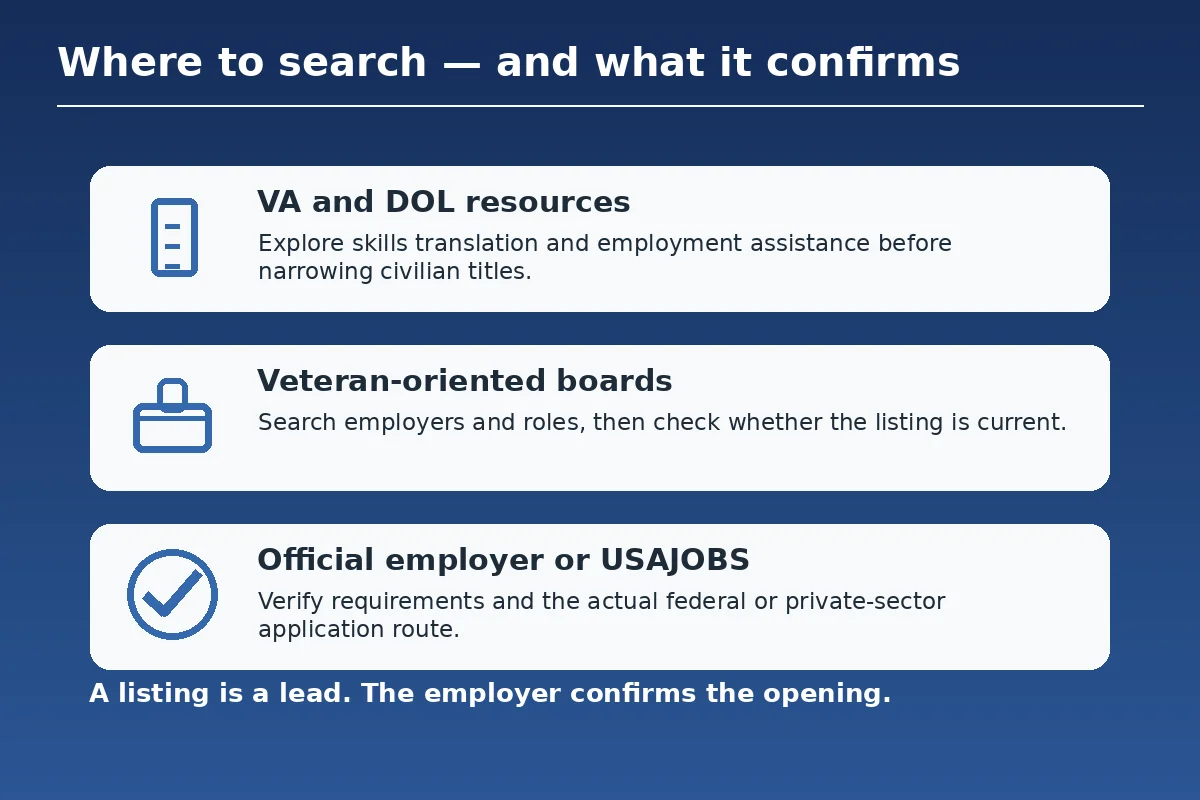
VA and DOL resources. Explore skills translation and employment assistance before narrowing civilian titles. Treat this as a distinct place to gather evidence, not as a substitute for reading the full job description. Save the official URL and the date you accessed it; recruitment pages and deadlines can change, and a screenshot alone does not confirm that an application was submitted.
Veteran-oriented boards. Search employers and roles, then check whether the listing is current. Treat this as a distinct place to gather evidence, not as a substitute for reading the full job description. Save the official URL and the date you accessed it; recruitment pages and deadlines can change, and a screenshot alone does not confirm that an application was submitted.
Official employer or USAJOBS. Verify requirements and the actual federal or private-sector application route. Treat this as a distinct place to gather evidence, not as a substitute for reading the full job description. Save the official URL and the date you accessed it; recruitment pages and deadlines can change, and a screenshot alone does not confirm that an application was submitted.
A search engine can repeat the same vacancy across several websites. Favor the underlying employer record rather than counting repeated results as new opportunities. If a directory lists a partner but no open role, note “program or employer lead” instead of “vacancy confirmed.” Apply using the method on the authentic opening, not an unrelated message from someone claiming to represent the company.
Read the listing before choosing a filter
Transferable duties: Does the description ask for work you have actually performed? Highlight the exact line that answers this question. If it is missing, write “not stated” in your tracking sheet and ask the employer using an independently verified contact. Avoid interpreting silence as permission or eligibility; the hiring organization decides which documents or training it requires.
Credentials: Which civilian certificate or license is required, if any? Highlight the exact line that answers this question. If it is missing, write “not stated” in your tracking sheet and ask the employer using an independently verified contact. Avoid interpreting silence as permission or eligibility; the hiring organization decides which documents or training it requires.
Location and schedule: Are travel, shifts, clearance, or relocation specified? Highlight the exact line that answers this question. If it is missing, write “not stated” in your tracking sheet and ask the employer using an independently verified contact. Avoid interpreting silence as permission or eligibility; the hiring organization decides which documents or training it requires.
Hiring route: Private application, federal posting, or referral to a training provider? Highlight the exact line that answers this question. If it is missing, write “not stated” in your tracking sheet and ask the employer using an independently verified contact. Avoid interpreting silence as permission or eligibility; the hiring organization decides which documents or training it requires.
Eligibility: Is a claimed preference or special authority relevant to your case? Highlight the exact line that answers this question. If it is missing, write “not stated” in your tracking sheet and ask the employer using an independently verified contact. Avoid interpreting silence as permission or eligibility; the hiring organization decides which documents or training it requires.
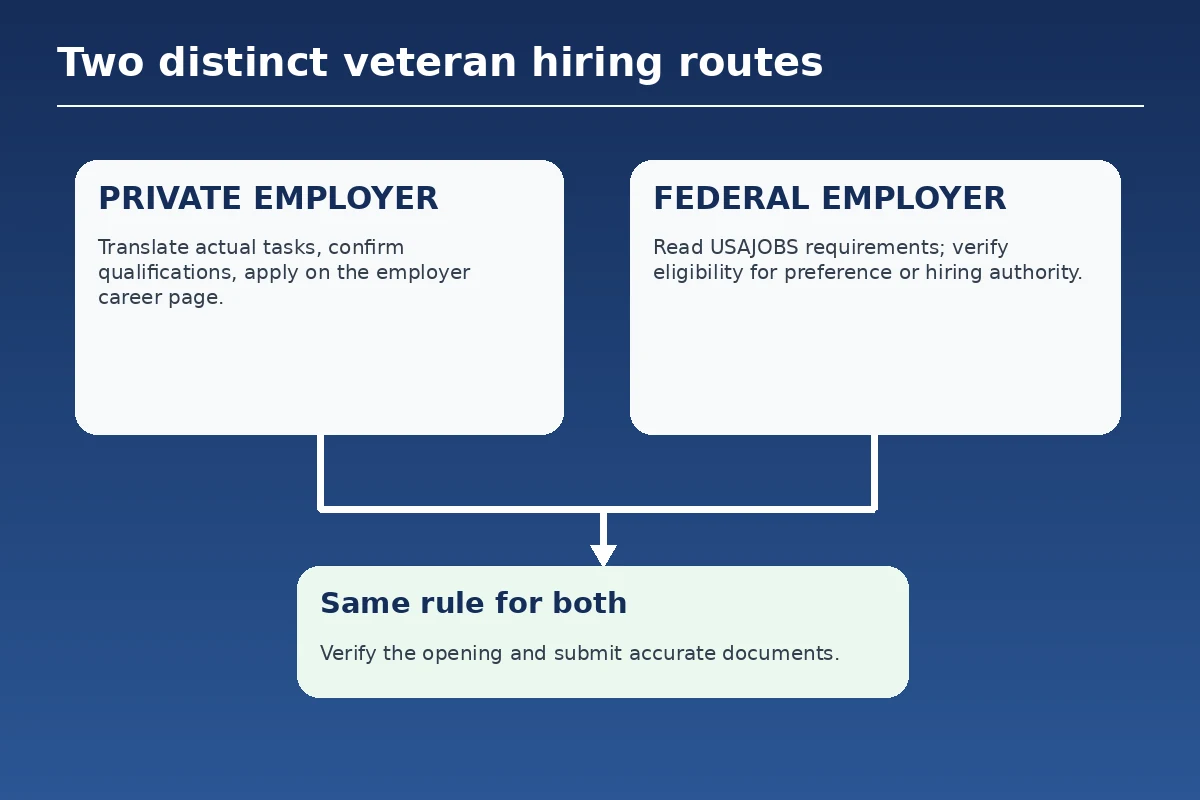
A veteran-specific board can help surface opportunities and employers who actively recruit veterans. But it cannot confirm that you qualify for a federal preference, a security clearance, or a regulated civilian occupation. Verify those separately through the official program or employer and do not assume a prior military job title directly equals a civilian credential.
Compare a promising listing with a weaker one
A former logistics specialist sees a civilian inventory coordinator role. They compare the posting’s inventory records, handoffs, equipment, and scheduling duties against their actual service records, then rewrite the resume with understandable civilian terms. They keep military-specific systems only when relevant and do not invent commercial software experience.
Another applicant sees a federal position with a veterans’ preference note. They review the official USAJOBS requirements and required documents rather than treating a badge on a separate recruiting site as an application approval. They ask an American Job Center for help if the process is unclear.
Translate your experience without inflating it
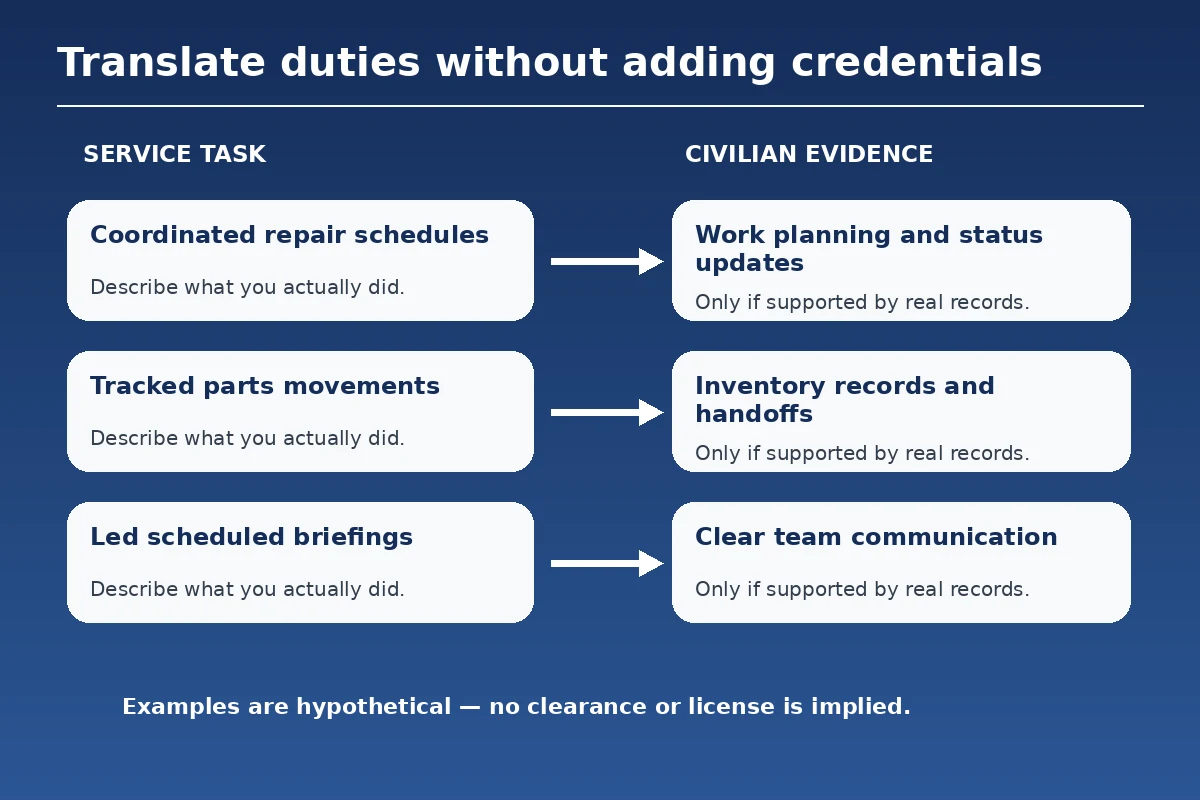
Build a translation sheet with columns for military assignment, everyday task, civilian equivalent, and proof. Example: “coordinated vehicle maintenance schedules” can support work planning if true, but does not automatically establish qualification as a licensed automotive technician. Keep leadership scope, team size, and specialized systems factual; avoid displaying sensitive information.
A useful resume line connects a real task to its working context, not an impressive label copied from the posting. If the employer asks for a software tool or credential you have not used, do not imply mastery. You can name genuinely related training and explain a learning plan if appropriate. Keep examples anonymous when they involve clients, students, coworkers, patients, equipment identifiers, or protected employer records.
Use an evidence-first application workflow
Start with a short target list rather than dozens of barely relevant clicks. For veteran job sites, search several precise job titles, compare the responsibilities, and discard results that require credentials or schedules you cannot truthfully meet. Copy the official role title, employer, location, link, and closing date into a private log. Re-read the requirement section before tailoring a resume or cover letter.
Next, verify the employer outside the job-board link. Visit the organization’s official career page or call a number published independently. Confirm that the posting exists, that the application destination belongs to the organization or its stated recruiting system, and that the hiring contact is legitimate. If the board and employer page disagree about the schedule or vacancy status, ask for clarification before uploading personal documents.
Finally, submit through the verified route and capture the confirmation page or acknowledgment if one appears. A saved draft, email address, or account creation is not proof that the application reached the employer. Record a follow-up date only after you know the vacancy’s instructions; do not send multiple duplicate applications merely because the confirmation email is delayed.
Protect your information while searching
The Federal Trade Commission warns that scammers can copy real employer advertisements and change their links or contact details. Be especially careful with requests for payment, check deposits, bank details, or government identification before there is a verified hiring process. Contact the employer using its own published information rather than answering the suspicious message. Report suspected fraud through the FTC and the relevant platform.
For a legitimate employer, provide only the information requested through an authenticated application process. Avoid putting Social Security numbers, bank details, copies of identity documents, references’ private phone numbers, or confidential work samples into public resume profiles. If you discover a suspicious posting after applying, stop communicating through that channel, preserve the messages, and consider appropriate account-security steps.
Create a repeatable comparison record
Use a six-column spreadsheet: source site, verified employer, exact role, eligibility or scope question, schedule or location, and application status. Add one optional notes column for a specific unresolved question. Mark “verified on employer site,” “contact needed,” “applied,” or “closed” rather than vague colors. This makes it easy to distinguish real openings from research leads as the search develops.
For this topic, write one short decision sentence after checking each listing: “I will apply because target roles selected and the responsibilities match my documented experience,” or “I will not apply yet because I still need to verify a key requirement.” That small pause is more useful than chasing a platform’s relevance score. It keeps the search focused on eligibility, accurate representation, and realistic next steps.
How We Research job-search websites
We checked these primary and institutional sources on 2026-10-30: official DOL resource; official VA resource; official career or training resource; official FTC resource; official career or training resource. They explain the occupational or platform process and fraud risks; they do not verify any particular vacancy, employer response, placement outcome, or a job board’s live inventory. Search results and program policies can change after this review.
Examples on this page are hypothetical, not real employer postings or testimonials. This guide is general career information rather than personalized legal, credentialing, or employment advice. We do not imply a paid affiliation with any job board or employer. See our affiliate disclosure before relying on external services.
Related Guides
- Student Job Search Websites: Compare Campus Portals and Real Openings
- Accounting Job Search Sites: Match Clerk and CPA Roles to the Right Boards
- How to List Military Experience on a Civilian Resume With Clear Skills
- Job Search Websites: Choose the Right Boards and Verify Listings
- Job Alerts on Search Websites: Set Filters and Cut Notification Noise
Access rules vary by platform and employer; read site policies. A veteran-friendly employer may advertise openings to other applicants too.
No. Federal preference and special hiring paths have eligibility requirements and do not guarantee selection.
Usually explain them in civilian terms when possible, preserving accurate responsibilities and measurable scope.
Use the official USAJOBS or federal agency channel and follow its specific posting instructions.
Verify the opening and recruiter through the employer’s official website and independent contact details.