
Accepting a Revised Job Offer After Negotiation: Confirm the Final Terms begins with the correct decision state: what has actually been offered, which document or contact is authoritative, and which response would create a commitment. Use the checks below before accepting. None of the sample situations implies a real hiring result or a guarantee of an offer.
All sample communications here are hypothetical. Replace bracketed details with verified information and follow the employer or agency’s current instructions rather than treating a general article as an official process.
Determine Which Document Is the Actual Offer
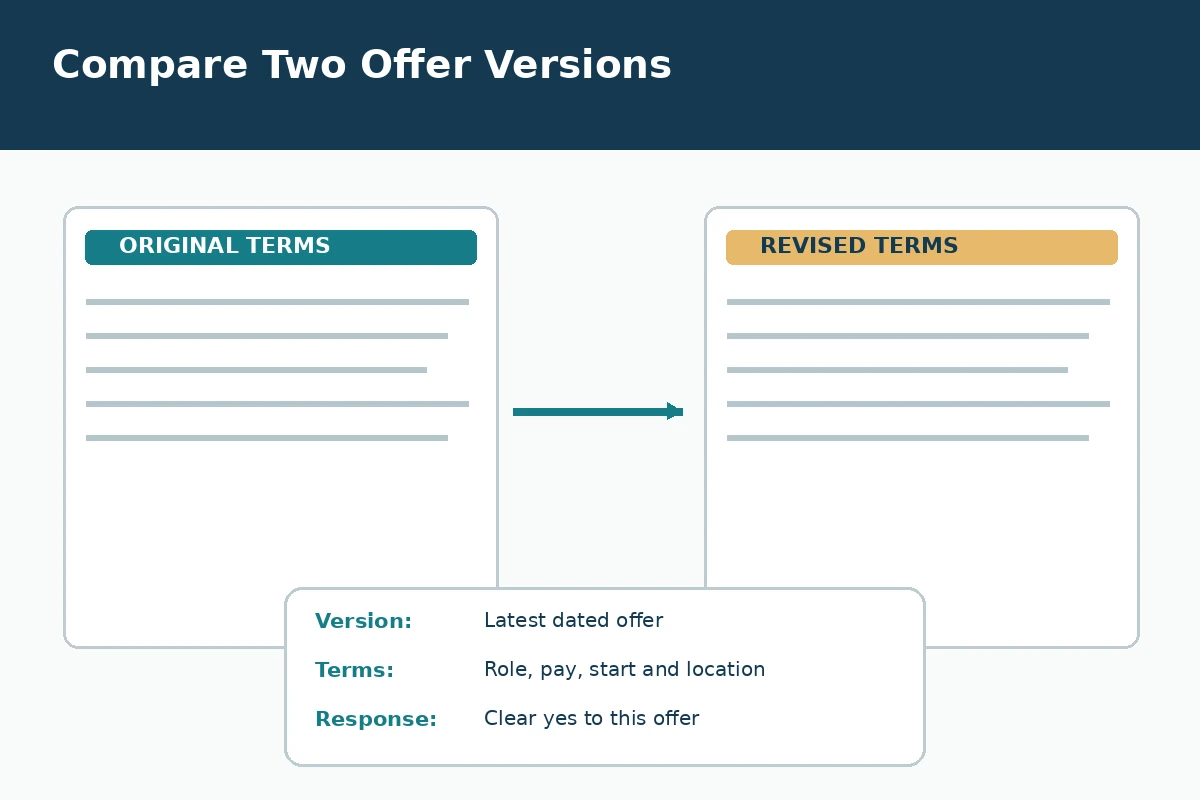
A phone conversation about pay or start date is not the same artifact as a revised offer letter. Place the original document beside the replacement and compare the exact language: title, reporting relationship, worksite, compensation basis, schedule, proposed first day, and any terms you discussed. Berkeley Career Engagement recommends asking for a new written offer when a negotiation changes a term. The practical task is to identify which version both sides are using, not merely to remember that the call felt positive.
Save both documents privately with their dates, but do not attach a version that includes someone else’s confidential information. If the employer supplies an updated letter through a portal, use its official download and reply process. A recruiter saying “we can probably do that” leaves a question open; it does not establish a final employer commitment. Until the new terms are documented, ask for a revision rather than declaring that you accepted a package that does not appear on paper.
Build a Change Log Without Re-Negotiating Everything
Use a three-column worksheet: term, earlier offer, and revised offer. Compare only the information supplied by the employer and your own recorded discussion. A higher base amount is not interchangeable with a signing bonus; a remote-work conversation is not a permanent written worksite policy. Check whether the revised document changes an originally acceptable clause elsewhere. Berkeley’s guidance supports documenting actual agreed changes, not assuming that every negotiation topic was approved.
A candidate might have asked to move a start date because of a scheduled commitment. The hypothetical comparison would list “original start date,” “requested date,” and “date now printed in revised offer.” There is no need to invent a reason the company agreed. If two versions conflict, send the recruiter one precise question identifying the section or date. A small written clarification now is easier than trying to rely on memory during onboarding.

Keep the Acceptance Distinct From the Negotiation Request
A counteroffer proposal says you would consider employment if certain terms change; an acceptance says yes to the available terms. Do not use “I accept, provided that…” when the condition is still unresolved unless you have explicitly discussed how the employer handles conditional replies. Harvard career guidance recommends negotiating before making a commitment. A message that simultaneously accepts and asks for a different base package can leave the two sides with different understandings.
If the recruiter offers a change during a call, thank them and request the updated written offer before sending an unconditional yes. It is reasonable to acknowledge the conversation without implying you have finalized it: “Thank you for discussing the revised start date; could you send the updated letter so I can review the final terms?” Once the accurate document arrives, a short acceptance referencing that version is enough. Avoid reopening resolved issues casually in the final note.
Write an Acceptance That Can Be Matched to a Version
Identify the job title, the date of the updated letter, and your acceptance of the terms it contains. You do not need to paste private compensation details into several email threads; a clear reference to the written version is often sufficient. Ask where to return a signature or portal response and keep the final signed copy for your records. Career guidance from Harvard recommends prompt and professional communication and attention to the employer’s own next-step instructions.
Hypothetical example: “Thank you for the revised offer dated [date] for [role]. I have reviewed the updated terms and am pleased to accept. Please let me know the secure method for completing the remaining documents.” This sample contains no real employer or candidate and assumes that all important changes already appear in the final offer. If they do not, send a clarification request instead. A sent email is not automatically a confirmation that the employer’s system recorded acceptance.

Review Logistics and Confidentiality Before Sending
Check the reply deadline, which inbox is authorized to receive the answer, and whether the employer needs a portal click or signed letter. Keep the revised offer within the designated hiring channel instead of forwarding sensitive salary details to people who were not part of the process. If your recruiter and HR contact are different people, ask which one is responsible for maintaining the final paperwork. Verify the sender using the organization’s established contact information.
Do not assume a signed document alone determines all local employment obligations; contract and state-law questions require professional advice when material. After accepting, stop presenting yourself as available for competing roles if you intend to honor the agreement. Harvard’s career resources frame acceptance as a meaningful commitment. Confirm onboarding steps, but do not claim that a background check, start date, or benefits eligibility is final unless the employer says so.
Hypothetical Message for This Situation
Hypothetical example only. This message is an editable demonstration, not a real candidate story, offer document or employer promise.
Example: Subject: Acceptance of Revised [Role] Offer — [Your Name]
Dear [Contact],
Thank you for sending the updated offer for [Role]. I have reviewed the revised letter dated [date], including [accurate description of agreed changes]. I am pleased to accept the position on the terms in that letter and look forward to the next steps. Please let me know which signed documents are required and where I should return them.
Best,
[Name]
Audit What Changed and What Did Not
Before clicking Send, read the version date, job title, effective start date, location or remote requirement, compensation format, and your proposed wording. If any important item is missing, ask a neutral question and keep the decision open. Re-read the email as if you were the HR specialist who must match it to a particular offer. Replace all hypothetical brackets; never cite an amount or benefit that you have not seen in the current documents.
Your final audit record should contain the revised offer, the acceptance you actually sent, and any receipt from the portal or recruiter. This workflow is a communication safeguard, not a legal determination or a guarantee that an employer will maintain the position. If a post-acceptance discrepancy arises, use the confirmed contact and original wording to seek correction rather than modifying the archived offer yourself.
How We Research Job Offer Guidance
Our 2026-10-27 source review used career.berkeley.edu, careerservices.fas.harvard.edu, careerservices.fas.harvard.edu, careerservices.upenn.edu. Each source supports the specific offer-stage, communication, process or classification point recorded in the source list. We also checked published JobAsk topic indexes and available past archives for intent and slug overlap. The sources do not promise a job, verify any particular recruiter, or establish that a sample note will succeed.
This is educational career content, not individualized tax, immigration or employment-law advice. The illustrations and examples are hypothetical, and no external human editor has independently approved this package. The closed WordPress draft inventory and each employer’s current terms are not available for confirmation here. No affiliate partnership is claimed. See our affiliate disclosure.
Related Workplace Guides
- Choosing Between Two Job Offers: Compare Deadlines Before Accepting One
- Reconsidering a Declined Job Offer: Ask Whether the Position Is Still Open
- Accepting a Contract Job Offer: Check the Assignment, Pay, and End Date
- Verbal Job Offer Follow-Up: Get Written Terms Before Accepting
- Federal Job Tentative Offer Acceptance: Separate Initial and Final Steps
You can acknowledge the discussion, but ask for the updated written terms before giving a final yes to a change that is not documented.
Usually a reference to the final dated offer is sufficient; restate a figure only when it helps clarify an actual written agreement.
Point to the specific term that should have changed and request a corrected version before accepting.
No. Treat it as a discussion until authorized written documents reflect the agreed terms.
The safest time to negotiate is before committing; later changes require a new discussion and agreement.