
An accounting resume should name the financial-record tasks you actually completed, the tools you used, and your level of responsibility. “Attention to detail” alone is a weak substitute for a documented reconciliation, accurate data entry, or a clear discrepancy handoff. Stronger skill descriptions distinguish preparing or checking records from approving transactions, conducting audits, or making accounting judgments you were not authorized to make.
Translate Accounting Job Requirements Into Task Evidence
Accounting positions vary widely. A clerk may enter invoices, match purchase documents, and organize payment records. A staff accountant may assist with entries, reconciliations, and period-end support. An auditor may evaluate evidence and controls under an established engagement scope. The Bureau of Labor Statistics accountants and auditors profile describes analytical judgment, clear communication, detail orientation, and organizing financial information as important qualities. That does not mean every clerical candidate has performed every professional accounting task.
Read the exact description and draw a line between a task and your proof. For “bank reconciliation,” find a real example where you compared records and investigated differences. For “accounts payable,” record whether you coded invoices, matched supporting documents, assembled a review package, or actually authorized payments. If you only supported the process, say so. Do not add professional designations, software experience, industry exposure, or closing responsibilities you have not earned. This task-to-proof method makes both the resume and interview more accurate.
Describe Reconciliations Without Inflating Authority
Reconciliation means comparing two record sets to explain differences; the actual steps depend on the system, organization and role. Your skill line might name bank reconciliations, vendor statement reviews, or subledger comparisons only if you performed them. A safe hypothetical bullet is: “Compared a training ledger against sample bank transactions and documented unmatched items for instructor review.” The setting makes it clear this was coursework, not employment or a certified financial close.
For paid work, describe the real review chain. “Prepared monthly account reconciliations for supervisor review” has a different scope from “approved reconciliations” or “signed off on a financial statement.” The O*NET accountants and auditors profile includes activities such as examining records and verifying accuracy. Those occupational descriptions are possible duties, not permissions granted to every person who writes a resume. When records remain unresolved, explain how the discrepancy was documented and escalated instead of inventing a tidy outcome.

Name Tools and Methods You Can Explain
Software belongs on the resume when you have used it to perform relevant work. An applicant might know spreadsheets, a particular bookkeeping product, or an employer’s accounts payable system. Name the exact product only if true, and be ready to explain the tasks involved: filtering reports, using formulas, matching purchase order numbers, or tracing an entry back to an invoice. “ERP expert” hides what you did and how thoroughly you used the system.
A credible examples section might include “Excel lookups and reconciliation worksheets” for someone who built them, or “invoice coding and document indexing” for someone whose actual job required those tasks. If you practiced in a sandbox training environment, label it as training. If you only viewed reports generated by another department, do not claim you designed or maintained the reporting system. Clarity about tool use allows employers to plan realistic onboarding rather than discover a mismatch later.
Show Controls and Accuracy as a Document Trail
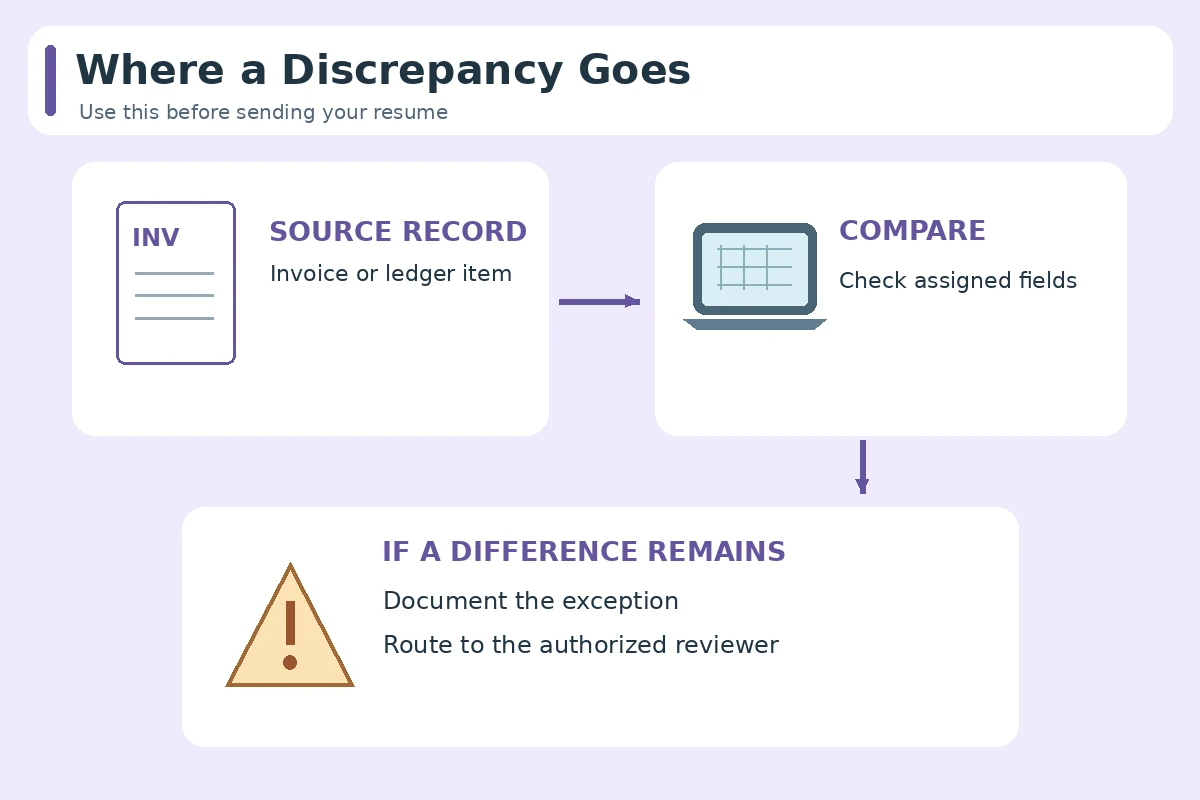
Financial record quality often depends on recording the source, checking it against policy, and routing exceptions for appropriate review. An entry-level worker may verify invoice fields against a purchase document while a designated approver authorizes payment. Those are different duties. Describe the part you owned: retrieved documents, matched account details, prepared an exception note, or maintained an organized audit trail under company instructions. Do not turn the word “controls” into a claim of independent compliance certification.
A hypothetical resume bullet could read: “Matched supplier invoice details to purchase records and sent unmatched items to the accounts payable lead for review.” This shows a specific control-related step without claiming you approved an invoice. Never include confidential vendor names, account numbers, or proprietary screenshots to prove your work. Instead, explain the workflow in general terms, protect private information and identify documented process improvements only if they genuinely occurred.

Separate Reporting Support From Financial Decisions
Many postings mention reporting, monthly close, forecasting, payroll, or audit support. Each label can cover tasks of very different seniority. If you prepared a report, say what data you compiled and who reviewed it. If you observed an audit but did not test controls, do not claim “performed audits.” If you entered payroll-related data, do not claim you calculated tax withholdings or exercised payroll approval rights unless you really did. Actual job descriptions and organization procedures govern the scope.
A concise skill section can use precise terms such as “Ledger maintenance; invoice matching; spreadsheet reconciliation; exception documentation,” but only when verified. Use experience bullets to show the handoff and the nature of the records. An applicant with nonfinancial administrative experience might emphasize document accuracy, records tracking, and spreadsheet skills while openly stating their career transition. Employers can train new processes, but a resume should not blur the line between a transferable skill and prior accounting practice.
Run a Financial-Accuracy Check Before Applying
Review every accounting word for an implied level of responsibility. “Managed accounts payable” may suggest ownership of the entire process when you only entered invoices. “Audited” can imply formal assurance work when you actually checked forms for completeness. Replace broad verbs with the task you performed and the person who reviewed or approved the result. The BLS profile distinguishes accountants and auditors as occupations involving examination and reporting; it is not an instruction to copy those responsibilities into your history.
Then cross-check dates, credentials, software names, and numbers against records you may legitimately use. Avoid fabricated savings and invented month-end volume. If you have a verified figure and permission to disclose it, provide context; otherwise, accurate task descriptions are enough. Finally, read the target vacancy again to confirm that your selected strengths match the employer’s actual needs. Clear boundaries between recording, checking, escalating and approving improve credibility and make training expectations more realistic.
How We Research Resume Skills and Examples
We use public U.S. occupational descriptions, career-service guidance and documented competency frameworks to distinguish typical duties from individual qualifications. Links were checked on October 27, 2026. All sample resume sentences here are hypothetical writing examples, not claims about real applicants or JobAsk clients. Our review of public search results and the supplied local topic index does not reveal private WordPress drafts or establish availability of a slug in the database.
Source: BLS. BLS accountants and auditors duties and important job qualities.
Source: O*NET. O*NET occupational tasks concerning financial records, analysis and verification.
Source: CareerOneStop. CareerOneStop guidance for translating real experience into relevant resume evidence.
These editorial references are informational, not a claim of endorsement or a commercial partnership. See the JobAsk affiliate disclosure. Skill examples must be adapted only to work you actually performed; no particular resume layout guarantees hiring or automated screening results.
More Resume and Cover Letter Guides
- Technical Skills on a Resume: Match Each Tool to Real Work
- Accounting Assistant Resume Objective: Prove Record Accuracy and Review Skills
- Sales Skills for a Resume: Discovery, Records, and Follow-Up
- Organizational Skills on a Resume: Prove Priorities and Handoffs
- Analytical Skills on a Resume: Connect Questions to Decisions
Yes, when you identify the work as coursework or a simulated exercise and describe the tools and records accurately.
No. Matching supporting records is a check; approval is a separate authorized decision under the organization’s rules.
Only if you genuinely used the named system, and ideally specify the task rather than claiming unsupported expert proficiency.
Use honest examples from coursework, volunteering, and transferable records work without presenting them as professional accounting experience.
Checking records is not automatically a formal audit. Name the verification tasks you completed and the review scope you actually had.