
An acting resume is primarily a compact casting record. A casting team needs to locate relevant credits, training, and skills in seconds, not read a conventional employment history arranged by corporate job title. Put your professional name and requested contact or representation details at the top, group screen and stage work clearly, and treat special skills as abilities you can actually demonstrate. A visually clever format is less valuable than credits someone can understand and verify.
Backstage describes a common order that groups film, television, theater, training, and special skills. Adapt the group order to the audition instead of inventing a universal rule for every agent or casting platform. Its acting resume templates show why beginners can include truthful training and student productions without presenting them as network television credits. Your objective is not to make a short history seem long; it is to make your actual fit clear.
Keep Film, Television, and Theater Credits Distinct
Screen and stage work are evaluated differently, so separate them under unambiguous headings such as Film, Television, Theater, Voiceover, or New Media if you have genuine entries. List only categories you need. A blank Film section makes a newer performer look less organized, not more experienced. Use a compact credit table or aligned text with project, role, and director or production company, selecting fields that are relevant and permitted by the submission instructions.
Do not present classroom work as a professional television credit. Student films can be valuable practice and belong under an accurately named category or clearly identified entry. Do not give yourself ‘lead’ status if you performed an ensemble part or alter a small role to match an audition. If a title is confidential or subject to a nondisclosure obligation, follow the relevant agreement and casting instructions. Reliable credits matter more than volume.

Choose Role Descriptions That Cast Readers Understand
Credit labels can vary between film, TV, and theater, and production contracts may specify them. Use the terms that genuinely describe your work rather than blindly applying labels from a resume template. For a theater production, a character name and theater or director may be enough; for a film, project, role, and production context may be more useful. If a casting platform supplies required fields, use those fields exactly and do not create substitutes that imply a different role category. Our guide “Architecture Resume Layout” goes into more detail.
Hypothetical line: ‘Evening Station (student short) | Supporting role | University film project.’ This fictional credit illustrates transparent labeling only. Never paste it into a real submission. If you have no performance credits, start with training and relevant projects. Include workshops, voice classes, or stage experiences that you actually completed; do not invent agents, theater companies, broadcast networks, unions, or awards to fill white space.
Put Training Where It Supports the Audition
Training can be a meaningful part of a beginner acting resume. Include course or workshop name, area of study, and school or instructor where appropriate. Distinguish completed instruction from a planned class and avoid treating a brief introductory session as conservatory graduation. Prioritize relevant training: for a voiceover audition, work in microphone technique may matter more than an unrelated physical-comedy workshop. Dates can be useful when they clarify that your skills are current.
If an instructor or studio has a common name, identify the official training organization rather than implying personal mentorship that did not occur. Do not claim stage combat certification merely for attending a single class. For young performers, follow the casting request and applicable guardian contact practices rather than publishing private personal information. A resume is a professional document, so remove any identifiers the recipient did not ask for. Our bartender resume format guide goes into more detail.

Audit Special Skills Before Listing Them
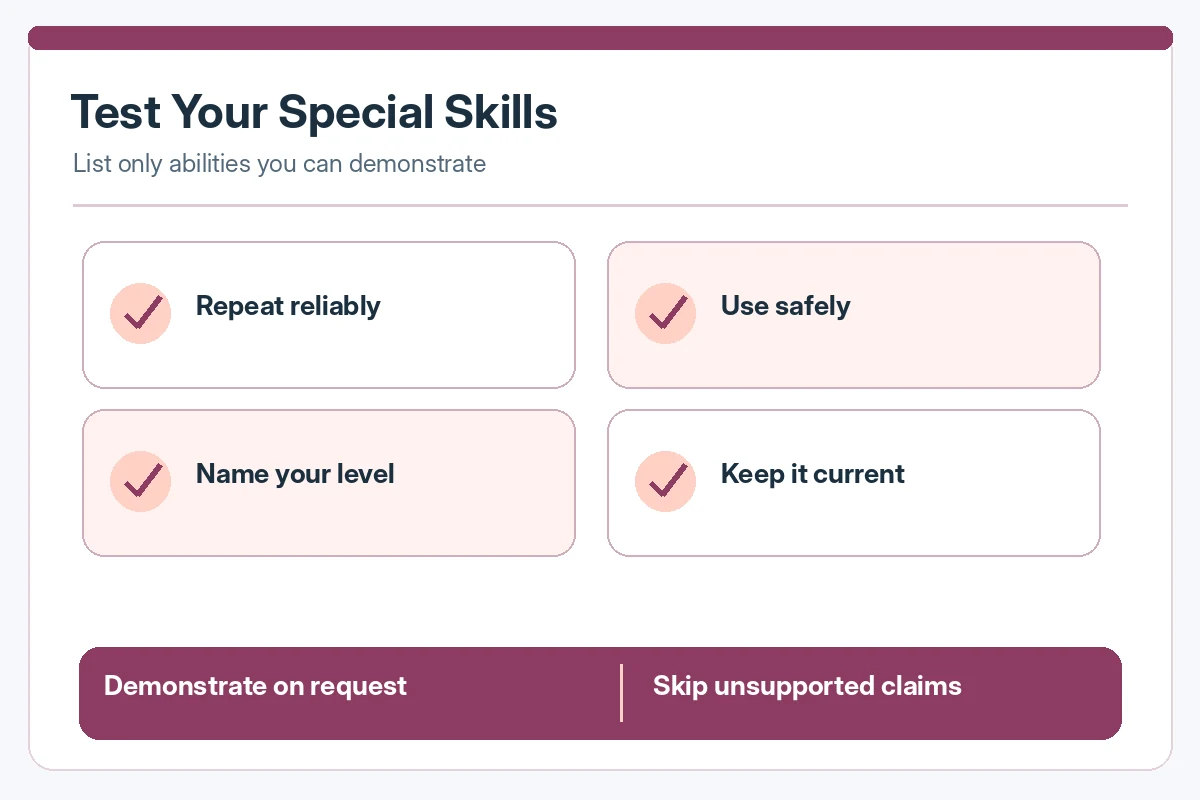
Special skills are an invitation to demonstrate an ability, not a decoration. List languages at a truthful proficiency level; for dialects, be ready to perform them consistently; for dance, instruments, sports, or technical stunts, consider the level at which you can safely perform on request. Backstage’s special-skills guidance recommends grouping related skills so the reader can scan them. Use groups only when you have enough real items to justify them.
Hypothetical skill line: ‘Piano (intermediate, sight-reading); Spanish (conversational); basic tap dance.’ This is not a claim about any real performer. If an activity carries safety risk, an informal hobby does not equal a professional qualification. Avoid listing weapons handling, stunts, or specialized certifications unless you hold the relevant training and can explain its scope. A short list that remains accurate under an audition test is better than a dozen impressive-sounding claims.
Match the Submission Format and Headshot
Some casting processes involve a digital profile, while others require a printable resume and headshot. Follow the exact attachment and page instructions supplied with the audition. Keep contact details readable and update representation information whenever it changes. Avoid attaching oversized decorative backgrounds, complicated multi-column layouts, or a biography that crowds out credits. The document should still make sense when exported as a PDF and opened on a smaller screen.
If pairing a print resume with a headshot, confirm that the page dimensions and attachment method meet the request. An agent’s name belongs on the document only if the relationship exists. Do not add false union affiliations or membership initials; such claims can be checked. The headshot and resume should accurately represent your current appearance and experience rather than promising a type of performance you cannot deliver.
Create an Early-Career Version Without Padding
A first acting resume might contain student productions, community theater, recent classes, movement training, and demonstrated skills. Select evidence that relates to the actual audition. An introductory voice workshop may belong on a voiceover submission but not need top billing for an athletic stage role. Remove placeholders such as ‘credits available upon request’ if they add no substance. Empty sections, made-up titles, and exaggerated abilities do not solve an experience gap.
Ask a colleague or instructor to check whether each line is clear to someone outside your training circle. Verify project titles, role names, instructor spelling, and category boundaries. Keep a private master list of past work, but submit a concise version with your best relevant credits. The result should be a credible casting snapshot that a reader can compare with the audition, not an attempt to imitate a famous performer’s career.
How We Research Professional Resume Formats
We compared claims with professional guide, occupational guidance, career reference. We emphasize what the sources actually establish: formatting practices, occupational responsibilities, and credential distinctions. These sources do not prove that one layout passes any particular applicant tracking system or secures employment. Employer instructions, professional norms, and state-specific requirements take precedence over a sample document.
All sample resume statements and names in this article are explicitly hypothetical, not verified candidates or invented success stories. The site provides an affiliate disclosure. We make no assumption of paid referrals, advertising partnerships, or employer endorsements in this article.
More Resume and Cover Letter Guides
- Cover Letter Format: Arrange Your Header, Evidence, and Closing Clearly
- Functional Resume Format: Highlight Skills Without Hiding Your Work History
- Caregiver Resume Format: Show Daily Support, Care Scope, and Training
- Nursing Resume Format: Put Credentials and Clinical Evidence First
- Flight Attendant Resume Format: Put Safety, Service, and Training First
Yes, if genuine and relevant; label them honestly as student films or projects rather than professional network credits.
Lead with real training, school or community productions, and specific demonstrated abilities. Do not invent film or television credits.
No. Choose skills relevant to roles and safe to demonstrate; truthful levels matter more than a long list.
Only if you have the actual affiliation and meet the relevant membership conditions. Never add a union label for appearance.
Usually not. Casting documents emphasize performance credits, relevant training, and demonstrable skills over ordinary business employment history.