
In an administrative interview, choose one job-related strength you can prove and one genuine weakness you are actively improving. A useful answer pairs a specific task with what you personally did, what changed, and the part someone else authorized or completed. For this role, a possible strength is calendar conflict resolution; a possible development area is hesitating to clarify competing priorities early. These are ideas to test against your own experience, not traits to claim automatically.
The examples below are hypothetical, not stories you should memorize as your own. First compare the employer’s posting with your actual responsibilities. Choose a real a calendar update and documented approval or describe its method safely; keep sensitive records and meeting access confidential or within authorized decision-making. Interviewers may ask what happened after your action, so prepare the answer in a way you can defend without private data or invented numbers.
Match an administrative strength to the employer’s actual tasks
For an administrative assistant interview, a useful strength is something an employer can connect to work: scheduling accuracy, document handling, clear messages, or reliable follow-through. BLS describes administrative support across communication and organization tasks, but each employer sets its own access rules and priorities. Pick one strength that matches the posting rather than reciting a collection of adjectives.
If the posting emphasizes calendar support, discuss how you check time zones, attendee availability, room needs, and confirmation messages. If it emphasizes records, focus on version control and locating the correct file. Interviewers need to hear your specific role, not a description of what the whole office achieved.
Build a strength answer around a calendar conflict
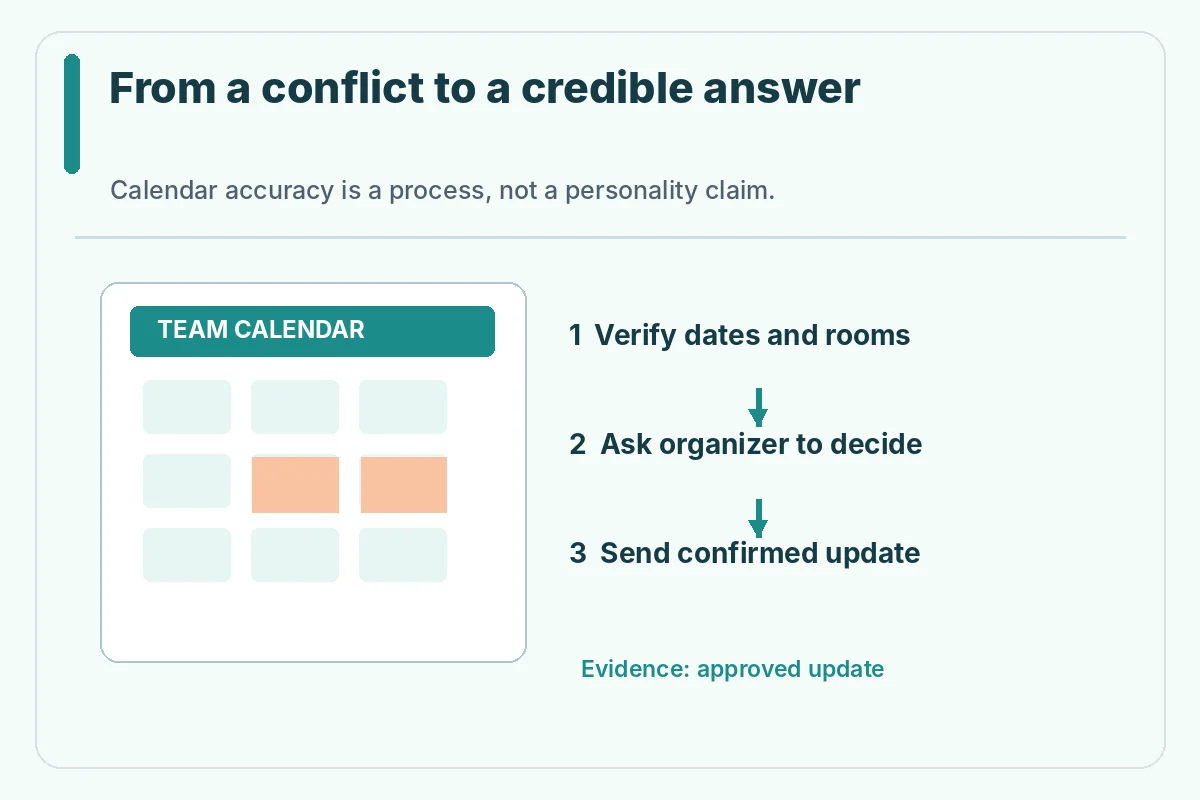
A strong answer explains the original scheduling problem, the checks you performed, who made the decision, and what was communicated. In a hypothetical situation, an interviewee might have noticed duplicate room bookings, compared the booking requests, asked the designated manager to choose a priority, and issued the corrected invitation after approval. This is stronger than claiming to be an excellent multitasker.
Describe the evidence you actually have: an approved calendar change, a meeting agenda, or a record showing the right attendees were informed. Do not expose names, meeting topics, or private documents to prove the story. If you are a beginner, a student event or volunteer scheduling example may work if you identify it honestly.
Pick a weakness that can be improved without bypassing controls
An administrative weakness might be waiting too long to ask which competing request matters most, or spending extra time polishing a routine memo when a clear first version would suffice. Neither should be described as harmless if it has caused real delays. Explain the effect you noticed and the improvement routine you adopted: confirming urgency, requesting a decision by a stated time, or using an approved template.
Avoid selecting careless handling of confidential records as a lighthearted weakness. Access and accuracy are essential; if you made a significant error, explain the reporting and correction process truthfully without revealing protected details. A weakness answer must not imply that you now make decisions beyond your authority.
Separate organization from unauthorized decision-making
A candidate can be proactive without independently changing a manager’s commitments or sharing restricted files. Tell the interviewer whether you gathered options, recommended a practical solution, or had authority to approve the change. If you needed sign-off, naming that step makes the story more credible, not less. Similar distinctions apply to invoice processing, purchasing, visitor access, and employee records.
One useful preparation exercise is to mark every verb in your sample answer as performed, recommended, or approved by someone else. Rewrite a sentence such as “I fixed the executive calendar” as “I identified the conflict, proposed alternatives, and updated invitations after approval” when that more accurately reflects what occurred.

Use office artifacts as evidence without sharing private information
Evidence can include a sanitized checklist for recurring requests, a template you created with permission, or a fictional scheduling example showing how you would log decisions. The purpose is to demonstrate your method; you are not required to bring real employee information to an interview. Describe the fields you checked and the point at which you escalated a question.
For example, a simple practice tracker can show request date, owner, deadline, access restriction, approval status, and final confirmation. Clearly label it as a practice sample, and never claim it represents the employer’s records. You can explain how the tracker prevents forgotten handoffs even when you cannot share a real office system.
Adapt the answer to a first administrative job
You can use school, retail, volunteer, or community event examples when they demonstrate the same process. Scheduling a club event can show tracking dates and communication; organizing files for a class project can show version naming. The interviewer may still ask whether you have used a specific office suite or managed executive calendars. Answer that gap plainly.
A reasonable bridge is to describe the relevant step you did perform, then how you would learn the employer’s approved system with training. Do not say you managed confidential personnel records when your example involved public event sign-ups. A narrower truthful example is much more useful than an impressive-sounding invented one.

Rehearse a short paired answer and keep the roles distinct
Practice one strength response in roughly a minute: name the strength, tell one specific situation, state your action and describe a verifiable result. Then practice one weakness response: name a real limitation, identify its effect and explain a change you have implemented or are actively testing. Do not claim an improvement is complete without evidence.
Keep the two answers complementary but not artificially linked. For instance, calendar accuracy can be your strength while earlier escalation on conflicting requests is a growth area. That pairing is plausible if you have an actual example of each. Speak naturally and leave room for the interviewer to ask who made the final decision.
Ask a role-specific follow-up question before accepting assumptions
After your answer, you can ask how the organization handles competing calendar requests, where administrative approvals are recorded, and what constitutes an urgent escalation. Such questions show you care about the operating rules rather than assuming all offices work the same way. They also help you evaluate the role.
Prepare a tiny debrief card: what happened, what you did, what changed, and what you would now do earlier. If you cannot explain one of those points, revise the example rather than adding a fabricated metric. The most persuasive administrative answer is accurate enough that a former supervisor could recognize your contribution.
An Example Answer You Must Adapt to Your Own Experience
Hypothetical example: I supported a shared calendar when two requests overlapped. I checked which meetings had firm deadlines, asked the authorized organizer to resolve the conflict, and notified the affected staff after confirmation. I did not move confidential meetings without approval. This is a made-up situation to illustrate a responsible answer. Use your own real situation, responsibilities, limits and result when speaking to an employer. If you never did the action, do not borrow the example as your work history.
Before the interview, write two short drafts: a strength story centered on calendar conflict resolution and a weakness story centered on hesitating to clarify competing priorities early. For each, mark the specific action, the available evidence, who else participated and any result you can confirm. Read each aloud. Replace jargon with clear verbs, and remove any number you cannot substantiate. An honest limitation with a real change in method is better than an untested claim of perfection.
How We Research and Verify This Guide
We compared job-relevant interview guidance with occupational descriptions and current search results on November 2, 2026. The U.S. Office of Personnel Management explains how interview questions can be tied to job competencies and how situation, action and result fit a behavioral example. Occupational references describe common tasks, not mandatory duties for every employer. The scenarios in this article are fictional, not verified candidate outcomes, hiring predictions or guaranteed interview scripts. The website’s relationship policy is available in our affiliate disclosure.
OPM Structured Interview Guidance: OPM explains job-related interview questions and the Situation/Task, Action, Result answer structure. Source reviewed November 2, 2026; always verify the particular job posting and employer procedure.
Official Occupational Reference: BLS describes administrative support duties including scheduling, communications and document organization. Source reviewed November 2, 2026; always verify the particular job posting and employer procedure.
OPM Structured Interview Guidance: OPM explains structured interviews and assessment of job-related competencies. Source reviewed November 2, 2026; always verify the particular job posting and employer procedure.
More Interview Preparation Guides
Choose a relevant behavior you can prove, such as resolving a scheduling conflict through accurate checks and approved communication. The example matters more than the label.
Yes, if you describe a real difficulty and a concrete improvement such as confirming urgency early. Do not pretend you were authorized to decide every priority.
No. Remove identifying people, meeting subjects and restricted details. Explain the process or use a clearly labeled hypothetical example.
Yes, if the responsibilities genuinely demonstrate organization and follow-through. Identify the setting rather than presenting volunteer work as paid office experience.
Give enough context to explain your action and outcome, generally one focused example, and let the interviewer ask follow-up questions.