
An apprenticeship resume with no experience should show learning readiness and real hands-on evidence, not pretend that classroom practice was licensed jobsite work. Start with the apprenticeship trade, your availability, completed courses and actual supervised projects. Describe tools and tasks only at the level you performed them. Registered Apprenticeship programs combine paid learning, mentoring and related instruction, according to Apprenticeship.gov; applicants are not expected to arrive as fully qualified journeyworkers. Entry requirements and selection procedures vary by sponsor and occupation.
Identify the trade and program requirements first
An electrician, plumbing, welding, machining or building-maintenance apprenticeship can require different entry qualifications, tests, schedules and physical or safety considerations. Read the official sponsor listing rather than borrowing requirements from a social-media post or another trade. Record the apprenticeship title, employer or sponsor, location, application documents and any official prerequisites. If the program asks for a driver license, math preparation, assessment or transcript, confirm those details directly. A generic resume claiming readiness for every trade is weaker than one that reflects the exact duties and training model described by the sponsor.
Sort projects into accurate experience categories
Use a small evidence inventory: school technology project, community repair event, workshop lesson, volunteer maintenance or personally completed nonhazardous build. For each item, write the objective, material or tool you actually handled, who supervised the task, how you checked your work and the result you can verify. A classroom wiring board is not a real commercial electrical installation. A woodworking school assignment is not contractor employment. Label project entries with the institution or context and dates when known. Do not present access to a professional-looking workshop as proof that you operated every machine in it.
Show safety awareness without claiming certifications
Applicants can mention safety procedures they actually learned, such as reviewing instructions, identifying risks, using assigned protective equipment and reporting uncertainty. But do not list OSHA training, first-aid credentials, equipment authorization or trade licenses that you have not earned. OSHA states that training and information about relevant hazards are employer responsibilities. In an honest example, ‘Followed instructor-provided eye protection and tool-check steps during a supervised class project’ is safer and more specific than ‘Certified to work on any construction site.’ Do not describe work with live electrical systems, lifts or machinery as independent if it required oversight.
Translate a supervised build into a resume bullet
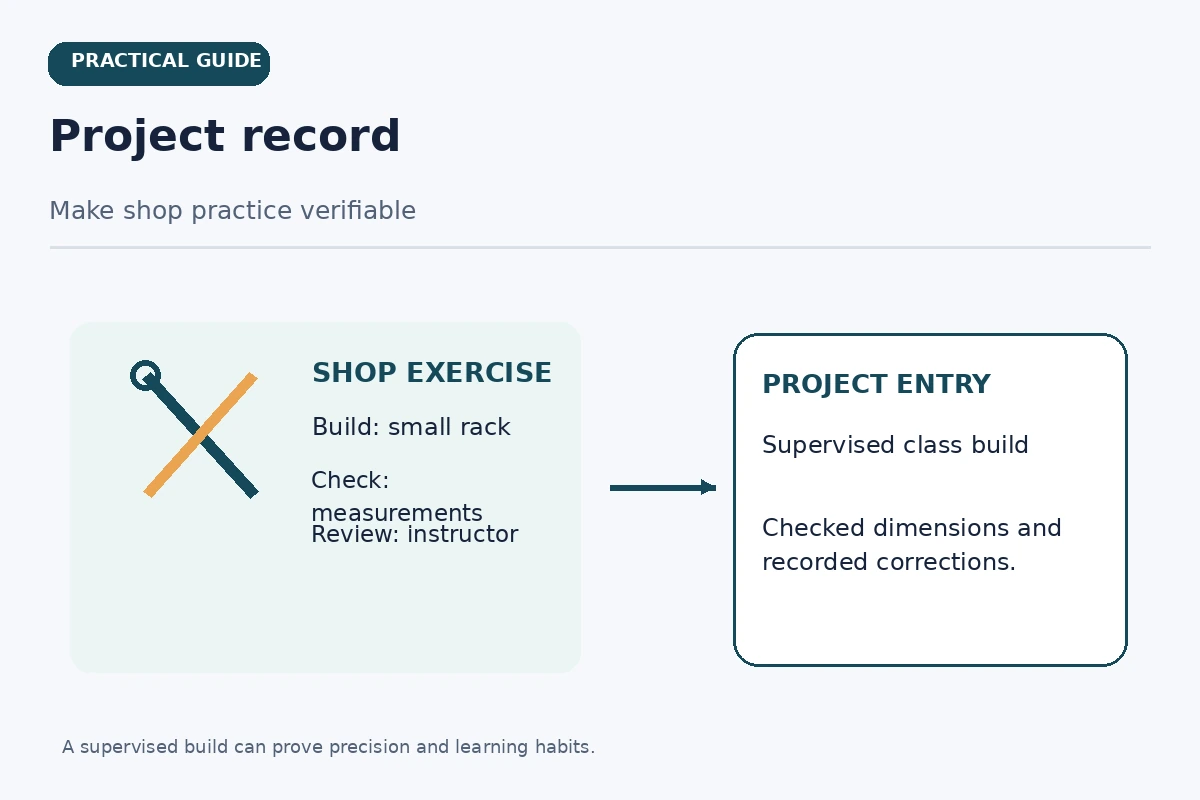
Hypothetical school example: ‘Assembled a small wooden storage rack from classroom plans under instructor supervision; checked dimensions and documented corrections before final review.’ The bullet names the artifact, the work and the review without inventing a commercial customer or a precise production rate. A second, distinct sample could say: ‘Organized and labeled classroom hand tools after a supervised shop session, confirming missing items with the instructor.’ If the student only observed a demonstration, write ‘Observed a demonstration of…’ in a training section rather than changing observation into hands-on experience. Use actual numbers only if you recorded them.

Include math, documentation and teamwork evidence
Entry-level programs can value careful reading, measurement, communication and persistence. Relevant examples may include a geometry or technical drawing assignment, a maintenance log, an inventory checklist or a team build with assigned roles. Describe the context, not an inflated outcome. For example, ‘Used a ruler and drawing to verify cut lengths in a class prototype’ is meaningful if true. Present spreadsheets and digital photos as supporting documentation only if they are permitted to share. Never upload a customer’s plans, employer files or restricted site photographs to prove you have seen a trade environment.
Keep certifications and training status unmistakable
Separate completed credentials from classes in progress and informal familiarity. ‘Coursework: Introduction to Blueprint Reading, completed’ is not the same as ‘Certified Blueprint Reader,’ unless an authorized issuer truly provided that credential. Record official provider names, dates and license numbers only when appropriate and requested. A program may arrange related instruction after hiring, so avoid paying for unnecessary outside certificates just because a resume template includes a certifications box. Apprenticeship.gov identifies registered programs as paid employment with structured instruction, not a shortcut to unsupervised work.

Make the resume match the sponsor application
A sponsor may prioritize attendance, transportation, educational records, apprenticeship aptitude tests or particular schedule commitments. Tailor the top of your resume to the genuine qualifications you already meet. If you have volunteer work, a school project and a paid unrelated job, choose the strongest examples for reliability and instruction-following. Explain a short experience gap through accurate education or caregiving entries only when it helps the application; do not create fake employers. Keep external links limited to appropriate public examples, and verify the program through an independently located sponsor or official apprenticeship listing.
Run a final scope and safety verification
Read every bullet aloud and classify it as observed, practiced with oversight, completed independently when permitted, or formally credentialed. Replace vague claims such as ‘expert electrician’ with a verifiable learning action. Check that training providers, dates, and program titles are spelled correctly. Ensure the PDF does not obscure text and that file names are professional. Keep a private evidence log that can support an interview discussion. The purpose is to show a sponsor that you can learn deliberately and follow safety rules, not to assert that you already possess the competence that the apprenticeship is designed to teach.
Prepare a sponsor-specific learning explanation
A simple interview preparation sheet can pair each project with one lesson and one question for the sponsor: what you measured, what you would do differently, and which decisions were controlled by an instructor. That shows active learning without overstating authority. For a role involving hazardous tasks, the accurate answer may be that you observed the procedure and would need workplace training before participating. Keep photographs or plans private when a school, organization or employer owns them.
How We Research Entry-Level Resume Guidance
We compare official occupational descriptions and other relevant primary guidance with the narrow application intent, then build examples that mark training, permission, experience and credentials separately. Every sample person, project and resume bullet in this article is hypothetical; adapt examples only to events you can verify. We do not predict hiring outcomes or promise a particular applicant-tracking result.
Sources consulted November 11, 2026: apprenticeship.gov — The U.S. Department of Labor describes Registered Apprenticeship as combining paid on-the-job learning, mentoring, related instruction, and a credential.. osha.gov — OSHA explains that workers need appropriate safety training, hazard information, and permission to ask questions about unfamiliar tasks.. osha.gov — OSHA states that employers must train workers on relevant workplace hazards and provide required protective instruction..
This article is informational editorial guidance, not an employer endorsement. See the JobAsk affiliate disclosure for relationship and link policies. The internal next steps below are not paid recommendations.
More Resume and Cover Letter Guides
Often yes, because apprenticeship combines employment and structured learning; exact eligibility and selection rules depend on the employer or program sponsor.
Yes. Label it as a school project or supervised training and describe what you actually built, checked, observed or learned.
Do not list a future credential as active. Use a clearly labeled in-progress training entry only when the status is accurate.
Describe the specific supervised training setup and your actions. Do not imply you performed licensed or live-system work independently.
Use an independently located employer or program sponsor and official Apprenticeship.gov resources; verify the actual listing and how applications are submitted.