
To ask for more time to accept a job offer, contact the hiring team before the existing deadline, suggest a specific new date, and wait for express confirmation. Thanking the employer or requesting more time does not itself extend the offer or accept it. Have a plan if the employer cannot change its schedule.
All names, dates, roles, and messages used as examples in this guide are hypothetical. Replace them with the details in your authentic offer and use your employer’s stated process. No example implies a guarantee of hiring, a legal conclusion, or permission to act outside your assigned authority.
Check the Actual Offer Deadline First
A hiring manager may say “let us know this week,” while a formal letter lists a date and time. Find the precise deadline and its time zone if applicable, and note whether it is stated in the written offer, a separate email, or a phone conversation. Do not rely on an assumed automatic grace period. If the deadline has already passed, ask whether the offer remains open before treating it as valid.
The Harvard career center guidance advises candidates to acknowledge an offer promptly, ask for more decision time where needed, and stay responsive. The point is to make a decision you can stand behind while respecting the employer’s planning. An extension request is different from simply thanking the recruiter or asking questions: it proposes a new decision date.

Know Why You Need the Extra Time
Identify the information or decision that is genuinely outstanding. You may need to review a benefits summary, understand the proposed schedule, discuss a family logistics issue, or compare a verified pending offer. You are not required to disclose every private consideration. Give enough context for the employer to understand the request without claiming another job offer that does not exist.
Choose a realistic extension: a date by which you could actually respond even if no new information arrives. If the uncertainty concerns a contractual term, it may be better to ask the employer to clarify that term first. If the issue is more fundamental—such as a worksite that cannot be reached—extra days alone may not resolve it.
Ask for One Specific Alternative Deadline
Reach out before the original deadline, ideally while the employer has time to consider the request. You can phone the recruiter or hiring contact if the deadline is close, then confirm any agreed date by email. Do not send a vague message asking for “a little longer” with no proposed decision point; a concrete date gives the other party a practical question to answer.
A clear request might say: “Thank you for the Program Assistant offer. Would it be possible to move my decision deadline from November 2 to November 5? I would appreciate time to review the detailed schedule and benefits. Please let me know if your hiring process allows that.” These dates are hypothetical; use the employer’s actual deadline and your legitimate need.

Wait for Confirmation Rather Than Assuming Approval
The employer may agree, offer less time, ask why you need it, or decline. Continue to treat the original deadline as controlling until an authorized contact explicitly changes it. If a recruiter says “that should be fine” without identifying a date, send a brief confirmation question. Avoid taking silence as approval or letting the date pass while waiting for a reply.
The University of Nebraska’s business career center recommends reviewing and negotiating terms before formal acceptance. If you need more time, ask before committing. A deadline extension is not acceptance and does not obligate the employer to reserve the position indefinitely. Employers vary in flexibility and hiring urgency.
Use an Email That Keeps the Decision Open
Keep the message positive but accurate: appreciate the offer, identify the role, name the currently stated deadline, propose the new date, and explicitly ask whether the extension can be granted. If there is one necessary document missing, identify it without turning the email into an elaborate list of unrelated demands. A polite acknowledgment should not contain an accidental “I accept.”
Hypothetical model: “Thank you for offering me the Program Assistant position. I am interested in the role and would like to review the finalized schedule before deciding. Would a November 5 response be possible instead of November 2? I understand the original deadline remains in effect unless you confirm a change.” This protects against confusion and keeps the next step obvious.
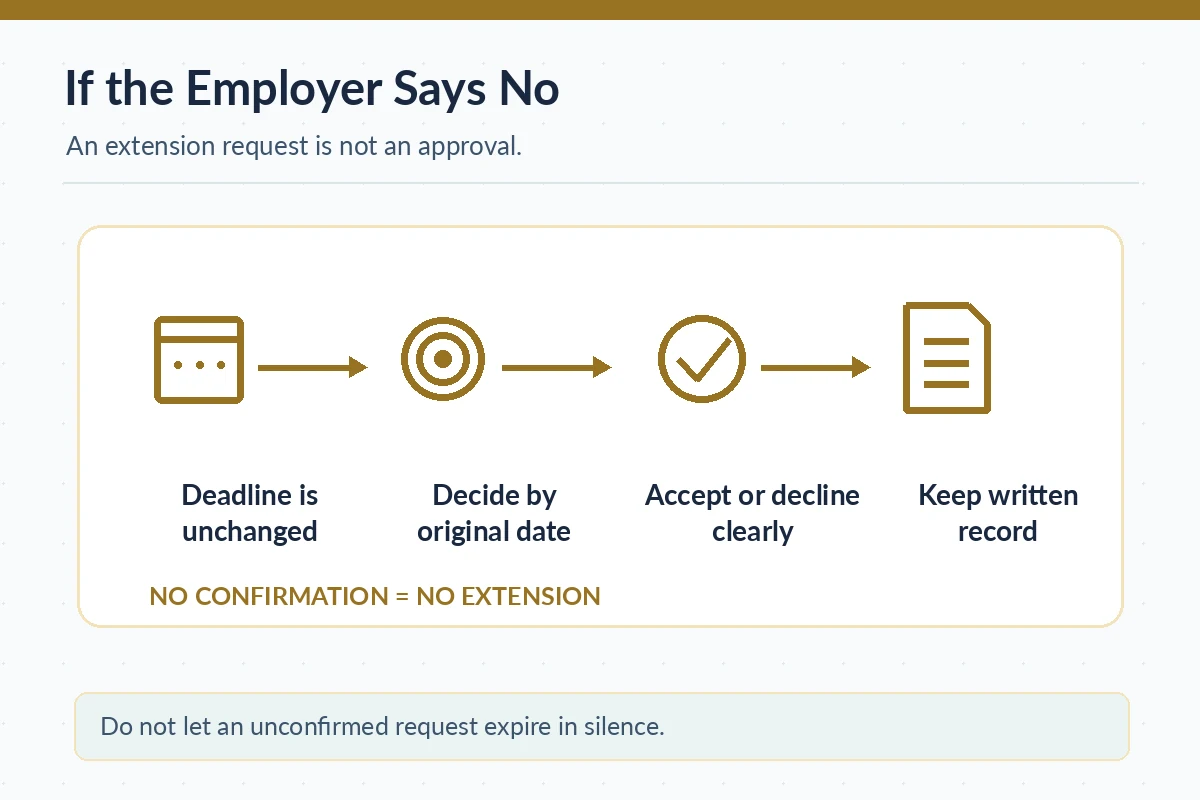
Make a Plan for Yes, No, or No Reply
If the employer agrees, save the response and make your final decision by the new confirmed deadline. If it offers a shorter extension, decide whether that provides enough time and confirm your understanding. If it refuses, accept or decline by the original date based on the information you have rather than hoping the role will remain open. If no reply arrives near the cutoff, use a verified contact method and ask urgently.
Before accepting, check position, location, schedule, pay structure, reporting line, benefits information, and remaining hiring conditions. CareerOneStop recommends reviewing the full offer, including schedule and working conditions. For suspicious or unexpected outreach, verify the employer independently before supplying sensitive details. Your goal is a considered and timely decision, not maximum delay.
A Hypothetical Email You Can Adapt
Subject: Request for Job Offer Decision Extension
Hello Lee,
Thank you for the offer for the Program Assistant position. I remain very interested. Would it be possible to extend my decision deadline from November 2 to November 5 so I can review the complete schedule and benefits information? I understand if your hiring timeline does not allow that change and will respond by the current deadline unless you confirm otherwise.
Thank you,
Drew
This model uses invented people and dates solely to show structure. Change the subject line, title, dates, and decisions to match an authorized written record. If your real terms are still unresolved, do not copy unconditional acceptance language from another example.
How We Research Job Offer Decisions
We distinguish documented career-service advice about evaluating and responding to an offer from scenario-specific practical suggestions. For matters such as employee classifications, required notice, transfer approvals, or enforceability, the applicable contract, workplace policy, and qualified local advice control. These sources do not create employer-specific rules:
cloudfront.careeronestop.org — CareerOneStop explains reviewing roles, working conditions, compensation and benefits before deciding on an offer.
careerservices.fas.harvard.edu — Harvard career guidance covers acknowledging offers, obtaining written details, extension requests, and keeping commitments.
business.unl.edu — University of Nebraska career guidance advises resolving negotiations before accepting and confirming official terms in writing.
consumer.ftc.gov — FTC explains warning signs of fraudulent job offers and sensitive-data requests.
JobAsk provides editorial information, not legal representation or a verified recruiting service. We do not guarantee an offer, promotion, or acceptance. Review our affiliate disclosure; no affiliate partnership is claimed in this article.
Related Workplace Guides
- How Long to Consider a Job Offer: Set a Deadline and Ask for Time
- How to Accept a Job Offer in Person Without Leaving Details Unclear
- How to Accept a Job Offer by Phone Without Missing Important Details
- Verbal Job Offer Follow-Up: Get Written Terms Before Accepting
- How to Accept a Conditional Job Offer and Track Its Requirements
Yes, you can ask, but the employer decides whether to agree. Request a specific new date before the current deadline.
Ask for only the time you realistically need. There is no universal extension length guaranteed by employers.
No. Clearly separate appreciation or interest from an explicit final acceptance.
Do not assume an extension exists. Follow up through a verified contact route and respect the original deadline unless it changes.
Decide whether to accept or decline on the existing timeline, based on verified terms and your priorities.