
Baker experience on a resume: A baker’s resume should show the production work you actually performed: measuring ingredients, preparing dough or fillings, monitoring a station, checking product quality, recording production information, or cleaning equipment within assigned procedures. If your experience was mostly at a bakery counter, describe customer service rather than claiming production authority. Use real tools, training and outcomes, and avoid invented bake quantities, food-safety credentials or recipe-development achievements.
Identify the stage of bakery work you performed
O*NET describes bakers measuring ingredients, preparing mixtures, operating baking equipment, checking quality and in some roles maintaining production records. That occupational overview does not imply that every bakery worker performs every stage. A dough assistant who prepared ingredients may have no responsibility for oven settings or production planning. A cake decorator may have different work evidence from someone who prepares bread at volume.
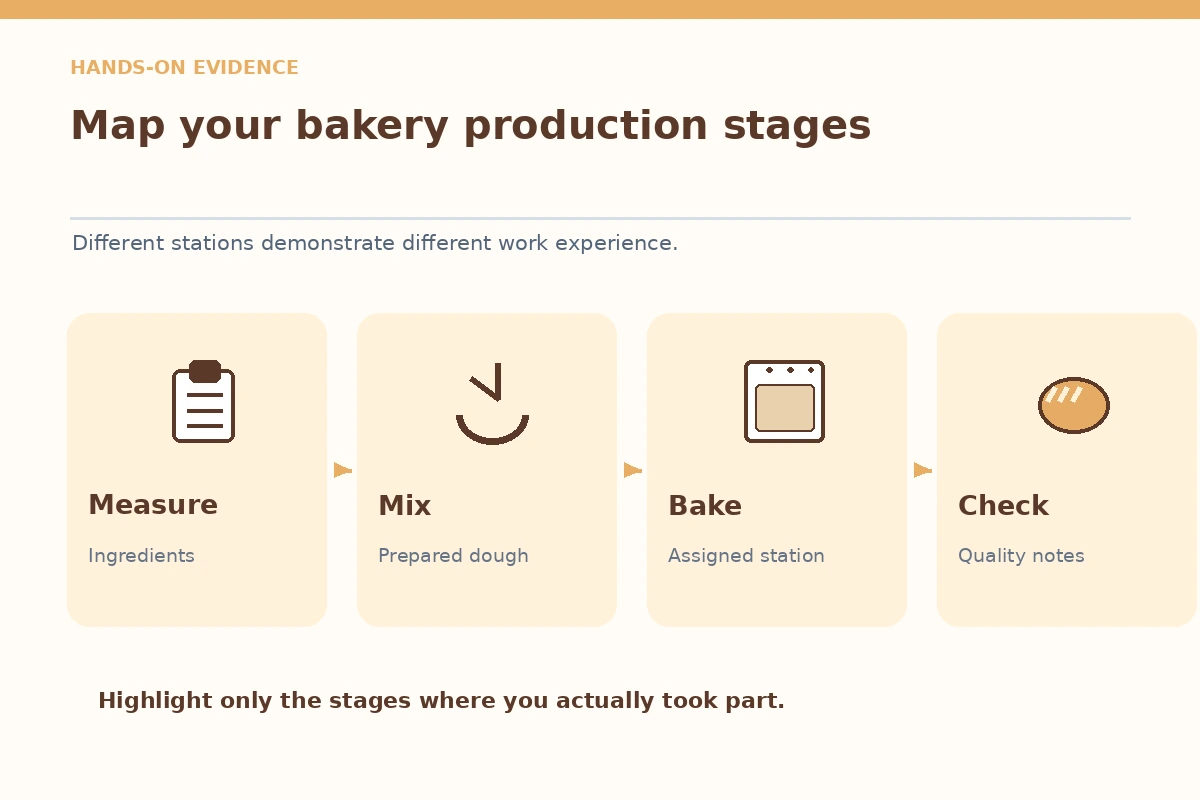
Build a stage map from your real shift: measure, mix, shape, bake, finish, check, record and hand off. Highlight only the steps where you took action. If you worked at the counter, a separate set of entries may fit better: orders, labels, customer questions and approved transactions. Use the official job title where possible and clarify your assignments with descriptive bullets rather than renaming yourself “head baker.”
Turn preparation tasks into credible bullet language
A vague line, “Made baked goods,” leaves out the skill. An illustrative but more useful bullet is, “Measured ingredients using the production sheet and prepared dough components for the next batch under the assigned procedure.” Use it only if you did those steps. Another possible example is, “Labeled prepared trays and handed production status notes to the next shift.” That example supports organization without assuming independent responsibility for approving recipes.
Name specific techniques and tools only when you used them in real work. A mixing machine, digital scale, pastry bag and cooling rack are not interchangeable skills. If you followed recipes created by others, say you followed established formulas; do not present yourself as the recipe developer. If a batch failed a quality check, describe reporting the issue rather than guaranteeing you personally resolved every underlying problem.
Write quality-check work with appropriate boundaries
Quality evidence can come from observing appearance, checking labels, separating damaged items and recording concerns for review. O*NET includes checking product quality among baker tasks, but the exact decision rights depend on the workplace. Do not claim to approve food for sale, sign off on sanitation compliance or set food-safety policy if you only notified a supervisor. Describe the concrete check and escalation you personally completed.
Likewise, do not turn orientation or in-house instruction into a professional certification. If you completed a named food-handling course, report the course title, issuing organization and status accurately. A role may have local rules or employer-specific requirements, but a resume article cannot establish one universal license. For safety questions, follow the real employer procedure and applicable local guidance rather than advertising unverified credentials.
Show production records without confidential operating details
Some bakeries use batch sheets, prep lists, stock logs, ingredient labels or waste notes. These are good sources for remembering what you actually did. A hypothetical example is, “Updated end-of-shift production notes and identified ingredient shortages for the lead baker.” That may be valuable to a production employer because it shows a verifiable handoff. It does not disclose a private recipe, exact production capacity or customer information.
Do not attach proprietary formulas, internal cost sheets or photographs taken in restricted work areas. Use generic descriptions that preserve the useful method. If a reader wants quantities, include only true figures you are permitted to discuss, with the time frame and your own contribution made clear. “Helped prepare scheduled batches” is better than claiming to have produced hundreds of units if that count belonged to the whole team.

Match the next job to production or bakery service
A production bakery may want measuring, shaping, proofing or quality routines. A retail bakery may want order accuracy, packaging and customer communication. A bakery manager listing might require supervision or purchasing authority that you have not held. Read the target vacancy, identify its duties, and choose the two or three actions you can support. Do not use every technical term in the job ad as a keyword if you have not performed it.
CareerOneStop recommends describing actual tasks and accomplishments relative to the employer’s goal. For a baking role, a concise specific line about ingredient preparation and station handoff may be stronger than “excellent teamwork.” If you are changing careers, select transferable work such as checking instructions, recording exceptions or coordinating across shifts. Keep the context clear so those skills are not mistaken for a different licensed occupation.
Audit a practical bakery entry
A fictional entry might read: “Bakery Production Assistant | [Employer] | [City, State] | [Dates]. Measured ingredients from assigned prep sheets, organized labeled trays and reported product defects to the shift lead.” Every claim must match the applicant’s real duties. Someone who only wrapped finished items should describe packaging and labels instead. Use the date and employer formatting already established elsewhere in your resume.
On a final read, ask whether your title matches payroll or contract records, whether you have evidence of any specialty skill, whether quality claims respect your decision rights, and whether the examples omit private workplace details. If a line sounds like a job advertisement rather than a task you can describe from memory, revise it. Accuracy is the distinctive strength of a credible bakery resume.

How We Research Resume Work Experience
JobAsk reviewed these public career and occupation references on November 4, 2026: CareerOneStop: Work Experience (CareerOneStop guidance for work history descriptions, tasks and achievements). O*NET: Bakers (O*NET occupation description for bakers, including measuring ingredients, production, quality checks and production records). CareerOneStop: Resume Formatting (CareerOneStop guidance on readable chronological work experience and dates). These explain typical resume practices and job duties; they do not establish any applicant’s real employment history, certifications, or hiring outcome.
Every example and diagram is illustrative. Replace sample actions, employers, months and duties with facts you can verify from your actual work, and recheck each job posting before tailoring an application. For editorial and commercial context, read our affiliate disclosure. This article does not claim a paid referral relationship or guaranteed resume screening result.
More Resume and Cover Letter Guides
Describe what you truly did. Counter and packaging work are useful but should not be presented as independent dough mixing, oven operation or recipe development.
Only if you know the real figure, it describes your contribution and it may be shared. Never invent throughput to impress a recruiter.
Only if that was genuinely your role and the result is verifiable. Routine cleaning or reporting is not the same as official inspection authority.
State your actual trainee or assistant title and identify specific tasks you performed under guidance without implying independent qualification.
It can be if the target role values accurate procedures, records and handoffs. Keep the actual bakery setting visible and choose transferable evidence.