
A bank teller interested in loan processing should emphasize accuracy and discretion, not pretend that handling deposits is the same as evaluating credit. Teller tasks can include verifying identity, recording transactions, balancing records and referring customers to specialists. Loan interviewers and clerks may collect financial information, verify that applications are complete, and prepare files for further review. The transition is about controlled document handling and careful communication, with each institution defining its own authorizations.
The BLS describes tellers and financial clerks as distinct roles, and lists loan interviewers or loan clerks among financial clerk occupations. It does not say a teller is automatically qualified to approve loans. Use this guide to compare job duties, draft defensible examples and ask better questions about processing systems and review boundaries before you apply.
Separate Teller Transactions From Loan File Processing
Start with work you have performed at the teller station: confirming information under bank procedure, recording a transaction, balancing a drawer, or referring a loan question to an appropriate colleague. A loan processing role can instead involve collecting a document checklist, verifying missing fields, following up on authorized requests and preparing an application file for a decision-maker. A loan officer or underwriter may have different responsibilities, and job titles vary by organization.
Create an evidence matrix with a row for each target duty. Mark teller experience only where it demonstrates the same behavior, such as checking fields or protecting personal information. Mark all credit analysis, rate decisions and approval authority as not established unless you performed them in an authorized role. A candidate can be a strong applicant by understanding their limits; replacing an accurate teller title with “credit analyst” would undermine that credibility.
Show Verification Habits Without Sharing Customer Files
A truthful application can explain how you followed an identity-check process or escalated a mismatch without showing any real bank record. Do not place account numbers, signatures, loan details, customer names or screenshots from branch software in a portfolio. The job seeker can explain the workflow in plain language and illustrate it using fabricated data labeled “example,” with no employer branding or secret internal procedures.
A hypothetical resume bullet might read: “Verified transaction information according to branch procedure and referred unresolved discrepancies to authorized staff.” That is different from “approved customer identity for mortgage closing.” Only include a version if it matches tasks you truly performed. Accuracy matters both at the input stage and at the handoff stage; identifying a gap is not the same as resolving it independently or approving the transaction.
| Teller experience | Possible processing bridge | Outside the claim |
|---|---|---|
| Verify identity under procedure | Check file fields | Underwrite credit risk |
| Record transactions accurately | Update application status | Approve loan terms |
| Refer account questions | Handoff missing documents | Set lending policy |
| Protect confidential data | Follow secure handling rules | Share sample customer files |

Understand the Loan Document Journey
A posting may mention application intake, requests for missing documents, data entry, verification, closing package preparation or status updates. These are potentially separate functions within a financial institution. BLS describes loan interviewers and clerks as obtaining and verifying applicant information and preparing files, but it does not give each employee authority to issue decisions. Ask which team owns underwriting, who reviews discrepancies, and which software access level the processor receives.
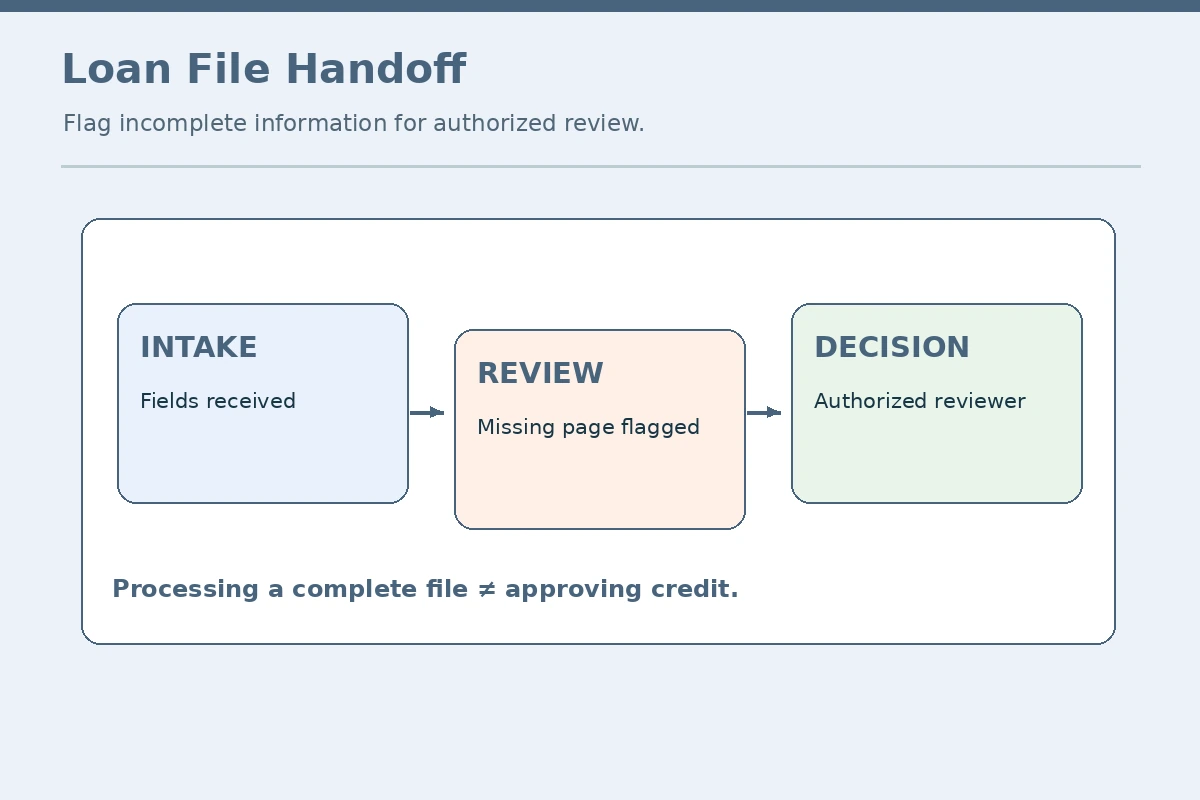
Build a fictional checklist with applicant authorization received, identification request routed, income documentation received, missing page flagged and final review pending. Do not add fictitious loan amounts or invented credit scores for impressiveness. The useful demonstration is that you can see which step needs a reviewer and avoid presenting an incomplete document as approved. Keep the example generic and never imply knowledge of a real employer’s private lending policies.
Choose the Right Processing Job Advertisement
Search “loan processing assistant,” “loan clerk,” and document-support roles, then read the full responsibilities. Some positions require mortgage-specific experience, specialized software, licensing or knowledge of particular products. Others are supervised administrative jobs. Do not infer requirements from the title alone or assume that prior work in any bank satisfies a credential requirement. If the employer requests a professional license, verify the exact jurisdiction and role before applying.
Compare the posting with your documented tasks, not just with a list of desirable qualities. A job that centers on collecting missing documents and updating file status may be a stronger bridge than a role that owns credit decisions. Confirm who contacts applicants, how sensitive data is handled and what reviews are required. Record gaps clearly so a realistic training plan can follow; do not buy a course merely because an advertisement promises immediate promotion.
Prepare a Resume and Interview Story With Clear Scope
A concise career-change profile could say: “Bank teller experienced in procedural verification, accurate electronic transaction records and sensitive customer communications, seeking a document-processing role.” This does not suggest you have already assessed loan risk. Keep the teller position under its original title and add a few credible bullets that name actions, required review, and systems you actually used. Use terminology a hiring manager can understand without inflating your access.
For an interview, choose one real example of detecting an incomplete or inconsistent record. Explain what information you were allowed to review, which rule or checklist you followed, whom you notified and how the issue was closed, if you know. Avoid inventing a rejection prevented or money saved. If asked about underwriting, acknowledge the distinction and explain what you would learn under a processor’s supervision rather than claiming unearned judgment.
Test the Transition Without Overstating Qualifications
You can create a de-identified practice exercise from fictional forms and practice naming missing fields, documenting an open question and routing it to the correct reviewer. Label the exercise “personal learning sample” and do not attach any actual bank forms or customer data. Learn the vocabulary of the target product through authoritative materials and the employer’s published requirements rather than random templates from a recruiter email.
Before submitting, review whether each resume line is traceable to your teller work. The decision to approve credit is distinct from administrative completeness checks, even when both are performed inside a bank. Be alert to legitimate background verification, but provide sensitive materials only through independently confirmed hiring channels. A successful transition plan is a set of realistic duties and documented gaps, not a claim that one banking role automatically qualifies you for another.

How We Research Career Transitions
On 2026-11-14, we reviewed official occupational guidance: BLS: Bank Tellers — BLS describes teller identity checks, electronic transaction recording, confidentiality and referrals to appropriate personnel.; BLS: Financial Clerks — BLS distinguishes loan interviewers and clerks who verify applications and prepare documentation from higher-level credit decisions.. We checked the chosen transition against the supplied WordPress title exports and the available prior article packages. The sample job descriptions, resume bullets and visual exercises are illustrative, not actual open vacancies or proof of a hiring outcome. Your location, credentials, job duties and authorized scope may differ from the occupational summaries. Verify each vacancy and employer independently. Read the affiliate disclosure; no employer partnership or sponsored placement is claimed.
Explore Related Career Guides
Yes, as transferable verification, recordkeeping and customer communication experience. Do not relabel teller duties as loan processing.
Requirements differ by product, activities, employer and jurisdiction. Verify the specific posting and official requirements rather than assume.
No. Keep bank and customer data confidential and use clearly fictional practice material instead.
No. Administrative intake and approval or underwriting decisions are distinct responsibilities.
Acknowledge the gap, describe similar tools you actually used and ask about employer training.