
Quick answer. A bookkeeper resume summary should tell a reader which parts of the accounting record cycle you genuinely handled. State whether you entered transactions, processed invoices, assisted with accounts payable or receivable, performed reconciliations or maintained a broader ledger. Then name a concrete verification habit, reporting responsibility or software task that you can explain. Do not claim responsibility for full accounts or signed financial statements if your work covered only a subset.
BLS and O*NET describe bookkeeping, accounting and auditing clerks as recording financial activity, checking postings, reconciling differences and preparing reports. These titles overlap but responsibilities differ. This guide uses an accounting-cycle scope check, clearly hypothetical summaries and practical questions to separate data entry from independent account management without inventing money handled, error rates or client relationships. To go further, our guide “Part-Time Bookkeeping Jobs” shows how to check skills, scope, and hours.
Map Your Responsibility Across the Record Cycle
Start with the work you actually performed: gathering source documents, entering transactions, assigning codes, matching invoices, reviewing exceptions, reconciling balances or preparing routine reports. Each is valuable, but they imply different levels of responsibility. BLS notes that some bookkeeping clerks handle broad records while accounting clerks may focus on particular transactions. Do not turn a short period entering bills into “managed the company general ledger.”
For example, an accounts payable assistant may verify invoice details and record approved payments while an experienced bookkeeper maintains several accounts and prepares month-end schedules. One role is not automatically interchangeable with the other. Compare your actual employer workflow to the target job, choose the strongest accurately performed tasks and put those facts at the start of the summary. Avoid using a senior title merely because it appears in a sample. Our guide to accounts payable interview questions goes into more detail.
Describe Reconciliation Without Claiming Audit Authority
Reconciliation involves comparing records and identifying or resolving differences through an agreed process. You might compare a bank statement to entries, match a vendor balance or flag an incorrect code. If you only assisted in gathering documents, say that rather than “reconciled all accounts.” Explain whether you investigated discrepancies, made authorized corrections or escalated them for review.
Bookkeeping accuracy is not the same as an independent financial audit. O*NET lists checking figures and discrepancies among clerical duties, but that does not establish that a clerk can certify accounts or perform a professional audit. Keep the boundary clear. A summary can emphasize careful comparison and documentation while the experience bullets explain which accounts, tools and approval steps were involved. Never describe confidential client values or unsupported compliance conclusions. Our guide to accounting clerk cover letter goes into more detail.

Write a Version That Matches Your Experience
Hypothetical experienced example: “Bookkeeper experienced in recording transactions, matching supporting documents and reconciling designated accounts under established procedures. Prepares organized exception notes and routine reports for review.” This educational example does not represent a real worker or an employer’s audited outcomes. Replace each task with one from your record and name a specific software system only if you actually used it.
Hypothetical entry-level version: “Accounting support assistant with experience entering invoice details, checking references against source documents and organizing records for review. Seeking a bookkeeping role focused on accurate transaction processing and learning reconciliation procedures.” It does not falsely claim the candidate performed independent month-end close. If your experience is solely a course exercise, say so; a simulated ledger is not a client account.
| Experience pattern | Possible evidence | Honest summary emphasis |
|---|---|---|
| Transaction entry | Recorded bills or receipts | Posted verified data |
| Reconciliation support | Comparison and exception notes | Investigated differences |
| Broader bookkeeping | Documented ledger and reporting scope | Maintained assigned accounts |
Decide Whether to Mention Software and Reports
Accounting software can support posting, invoice processing, reporting and reconciliations. Mention a platform when it is requested by the posting and you can identify which features you actually used. Reading about a product does not equal entering transactions in a live system. A spreadsheet project can show formulas and checks, but it does not automatically prove proficiency with an enterprise accounting package.
For reporting claims, specify whether you assembled source data, generated a standard report or interpreted the results. The title “financial analyst” would imply a different scope from maintaining records. If you provided summaries for an accountant, describe that contribution honestly. Never suggest that a report was a certified financial statement or that you held statutory responsibility you did not have. Put detailed tool names in skills when they do not improve the opening sentence.
Show Accuracy Through Procedures Rather Than Fictional Rates
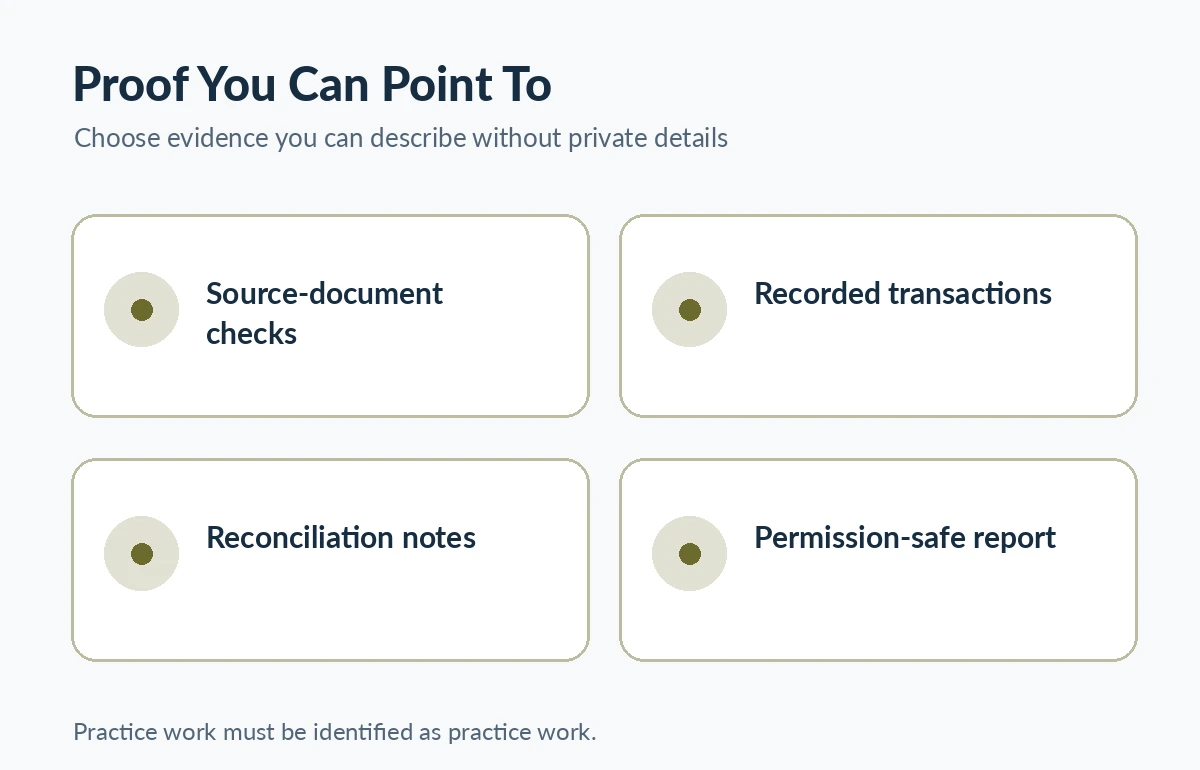
The strongest accuracy evidence may be an explicit routine: matching invoices to approvals, verifying entry codes, separating exceptions for review or documenting adjustments. You do not need to claim 99.9% accuracy. If your workplace maintained a valid error metric, make sure the period, denominator and your role are clear before including it. Otherwise use a qualitative but specific practice description.
A hypothetical task example: an assistant notices a duplicated invoice reference, checks the supporting material and asks an authorized reviewer before posting. That shows a reasonable verification flow, not a real accounting outcome. Do not add an invented dollar amount. If you have never handled a live financial record, describe a clearly labeled training ledger and its limitations rather than pretending to have managed client funds.
Protect Confidential Information in Evidence Examples
Financial records may contain private client and employer details. Your summary should not reveal account balances, customer names or internal system details merely to appear credible. Describe the type of work, scope and your authorized actions at a level that respects confidentiality. If you want a portfolio example, use a permitted synthetic dataset and label it clearly. An independent practice account does not establish responsibility for a real business.
Avoid publishing screenshots of invoices, transactions or payroll data without permission. Even where a document seems ordinary, it may contain identifiers or sensitive amounts. A concise summary can show discipline through routine language such as “maintained supporting records” or “reported unmatched transactions.” A supervisor might verify your broad responsibilities without needing you to disclose protected records. Privacy-conscious accuracy is itself worth preserving.
Separate Bookkeeping From Accounting Advice
Not every bookkeeping task involves making tax decisions, interpreting accounting standards or providing regulated professional advice. If you helped prepare materials for an accountant, distinguish preparation from signing, filing or advising. This guide does not prescribe tax procedures or legal responsibilities. Job requirements and credentials depend on employer, task and location, so verify specialized qualifications directly rather than inferring them from an occupational label.
Likewise, do not equate bookkeeping with handling every payroll, purchasing or accounts-receivable function. BLS describes these as possible tasks across the occupation, not guarantees for each worker. A resume summary should stay within the tasks you truly carried out and would comfortably explain. When an advertised role asks for a gap you have, you can plan training or seek a more appropriate role without making a false claim. For the fuller picture, see our warehouse worker resume summary guide.
Run a Final Scope and Consistency Check
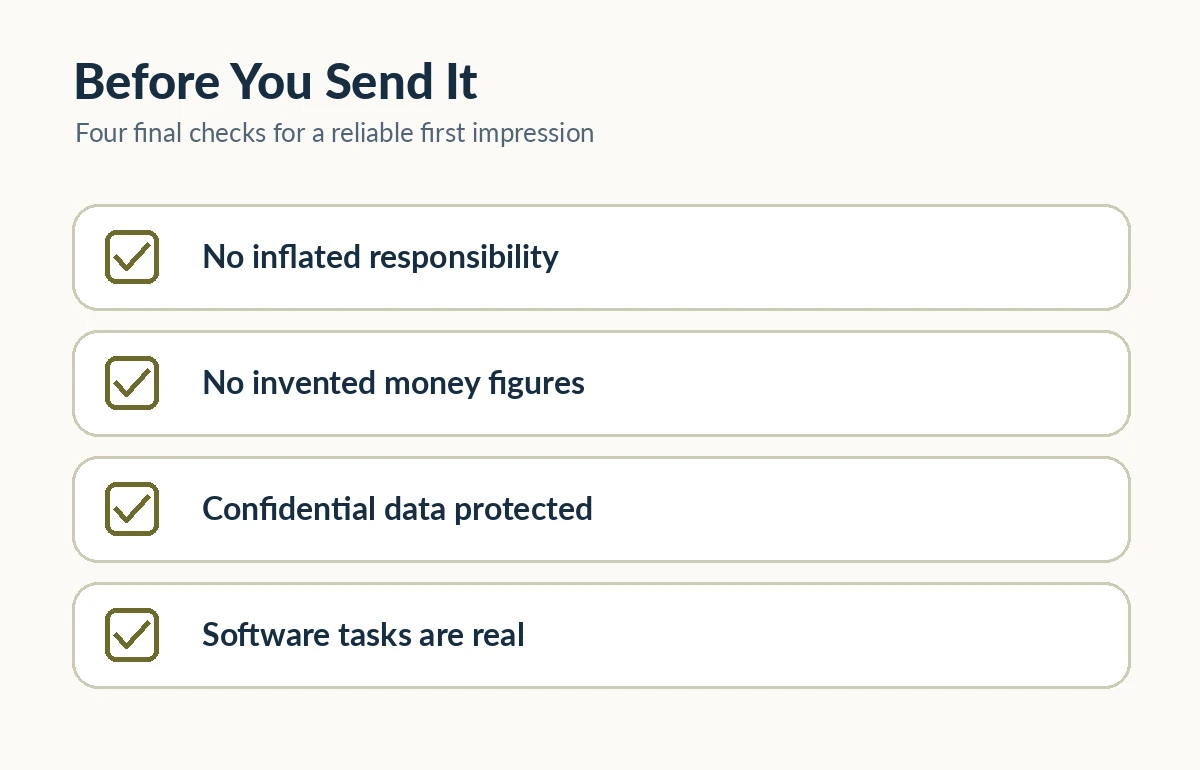
Underline each action word: posted, reconciled, reviewed, processed, prepared or managed. Next to each, write one real example and your authority. If you cannot identify the record type, procedure and review step, consider replacing the verb with a more accurate one. Check that your experience section supports the summary. Use consistent titles and dates, and confirm software skills are described at the level you actually reached.
CareerOneStop recommends brief and relevant summaries, not generic praise. A strong bookkeeping opening can be modest: it identifies the record cycle you know and shows careful methods. It does not need invented employer savings, undisclosed financial data or promises that a hiring system will prefer one phrase. Tailor the emphasis to the posting while preserving every factual boundary; precision is a practical professional strength. For the fuller picture, see our guide “Data Entry Resume Skills”.
How We Research Bookkeeper Resume Summaries
We reviewed role-specific search results and compared the published tasks in U.S. Bureau of Labor Statistics, O*NET occupational description and CareerOneStop resume guide. The public sources were checked on October 20, 2026. Occupational sources describe types of tasks, not any one employer or candidate; career guidance describes a concise, relevant opening. The teaching summaries and diagrams here were written for this page and are hypothetical, not real employee records.
JobAsk offers informational resume guidance. No employer endorsement, hiring guarantee, applicant-tracking shortcut or paid partner relationship is implied. Read the affiliate disclosure. Any example must be rewritten using your own truthful qualifications and checked against the specific job requirements.
More Resume and Cover Letter Guides
- Bookkeeper Cover Letter: Demonstrate Reconciliation and Record Accuracy
- Accounts Payable Resume Summary: Show Invoice Controls and Scope
- Bookkeeper Cover Letter: Prove Accuracy and Reconciliation Skills
- Resume Summary Examples: Write a Specific, Evidence-Based Introduction
- How to Write a Professional Resume Summary With Evidence, Not Buzzwords
They can target bookkeeping jobs while clearly describing their actual accounts payable experience. Do not claim full ledger ownership unless it is true.
Only if the figures are accurate, relevant, permitted to disclose and correctly attributable. The summary is useful without a dollar figure.
No. Comparing and correcting records under a procedure is different from a professional audit or certifying financial statements.
Describe that as learning, not workplace proficiency. Mention real software tasks you performed and can demonstrate.
Yes, clearly labeled as an academic or self-directed exercise. A simulated ledger should never be presented as a real client account.