
Part-time jobs for college students should fit around mandatory class meetings, labs, studying, and travel—not merely around an optimistic estimate of free hours. Start by mapping your nonnegotiable course commitments. Then compare on-campus student employment, Federal Work-Study positions if eligible, and ordinary off-campus jobs based on confirmed schedules and duties.
Receiving a work-study award does not mean you have already been hired. You generally still need to find, apply for, and secure an appropriate position. Every schedule below is hypothetical, and your college’s financial aid and student employment offices provide the rules and vacancies that matter for your case. Our guide “Part-Time Jobs for Retirees” covers how to find sustainable work that fits your goals.
Build a Class-First Weekly Work Grid
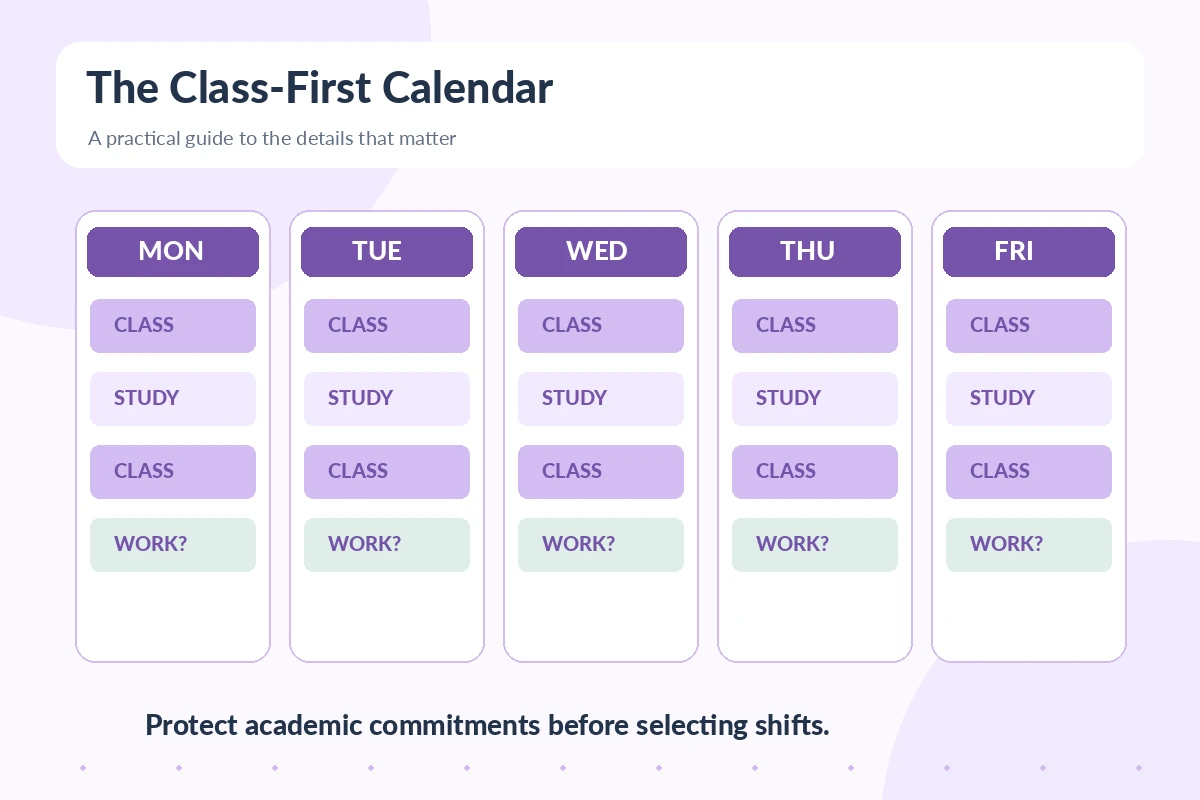
Put lectures, required labs, exam blocks, and travel between campuses on one weekly grid. Add the study periods and basic personal commitments that must be protected to keep coursework manageable. What remains is your genuine employment availability. A student with a two-hour gap between classes may have little practical time for an off-campus shift once commuting is counted.
Show your grid to yourself before you start searching. Distinguish predictable weekly windows from occasional availability after an exam. If your timetable changes next term, add the date you will need to revisit your work hours. You can be interested in additional shifts without promising that your schedule will always allow them.
Know What Federal Work-Study Actually Means
Federal Student Aid explains that students need to complete the FAFSA to be considered for Federal Work-Study, and that a school’s financial aid offer indicates eligibility. It also says that many students must search, apply, and interview for work-study jobs rather than being assigned one automatically. Contact your financial aid office if you are unsure whether your aid package includes this program.
Federal Student Aid describes Work-Study as part-time employment that helps eligible students earn money for education-related costs. Work-study jobs may be on or off campus, depending on arrangements; not every campus role uses Work-Study funding. Ask how the school classifies the opening and whether your award and the job’s anticipated hours are compatible.
Compare Campus and Off-Campus Options
Campus libraries, departments, administrative offices, academic support units, and recreation facilities may have student openings, depending on the institution. A campus job may reduce travel time, but a convenient location does not guarantee a flexible schedule. Search your institution’s verified student employment portal and read the eligibility, hours, training, and term-length requirements for each posting.
Off-campus roles such as service, retail, tutoring, or local office support may offer different hours or skill development. Compare commute, late shifts, weekend expectations, and the likelihood of conflicts during exams. If you have access restrictions or school-specific employment conditions, obtain guidance from the appropriate school office rather than relying on a generalized online claim.

Translate Coursework Into Verifiable Experience
Choose evidence from classes, group projects, volunteer activities, student organizations, or prior jobs that directly matches the posting. A team assignment can support a statement about meeting deadlines or organizing information if you describe exactly what you did. A lab report may demonstrate documentation and care with details. Avoid turning class attendance into an invented leadership accomplishment.
For a hypothetical library-assistant application, a truthful statement might be “Organized shared course research files and checked citations for a group project.” Use it only if you performed those tasks. An application should state your real schedule and the skills you can show, rather than generic claims that you are hardworking and available at all times.
Avoid Overloading the Week
Review proposed shifts against academic deadlines, not just recurring class hours. Work that appears manageable during a quiet week may conflict with midterms, practicum hours, or a required evening session. Ask how far ahead schedules are published and whether the employer can consider known exam dates. Do not assume that a particular employer will automatically give students time off. Our guide “Online Job Applications for Students” shows how to match class hours and relevant evidence.
Think in terms of usable study blocks. If a role fragments every afternoon into short shifts, a slightly different schedule with fewer commutes may work better for concentrated coursework. The best choice depends on your actual obligations, how you travel, and the nature of the tasks—not a universal number of hours suitable for all students.

Search and Confirm Legitimate Openings
Begin with the college’s official student jobs page and financial aid office, then add independent employers you can verify. Save the exact official posting link and the contact instructions. Ask whether the listing requires Work-Study eligibility, what identification the school needs after hiring, and whether a supervisor can confirm the schedule. Do not confuse a job board’s label with your financial aid office’s determination.
The FTC warns that job scammers copy employer identities and advertise openings that do not exist. Check organizations through independent websites and never pay to obtain a job. Campus-related offers and unexpected social messages deserve the same verification as any other recruitment contact.
Use a Two-Term Application Tracker
Track the department or company, employment type, eligibility requirement, weekly hours, start date, training schedule, and whom to contact. Add the last week of the semester and any known date when your availability changes. A job described as “school-year employment” may have different expectations from a role that runs through summer break; the employer must confirm those details.
Before you accept, reconcile the position with your latest class schedule and financial aid information. A hypothetical final email could say, “I can work Tuesdays after 2 p.m. and Thursday mornings this term; could you confirm whether those hours meet the position’s needs?” This is more useful than promising “flexible availability” while hoping the schedule will work.
How We Research These Job Search Decisions
This guidance compares publicly available professional and government descriptions of job duties and employment arrangements, including Federal Student Aid, Federal Student Aid, Federal Trade Commission. Occupational descriptions provide context, not proof that a particular employer has an opening or that an individual applicant will be hired. Examples and scripts are hypothetical.
This is an independent informational guide, not an employment placement service. No paid partnership or employer referral is asserted. Read our affiliate disclosure for how site relationships are described.
Related Job Search Guides
- Weekend-Only Part-Time Jobs: Find Shifts That Fit Your Schedule
- Seasonal Part-Time Jobs: Verify the Work Period and Weekly Hours
- Flexible Part-Time Jobs: Compare Fixed, Rotating, and On-Call Hours
- Evening Part-Time Jobs: Compare Shift Times, Transit, and Closing Duties
- Early Morning Part-Time Jobs: Compare Opening Shifts and Travel
No. An award indicates eligibility for an aid program, not an automatic placement; many students must apply and interview for an actual opening.
Often there are ordinary off-campus jobs, but eligibility and any personal circumstances must be checked with the relevant employer or school office.
No. Campus employers may have both Work-Study and regular student employment roles. Verify the funding/eligibility label for each vacancy.
Give the regular weekly windows first and describe known exam conflicts before accepting a schedule. Ask the employer about its scheduling practices.
Start with your college’s official student employment platform and financial aid office rather than assuming every social-media job post is legitimate.