
Quick answer. Choose a real work-related disagreement, not a personal attack. Name the shared goal, explain the different approaches without blaming the coworker, describe what you did to clarify or resolve the issue, and state the outcome you actually observed. A useful answer demonstrates respectful judgment, not that you won every argument. This is interview preparation, not an employer-approved script or a promised hiring result.
Choose A Work Disagreement You Can Explain
A workable conflict example has a concrete question at its center: who owns a handoff, which deadline applies, how to divide a task, or how to interpret an instruction. A disagreement does not have to include shouting or personal hostility. In fact, choosing a routine difference in approach can help you explain your judgment more precisely. Avoid making a colleague into a villain or revealing private personnel details to make yourself look better.
Select a moment when you had an identifiable part in the outcome. If a supervisor made the final decision, your contribution may have been presenting options, listening to both sides, or documenting the agreed next step. This is different from claiming that you personally resolved every difficulty. Compare two possible stories: one in which a coworker was allegedly always difficult, and one in which you and a coworker had different ideas about priority. The second offers actions the interviewer can reasonably explore.
University career guidance on behavioral questions recommends concrete past examples with an action and an outcome. Your story should therefore be about an actual event and your response, not just a statement that you get along with everyone. If you have little paid experience, a real disagreement during a student, volunteer or community project can be usable when you label the setting accurately.
Separate The Issue From Personal Judgment
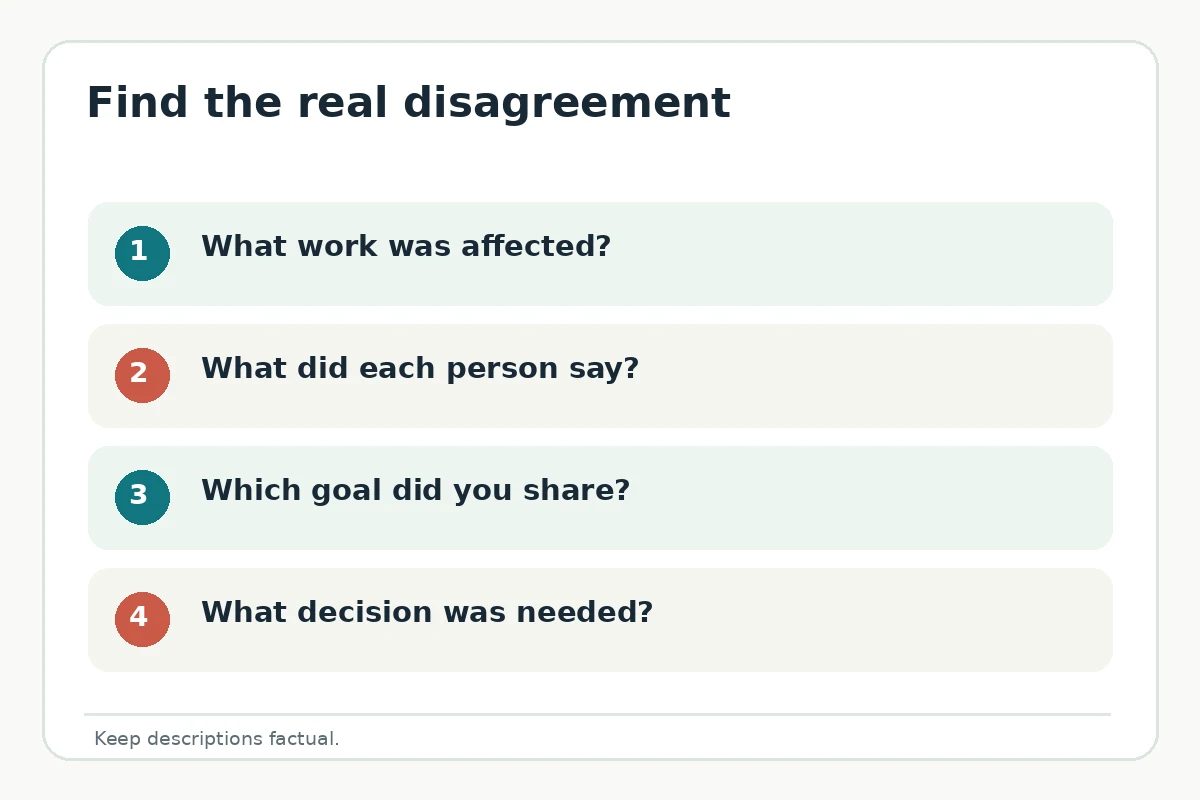
Draw four small boxes before rehearsing: the common task, your view, the other person’s stated concern, and the decision that needed to be made. Use only what the other person actually said or did; do not assume you know their motives. This keeps the problem specific enough to discuss and protects against exaggerating interpersonal drama. It also reveals whether your story was a disagreement about process, priorities, evidence or authority.
In your spoken answer, use neutral language: “We had different assumptions about which request was due first” gives more useful context than “My coworker did not care about deadlines.” Explain how you checked those assumptions. Did you ask a clarifying question, compare the instructions, seek agreement on acceptance criteria, or take the issue to an authorized lead? Mention the step that was real rather than reciting a perfect conflict-management script. For the fuller picture, see our guide “Tell Me About a Time You Made a Mistake”.
A constructive ending does not require everyone to become friends. A documented handoff, a workable compromise, an agreed escalation or a better understanding of the constraint can be sufficient. If the parties remained divided, acknowledge that and explain how work continued appropriately. Never suggest that you should privately override safety requirements or approved policy to maintain peace.
Study Two Clearly Hypothetical Answer Examples
Hypothetical example — office coordination: “In a shared project, a colleague and I interpreted the update schedule differently. I thought the notes needed to be ready for the morning meeting; they understood the deadline to be the end of the day. I checked the request, explained which teammates were waiting, and proposed a shorter morning update with details added later. We agreed to confirm deadlines in the project log.” This is an invented teaching scenario, not a real applicant or reported employer outcome.
Hypothetical example — student team: “A classmate and I disagreed about whether to start designing slides before finishing the research. I asked what each of us was concerned about and suggested we make an outline first, so we could test the structure while the sources were still being checked. The group adopted that sequence for our assignment.” Use a story like this only if an equivalent event truly occurred in your own life.
Notice the small but important evidence in both illustrations: an identifiable difference, a listening or checking step, a feasible proposal and a bounded result. Neither narrator claims to have changed the coworker’s personality. An outcome such as “we agreed on next steps” is acceptable only if there really was agreement. If you instead asked a supervisor to decide, describe that accurately.

Handle Unresolved Or Higher-Stakes Conflicts Honestly
If your disagreement involved discrimination, harassment, threats, safety, confidential information or other high-stakes concerns, a tidy compromise story may be inappropriate. You can say that you followed relevant reporting or escalation procedures, if that is what actually happened. Do not provide unverified legal interpretations or imply every workplace handles these concerns in the same way. Select a different, less sensitive example when possible.
If your attempt failed, the interview answer can still show responsibility: you asked for clarification, documented your part, sought help within your authority, and learned how to surface disagreements earlier. Do not relabel a loss as a mutual win. Acknowledging limits often makes a response easier to defend when the interviewer asks what you would do differently. Our difficult customer interview answer guide goes into more detail.
Avoid phrases such as “I always avoid conflict,” “everyone eventually agreed I was right,” or “my manager said I am the best mediator.” These either obscure the event or assert a compliment you may be unable to substantiate. Focus on observable steps: what you said, what you checked, how you adjusted and which decision was reached.
| Part of the story | Better evidence | Avoid |
|---|---|---|
| Work issue | Different deadline interpretations | A personal insult |
| Your action | Asked and checked requirements | Claimed you changed a personality |
| Decision authority | Named who approved next steps | Pretended approval was yours |
| Outcome | Recorded agreement or limit | Invented reconciliation |
Rehearse Your Own Role And Follow-Up Details
Try three follow-up prompts: “What exactly were you disagreeing about?”, “What did you change in your own approach?” and “What was the final decision?” If you cannot answer them without guessing at another person’s feelings, rewrite your story around facts you directly observed. One short sentence about the setting is usually enough; reserve most of your answer for the interaction and decision.
As a final role check, underline every “we” and “I.” “We agreed” names a shared outcome; “I proposed the sequence” identifies your specific action. Keeping both accurate prevents self-credit from swallowing teammates’ contributions. Tie the skill to the prospective job only after the factual account is clear. A neutral story that explains fair communication is more useful than a dramatic anecdote designed to impress. Our teamwork interview answer guide goes into more detail.

Make The Answer Accurate Before You Rehearse
Read each sentence as though an interviewer will ask, “How do you know?” Remove claims about another person’s thoughts, unverified numbers, undocumented manager praise and outcomes you never observed. Distinguish what you did from what the group or a supervisor did. If the story includes customers, coworkers or internal records, omit identifying details and follow applicable confidentiality rules. A modest but verifiable account is more useful than a dramatic invented one.
Use the open job description to decide which part of the experience to emphasize. Then practice the actual sequence aloud, without trying to memorize every word. If you do not have a genuine situation for the exact question, consider a relevant school, volunteering or project example and label it honestly. Do not describe a hypothetical illustration on this page as a personal achievement; every example here is made up for teaching. Our leadership interview example guide goes into more detail.
How We Research Interview Guidance
The issue-action-outcome worksheet is original JobAsk teaching material, not an employer scoring rubric.
Reviewed Sources And Disclosure Details
Public sources reviewed October 20, 2026: UCSF Career Development — UCSF describes behavioral answers to disagreements as opportunities to explain communication and actions.; University of Houston Career Center — University of Houston hosts a coworker conflict question guide prioritizing a work-focused example and an appropriate resolution.; University of Michigan Career Center — University of Michigan recommends reflecting on genuine experiences, connecting them to a role and rehearsing without memorizing.. These sources support specific job duties or interview-preparation methods; JobAsk worksheets are original editorial tools, not employer scoring systems.
No paid referral, confirmed affiliate partnership, or employment outcome is claimed in this article. No affiliate products or services are recommended here. See JobAsk’s affiliate disclosure for the site-wide policy.
More Interview Preparation Guides
- Tell Me About Critical Feedback: An Interview Answer With Proof
- Went Above and Beyond Interview Answer: Show Extra Value Without Overclaiming
- Greatest Achievement Interview Answer: Choose a Story You Can Prove
- Work Under Pressure Interview Answer: Show Calm, Safe Choices
- Difficult Stakeholder Interview Answer: Clarify Needs and Document Trade-Offs
Use a truthful disagreement about work methods, timing or responsibilities. A calm difference in approach can be enough to show how you respond.
You can when it fits the question, but explain the hierarchy and your actual authority. Do not claim you reversed a decision unless that happened.
Describe the relevant facts and tradeoffs. Assigning motives or attacking character makes it harder to show your own decision-making.
State the actual decision, escalation or unresolved status and what you learned. Do not fabricate a harmonious ending.
Yes, if it is genuine and you identify it as an academic rather than professional setting. Explain the transferable communication skill.