
Helpful coworker performance feedback describes work you directly observed, its effect on shared tasks, and a realistic suggestion if change is needed. It does not diagnose a person’s attitude, assign a rating outside your authority, or repeat rumors. If your employer asks for a peer review, your job is to contribute credible observations to its process—not to decide your colleague’s promotion, pay, or disciplinary outcome.
The examples below are hypothetical sentence models, not statements about real coworkers. They apply best to projects where you worked closely enough to know what happened. If you have not observed a relevant behavior, say your evidence is limited rather than filling a form with invented praise or criticism.
Confirm the Question and Your Observation Window
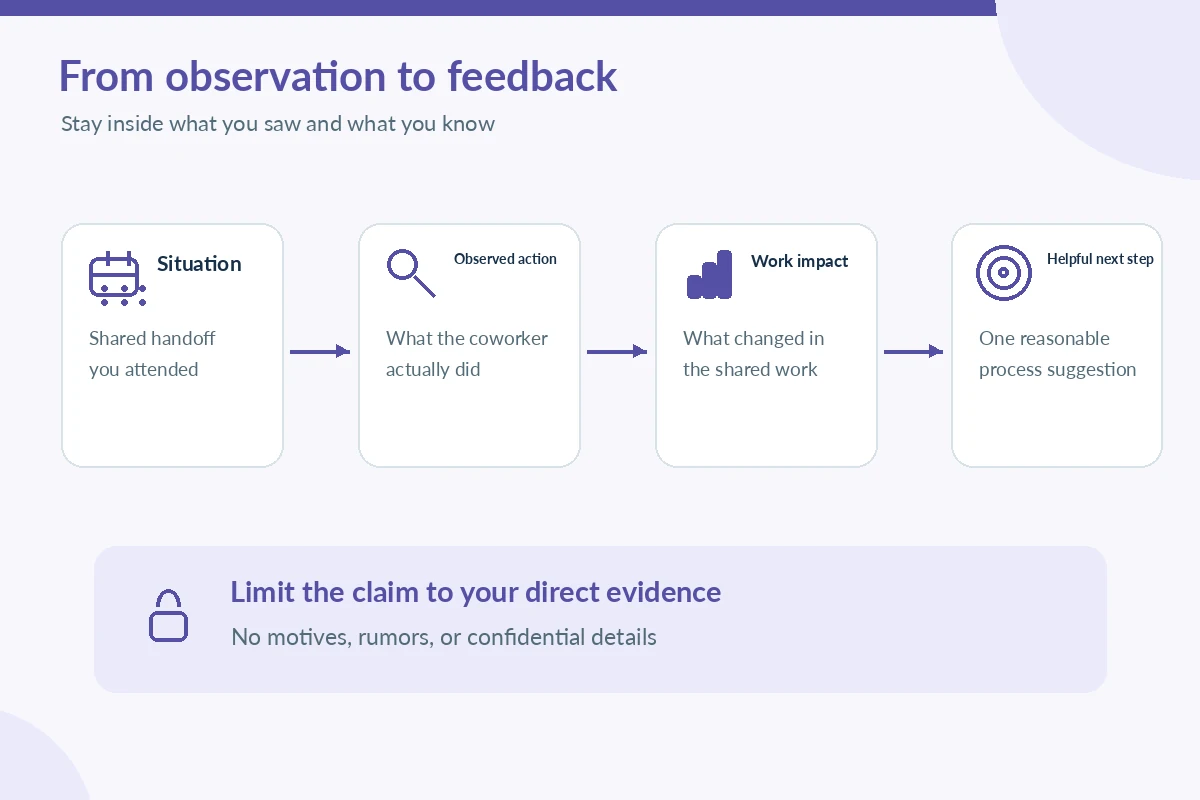
Start by checking whether the form asks about collaboration, work quality, communication, or another defined competency. Then ask how you know the answer. Did you review the deliverable, attend the handoff, or jointly resolve an issue? Your direct observations may cover one project rather than the whole year. Limit your comment accordingly: “During our March inventory handoff” is more precise than “always reliable.”
If a supervisor requests input about an unfamiliar colleague, you may be able to say that you cannot provide a meaningful assessment. Avoid relying on a team chat rumor or interpreting a coworker’s private reason for an absence. You can describe a handoff delay without speculating about the person’s health, motivation, or schedule permissions.
Build Each Comment From Action and Impact
Use four pieces: shared situation, observed action, work impact, and optional next step. For example, “During the product-launch review, Sam flagged an inconsistent version number before the handoff, allowing the team to confirm the correct file.” If you do not know whether an action prevented a measurable loss, do not claim one. You can identify a practical benefit without inventing dollars or percentages.
The OPM monitoring and development guidance supports actionable feedback that recognizes behavior and outcomes. A peer should adapt that general principle to their narrower knowledge and authority. Focus on the part of the workflow you shared, not a universal judgment of the colleague’s career potential.
Write Specific Positive Feedback Without Flattery
Hypothetical positive example: “When we switched the delivery order for the client deck, Avery updated the shared checklist and confirmed that each contributor had the revised sequence. I could complete my review against the current version.” This explains both what the coworker did and why it mattered to your shared work. It is stronger than “Avery is amazing and always saves the team.”
Positive comments can mention careful documentation, clear requests for input, knowledge sharing, or respectful escalation. Do not award credit for results a whole team produced unless you can identify the coworker’s contribution. If their behavior helped you, explain how; if you do not know the final business outcome, stop at the observed handoff.
Give Constructive Feedback Without Personal Labels
Hypothetical improvement example: “On two shared draft reviews, the final changes arrived after the agreed review window, which limited the time available for cross-checking. It would help to confirm a revised deadline as soon as the scope changes.” This points to a specific coordination issue and a possible process improvement. It does not call the coworker lazy, careless, or unreliable.
Be careful about attribution. Perhaps the deadline moved or another approval was delayed. Verify the sequence before writing the comment. If several teams shared responsibility for a missed handoff, name the actual interfaces rather than singling out one person. Constructive feedback is not a substitute for a safety or harassment reporting process; use the employer’s appropriate channel for urgent concerns.

Decide What Not to Put in a Peer Review
Leave out medical information, family circumstances, salary details, unverified personal claims, private messages that are not yours to disclose, and complaints unrelated to the competency being reviewed. A peer review form is not a venue for comparing friendships or assigning motives. Where confidentiality applies, follow the employer’s rules about handling customer names and internal projects.
Do not promise a colleague anonymity if you do not know how the review system handles identifying information. Ask HR or the review coordinator how comments are used if the form is unclear. The MIT HR review process includes multi-rater input, but that does not mean every workplace uses identical privacy or disclosure rules.
Use a Quick Evidence Gate Before Submitting
For each sentence, ask: Did I see it myself? Is the time frame fair? Does it describe work rather than personality? Does the impact follow from what I observed? Is a suggested change under the colleague’s influence? If the answer is no, narrow or remove the claim. One reliable example is more valuable than ten repeated adjectives.
You may choose two strengths and one practical development suggestion if that is supported by the evidence and the form asks for both. If you know only a positive collaboration, do not manufacture a negative item for balance. Conversely, avoid vague positivity when a material shared-work issue needs clear documentation.

Handle Disagreement and Follow-Up Professionally
If the colleague later asks about the feedback, honor your organization’s review process. You can discuss shared workflow facts in an appropriate setting, but you should not claim to know the official overall rating or reveal other reviewers’ comments. If you realize that a submitted fact was wrong, contact the review coordinator through the prescribed correction route.
The OPM supervisor roadmap recommends evidence-based documentation and consistent criteria. Peers can support that by staying within their firsthand knowledge. Feedback is more defensible when a future reader can understand what happened without adopting the writer’s assumptions.
Compare Three Peer-Feedback Scenarios
For a handoff, describe how the coworker shared the current file and whether that helped or delayed review. For a joint analysis task, identify the evidence the colleague checked and what you saw them correct. For a meeting, describe a clarifying question or follow-up note rather than judging who seemed confident. These settings call for different comments even when the form uses the same collaboration competency.
In each case, ask whether you saw the result or are interpreting it from someone else’s report. A peer may know that the correct file was sent but not whether the client accepted it. A credible review can be narrow. If the example suggests a process issue outside the coworker’s control, recommend a clearer team agreement instead of a personal label.
How We Research Peer Feedback
We compared MIT HR guidance on multi-rater input, OPM on actionable workplace feedback, and OPM on evidence and consistent criteria. These sources do not establish a universal rule for anonymity or review scoring.
All named situations here are hypothetical. Review your own employer’s policy, and see the JobAsk affiliate disclosure for relationship transparency.
Explore Related Career Guides
- 360 Peer Feedback Examples: Useful Observations Without Anonymous Guesswork
- Annual Performance Review Questions: Ask About Evidence and Priorities
- 90-Day Employee Performance Review: A Manager’s Evidence-Based Check-In
- Job Knowledge Performance Review Comments: Skills and Evidence
- Feedback About Your Manager: Honest Examples and Safer Wording
Say the evidence is limited; do not construct a full performance judgment from one interaction.
Yes, if you directly know the deadline, relevant context, and shared-work effect. Avoid guessing why the delay occurred.
No. Provide a constructive suggestion only when a real, relevant observation supports it.
That depends on the employer’s actual review system. Do not assume anonymity without checking.
Do not imply that your peer comment determines a rating. Follow the employer’s communication and confidentiality process.