
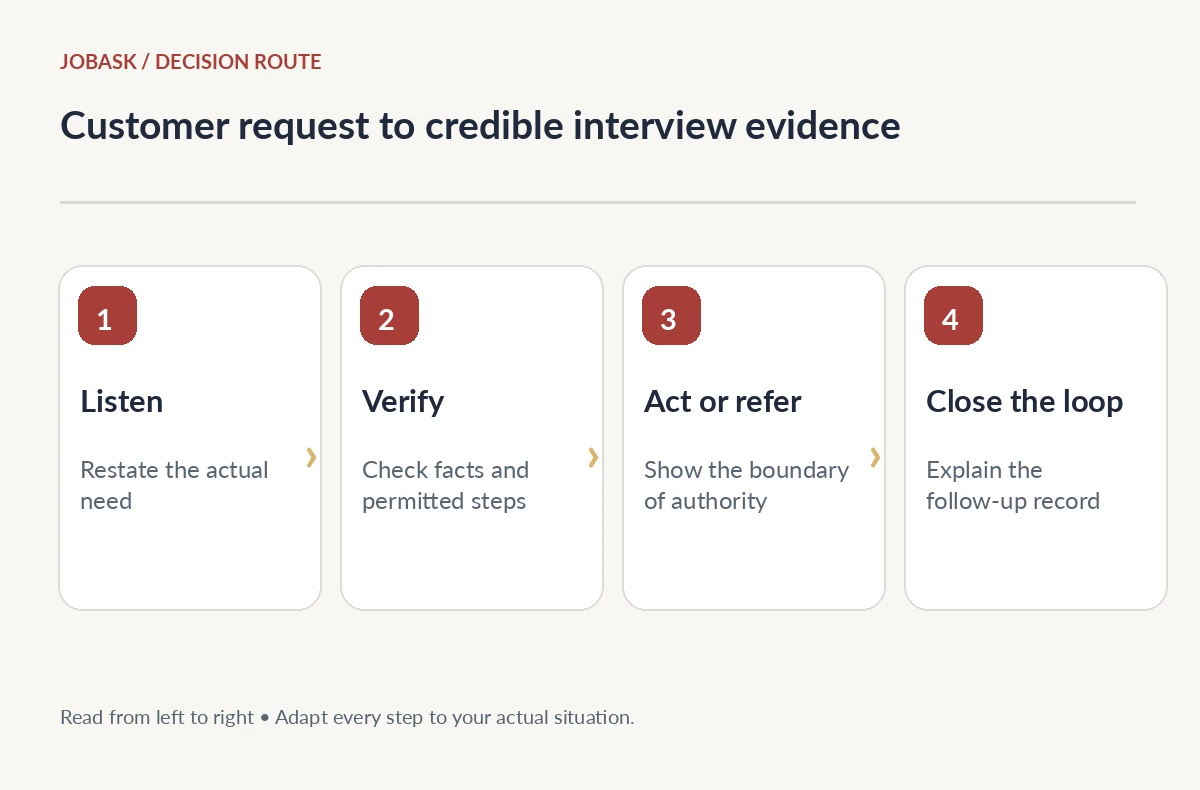
Questions about customer-service scenarios become easier when you prepare evidence of how you listen, verify a request, stay within your authority and close the loop. The interviewer might ask about an upset customer, several messages arriving at once or a mistake you corrected. There is no secret employer-approved script and no single response guarantees an offer. The Bureau of Labor Statistics describes responding to questions, recording contacts and referring cases as typical work, although duties vary by organization. Use the answer worksheet below with events you can personally verify. Every name and situation in the illustrations is hypothetical.
Decode what a service question tests
A prompt such as “Tell me about an unhappy customer” is not just a request for a friendly-sounding story. The interviewer may want to learn whether you listened, identified the actual problem, explained what you could do and escalated appropriately. Separate the question into four possible signals: empathy, accuracy, ownership and limits. Prepare a short factual example that shows your personal action. If the job involves chat rather than phone work, explain how you check the meaning of an unclear written request instead of presuming the same workflow applies everywhere.
Another common prompt is “How do you handle a question you cannot answer?” A credible answer does not claim instant expertise. It explains how you verify the available policy or product facts, what you say to the customer while checking, and when you refer the issue to someone authorized. BLS includes referral to supervisors or experienced employees among typical duties. You can demonstrate good judgment even if your actual experience comes from volunteering, retail, a student organization or a course service project; disclose the setting accurately rather than relabeling it paid customer support.
Prepare an upset customer example
A useful response describes a specific issue without revealing private customer information. State what the person needed, which part you controlled and what you did next. Hypothetical example: “In a campus event team, a guest reported that the posted room number was wrong. I confirmed the reservation, guided the guest to the correct location and told the coordinator to correct our notice.” This illustrates verification, action and communication. It is not evidence of a real event and should never be copied unless your actual record supports it.
If you have never handled a complaint directly, say so and choose a comparable situation where someone was confused or disappointed. You can explain the process you would follow for a hypothetical scenario, but label future intentions rather than presenting them as past achievements. A weak answer blames the customer; a stronger answer sets boundaries politely and concentrates on the solvable part. Rehearse your example aloud, then remove invented numbers, impossible timing and promises you were not empowered to make.
Practice prioritization without rushing customers
“How would you handle three customer requests at the same time?” tests clarity, not just speed. Explain that you would assess urgent harm or service interruption first, follow the employer’s stated priority rules, acknowledge outstanding requests and track ownership. Do not claim there is a universal response-time target. In a real interview, ask whether the team uses ticket categories, queues or a supervisor escalation path. That question demonstrates attention to local procedures instead of assuming tools or standards you have never used.
Try a hypothetical role play: one person has a billing question, another needs accessibility assistance, and a third wants an order update. You would first identify any urgent need, check your authority and tell each person what will happen next. Different organizations may require different handling; this is a reasoning exercise, not an instruction for a regulated account. Good practice includes a recap: whom you told, what you recorded, and how the next person could continue without making the customer repeat sensitive details.

Turn ordinary experience into proof
An applicant without a customer service title may still have useful communication evidence. Think about assisting visitors at a school event, answering common questions for a club, explaining a process to a classmate or taking a structured message at a community organization. Select one story for careful listening, one for resolving confusion and one for a handoff. For each, write the request, your actual action, the observable outcome and the part you cannot verify. Leave gaps visible until you can check them. Our guide “Tell Me About Yourself for Customer Service” goes deeper into a calm, evidence-based answer.
Avoid saying “I am a people person” as your only evidence. A clear account of how you repeated a request back, checked available instructions and followed up is more informative. Conversely, a dramatic confrontation story may distract from the role if you omit what you learned or imply you violated policy. UC Davis’s interview guide recommends examples of concrete actions and outcomes. Use its guidance to test whether each answer explains your contribution, not only the team’s achievements.
Compare answers with job duties
Read the specific job description before rehearsing. A retail desk may emphasize returns and product information; a call center may emphasize records and escalation; an online support role may emphasize written clarity. The BLS profile identifies a range of channels and tasks, not one universal customer-service job. Pick two duties that actually appear in the posting, then connect each to a true example you could discuss comfortably if asked a follow-up question.
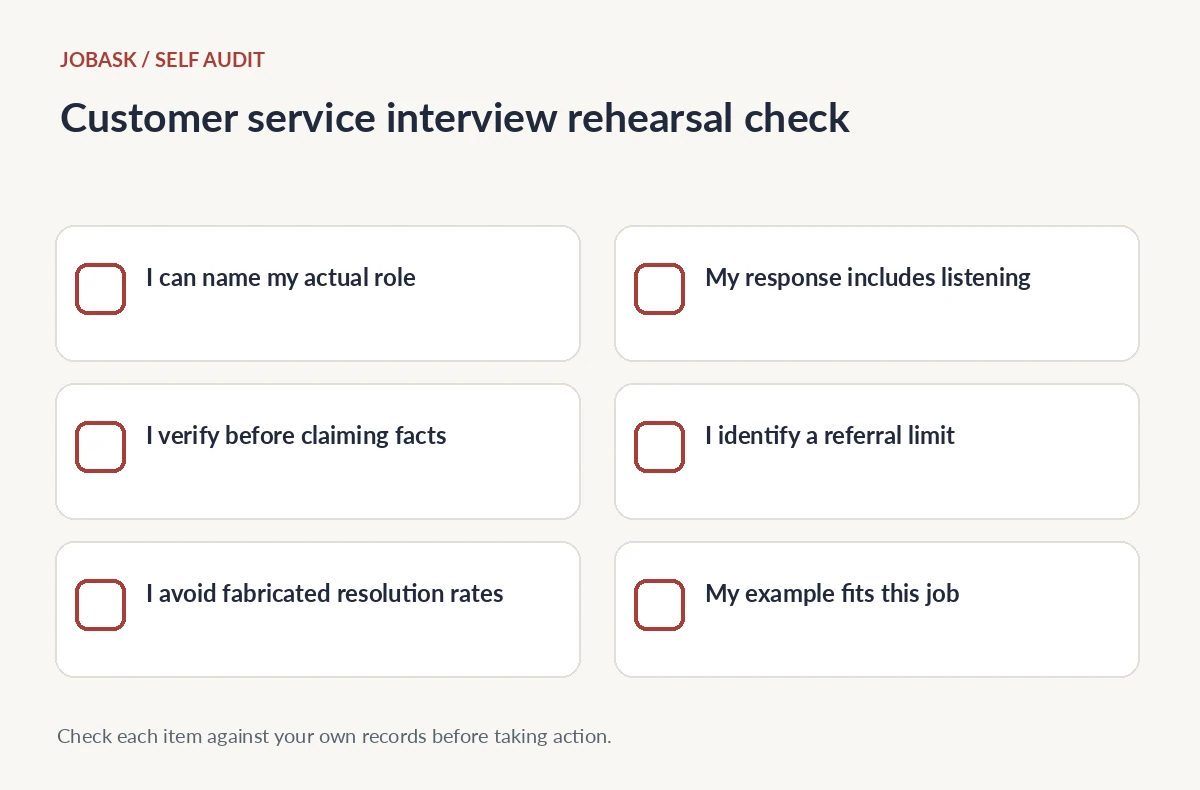
Keep a two-column practice sheet: “role duty” and “what I did.” In a third column record what you would need training to perform. This honest limitation can become a useful learning statement: “I have experience documenting requests, but I would need to learn your case-management system.” Never invent credentials, software use or permission to change customer records. The aim is credible role fit, not perfect-sounding answers to every imagined question.
Rehearse a short question set
Practice explaining a complaint, a time you handled an unfamiliar issue, a careful handoff, a mistaken assumption and a moment when priorities competed. Answer one question at a time, ideally with a friend who asks “What did you personally do?” and “What would you change?” These follow-ups expose vague claims early. If you have no paid examples, use verified coursework or service examples and keep the distinction between past action and hypothetical plan visible.
Finish by preparing questions for the employer: how the team defines successful resolution, what documentation is expected and when staff should escalate. These are diagnostic questions, not evidence that the organization uses any particular tool. After a practice round, mark sentences that contain unproven outcomes or generic praise and rewrite them as actions. This small audit makes your delivery both more believable and easier to adapt to the actual job.
| Situation | Practical next step | Important limit |
|---|---|---|
| Upset customer | Explain listening, verification and authorized next step | Never expose private details |
| Unknown answer | Check source of truth and escalation route | Do not promise unapproved outcomes |
| Simultaneous requests | Prioritize using actual policies; acknowledge the queue | No universal response-time rule |
| No paid experience | Use a clearly labeled school or volunteer example | Do not claim invented customers |
How We Research and What Remains Unverified
We mapped the BLS duties to specific behavioral prompts, cross-checked the answer method against UC Davis and St Thomas, and excluded scripts claiming guaranteed success. The original JobAsk contribution is the listening-to-escalation matrix; the hypothetical conversations were authored for illustration, not drawn from employer interviews. Public topical search results and the listed source pages were reviewed on October 19, 2026.
Sources reviewed October 19, 2026: Source 1 — BLS specifies listening, handling complaints, keeping contact records and escalating issues among representative duties. UC Davis recommends practicing distinct real examples that demonstrate problem solving, communication and initiative. University of St Thomas includes evidence-based behavioral questions and encourages practice rather than memorization.
Affiliate disclosure for customer service interview questions: the resources linked in this guide are editorial sources, not verified paid endorsements or approved JobAsk partnerships. This guide contains no affiliate links. Read the JobAsk affiliate disclosure before considering a commercial service. Verify current conditions with the organization itself.
Related Guides
- Questions to Ask in a Customer Service Interview: Escalation, Quality, and Coaching
- Bank Teller Interview Questions About Accuracy and Customer Service
- Customer Service Representative Cover Letter: Resolution Examples
- Customer Service Self-Evaluation Examples: From Request to Follow-Up
- Customer Service Skills for a Resume: Show What Happened After the Request
Use a real example from school, volunteering or another setting where you clarified a request and followed through. State the setting and your responsibility accurately.
Rehearse an evidence structure, not exact lines. Interviews use follow-up questions and memorized answers can hide missing details.
Explain listening, fact checking, any step within your authority, appropriate escalation and how you communicated the next step.
Yes, when authority or accurate information is missing. Explain what you would check and what you would tell the customer during the handoff.
A small set covering complaint handling, prioritization and an unfamiliar question can be adapted, provided each example is true and relevant.