
Customer service resume keywords should explain the work behind phrases such as “customer inquiries,” “case documentation,” “CRM,” and “escalation.” Look at the actual role: a phone queue, support inbox, service desk, and live chat team can share goals while using different procedures. Choose the channel, customer issue, and resolution or handoff you really handled. Avoid invented satisfaction scores, refund authority, or promises that a certain wording will satisfy an applicant tracking system. The useful test is whether each phrase would still be accurate if a supervisor read it aloud.
Distinguish service channels before borrowing phrases
A listing may mention omnichannel service, email support, inbound calls, live chat, and ticketing. These words are not interchangeable. If your work was reception calls, do not rewrite it as live chat support. If you answered email inquiries, include “email customer support” and the types of questions you were permitted to handle. An entry-level application can draw from retail, campus information desks, or organized volunteer inquiries when those settings are labeled clearly. The job description tells you what matters to the employer; it does not create experience that you did not have.
Use case notes as evidence instead of decoration
Support teams often record the issue, action, owner, and next step. O*NET includes keeping customer interaction records among common customer-service activities. An honest hypothetical bullet could read, “Logged customer questions in a shared case tracker, noted the requested follow-up, and routed unresolved items to the service lead.” If you used a real customer relationship management system, you can name the platform. If you only updated a paper form, say “case log” or “intake records.” Never invent Salesforce or a help desk platform because a job description asks for it.
Define escalation instead of writing “resolved complaints”
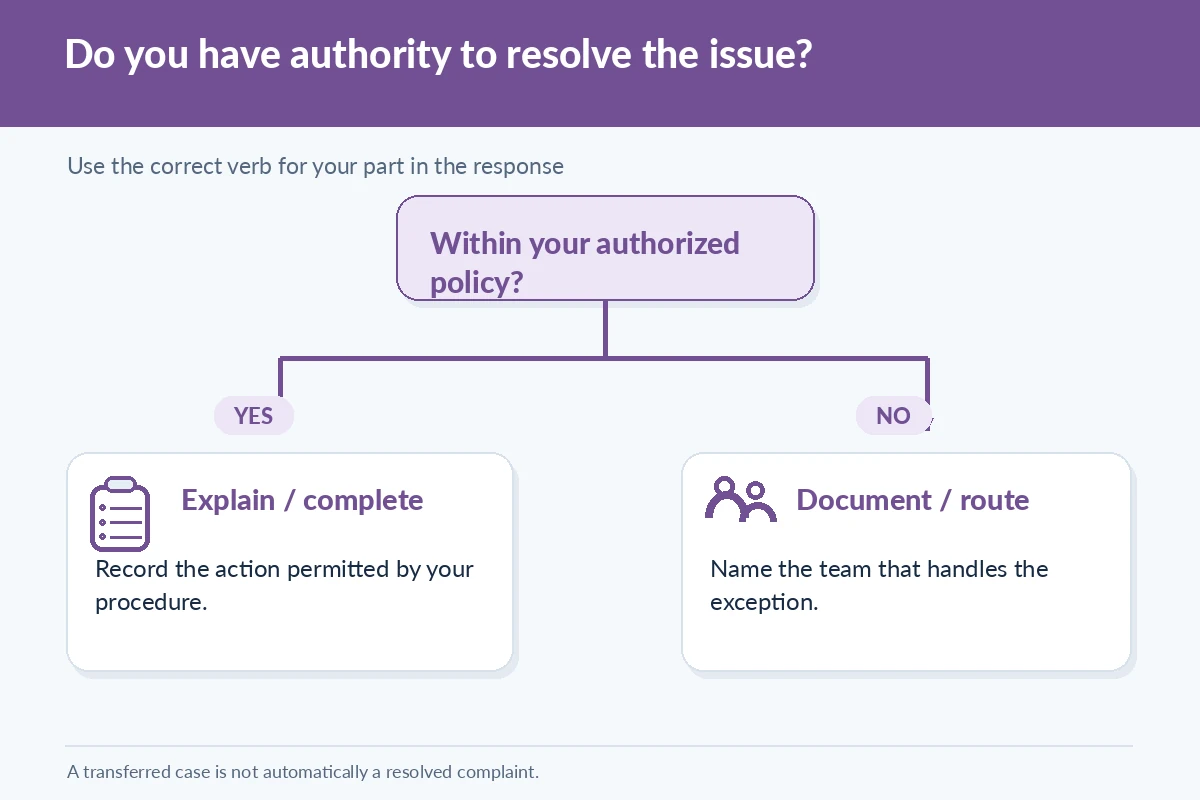
Escalation is a process, not a failure. It can mean identifying a billing exception, recording the facts, and sending the case to an authorized specialist. “Resolved complaints independently” suggests authority and outcome that a trainee or frontline agent may not possess. In a hypothetical reception role, “Documented repeat billing inquiries and passed disputed amounts to the billing team” is both useful and bounded. Explain who could make a refund, policy exception, or account decision. Keep the customer’s personal details out of resume examples and portfolio materials.

Connect service outcomes to verifiable observations
Service postings may value response quality, accuracy, turnaround, and customer experience. If you never measured a rate, do not add one. Instead describe a repeatable behavior: “Verified contact details before passing cases to the correct queue” or “Used approved templates to respond consistently to common questions.” If your employer supplied a documented metric that you are allowed to disclose, state the precise period and your actual contribution. A team-wide performance figure is not automatically an individual result. Quantities matter only when they are real, relevant, and explainable.
| Job posting term | Evidence you could describe | Important limitation |
|---|---|---|
| Inbound inquiries | Handled phone or email requests | Name the real channel |
| CRM updates | Recorded authorized case notes | Name a system only if used |
| Escalation | Sent exceptions to the correct team | Do not claim final approval |
| Customer retention | Discussed approved options | Do not invent save rates |
Compare customer support and selling carefully
Some service jobs include product recommendations or renewals, while others explicitly exclude sales. A resume that says “upselling” for a position where you only explained product features may misrepresent your work. Distinguish information sharing, order status, complaint documentation, retention conversation, and sales closure. Look for words like “refund authorization” or “account adjustments” in the posting: these may describe restricted actions. A former cashier can truthfully say “explained return options under store policy” without claiming they personally approved exceptions.

Match the job description through a case example
Read one posting and underline what you can prove: intake channel, type of request, CRM or queue tool, appropriate response, and escalation boundary. Then write a sentence with those parts. For example, “Answered inbound appointment questions, confirmed permitted scheduling details, and forwarded clinical questions to the authorized staff” is a hypothetical service example with a clear scope. If the posting requests health-care experience, the example alone does not grant it. Preserve the exact setting and keep all competency or licensing claims accurate.
Keep human-readable structure in the final resume
Use recognizable headings such as Work Experience and Skills. Put direct evidence beside the real job or volunteer experience, and keep a short skills list for systems and channels you have genuinely used. Avoid a paragraph packed with CRM, ticketing, Salesforce, customer success, refunds, SLAs, and chat if most of those terms are not yours. A hiring reviewer should find a credible story in a few seconds. The software an employer uses may classify different fields in different ways; no outside checklist can verify a universal parsing outcome.
Check whether your service context really fits the role
A new posting may use customer success language for retention, technical support language for troubleshooting, or frontline service language for standard inquiries. These positions overlap but do not carry identical skill requirements. Look for the actual issue categories and systems named in the employer description. If the posting calls for technical diagnostics and you have only handled appointment changes, do not describe yourself as a technical support specialist. Instead, explain the communication, recordkeeping, and routing skills you have and keep the gap visible. This makes the resume useful for an actual hiring conversation rather than merely matching words in a document.
Prepare for the interview question behind each keyword
If you list “escalation,” expect to explain when you escalated and how you recorded the handoff. If you list “CRM,” explain what you entered and how you checked accuracy. If you list “conflict resolution,” explain what you were authorized to say and what remained unresolved. An authentic, modest example beats a flashy word list. Save the job-specific resume copy so that interview preparation matches what you actually submitted.
How We Research Resume Keywords and Evidence
We compared university career-center recommendations about resume tailoring and ATS readability with O*NET OnLine occupational task descriptions. The occupational task inventory describes possible work, not what any reader personally performed; the hypothetical resume lines demonstrate how to show scope without inventing responsibility. The sources linked below were checked on November 15, 2026. Employers configure application systems differently and descriptions can change, so use the current posting and your actual records before submitting.
Sources consulted: University of Maryland resume guide; Georgetown resume and ATS advice; O*NET Customer Service occupational tasks; University of Florida application tailoring. These references support process advice and occupational context, not ATS acceptance guarantees.
For site partnerships, promotional links, and editorial disclosures, see the JobAsk affiliate disclosure.
More Resume and Cover Letter Guides
Yes when you used a CRM. Name the actual system and work; otherwise use an accurate phrase such as intake log.
Yes when the duties are transferable; keep the retail setting and responsibility level clear.
No. Say you explained the policy or directed the request to an authorized employee.
Describe a verified process, quality check, or handoff; never manufacture a percentage.
State the issue type, what you documented, and to whom you transferred it, without revealing customer information.