
Ask data analyst interview questions that trace a request from a business question to source data, validation, review, and a decision. These details reveal more about the job than a list of tools alone. Your aim is to distinguish an analyst who investigates ambiguous metrics from a reporting role that mainly refreshes predefined dashboards—and to identify the approvals and support available.
“Data analyst” can describe several different environments. A small team may mix data preparation, reporting and stakeholder communication; another may assign those functions to separate specialists. Do not infer access rights, production deployment permissions, or ownership of a metric from the job title alone.
Choose questions that reveal how this job actually works
Before the interview, highlight three unclear responsibilities in the job posting. Decide which interviewer can answer each one: a recruiter can often confirm the process, while a hiring manager or future teammate may explain the day-to-day workflow. Begin with a specific detail you observed and then ask an open question. A yes-or-no question such as “Do you offer training?” usually produces less usable information than asking how training is organized.
Avoid treating every answer as a promise. Clarify whether the speaker describes a usual practice, a written policy, or a plan that has not yet been implemented. If the interviewer already covered one of your prepared questions, acknowledge it and choose another. A short list used thoughtfully is better than reciting a long sequence without listening.
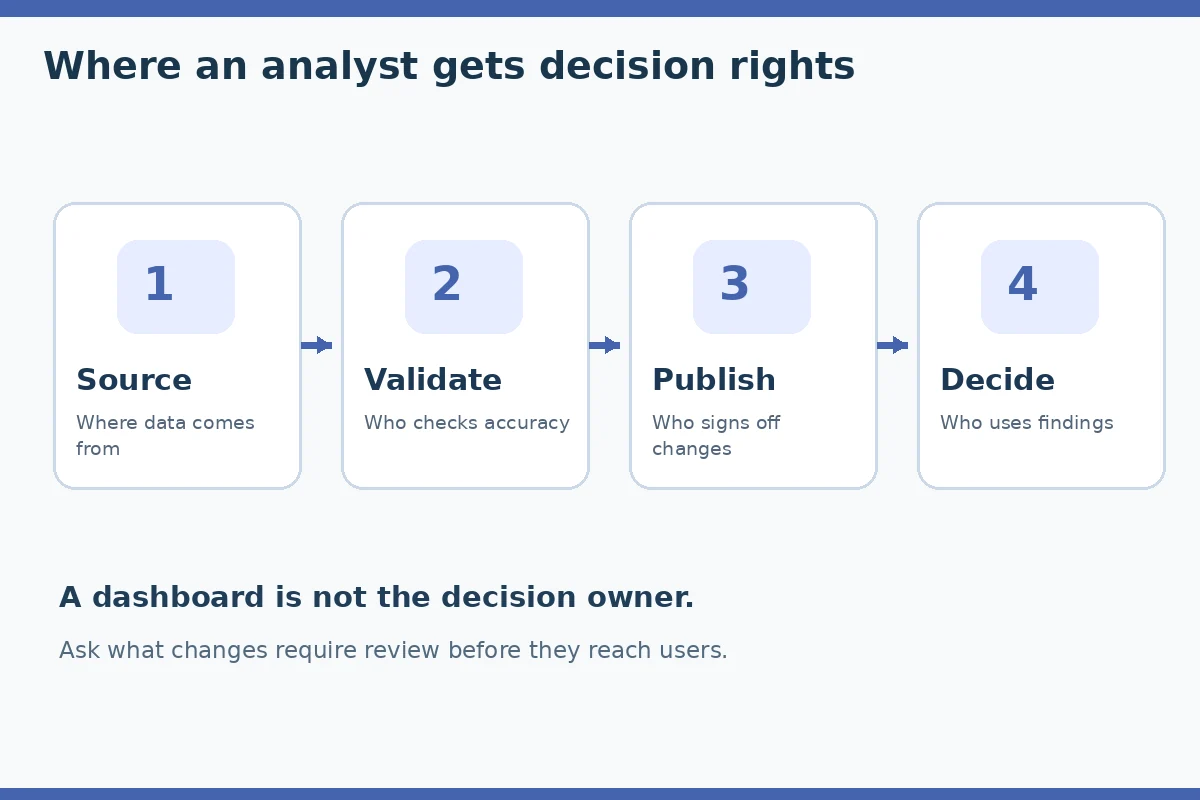
Ask about the work and the support available
Data definitions — Ask: “When two dashboards disagree about the same metric, who decides the definition to use?” This surfaces the source of truth, the role of business owners and the process for documenting definitions. Listen for an accessible glossary or review process rather than an expectation to choose whichever number supports a preferred story. Follow-up: “Where are approved metric definitions recorded, and who signs off changes?”
Validation pathway — Ask: “What checks happen before an analysis or dashboard reaches stakeholders?” Ask for one safe, anonymized example of reconciliation, tests, peer review or stakeholder sign-off. A strong answer identifies the error-handling path and who is responsible for correcting source data versus report logic. Follow-up: “If the raw data is incomplete, who determines whether to delay publication or add a limitation?”
Stakeholder questions — Ask: “How does an analyst turn a broad request into a scoped business question?” This clarifies the discovery process: who defines the decision, what deadline applies, and what evidence is sufficient. A team may value careful clarification more than a rapid chart that answers the wrong question. Follow-up: “Could you describe an example of a request that changed after clarification?”
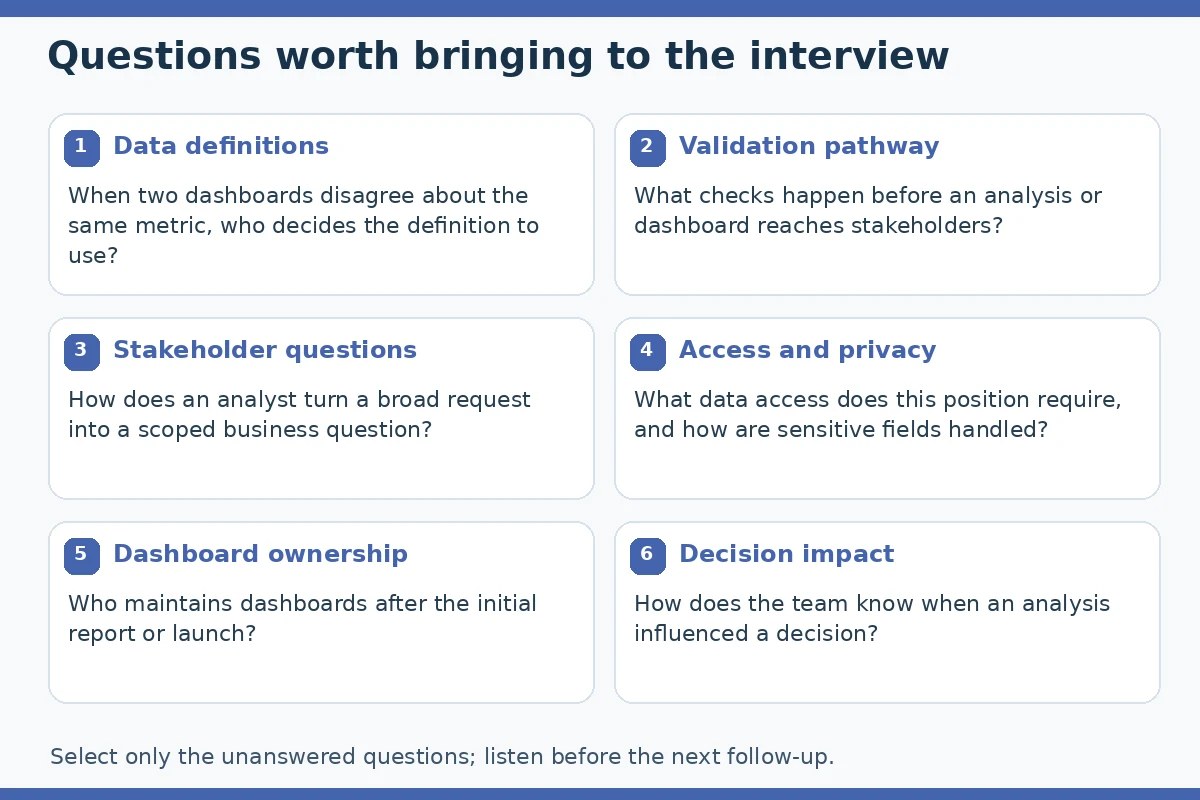
Clarify ownership, boundaries, and evaluation
Access and privacy — Ask: “What data access does this position require, and how are sensitive fields handled?” The goal is to understand controls and onboarding, not to request actual confidential datasets. Ask about approved workspaces, data minimization, security training, and where restricted work is reviewed. Avoid assuming analysts can export raw customer information or share dashboards publicly. Follow-up: “How are permissions changed when the analyst joins a different project?”
Dashboard ownership — Ask: “Who maintains dashboards after the initial report or launch?” A dashboard is an ongoing product if definitions, feeds and requests evolve. Identify whether the analyst owns refreshes, investigates broken data, maintains documentation, or hands off to another team. Follow-up: “How are users notified when a dataset or metric changes?”
Decision impact — Ask: “How does the team know when an analysis influenced a decision?” Ask about traceability rather than a guaranteed percentage improvement. Look for examples where stakeholders documented a decision or explained why findings were not acted on. An analyst can contribute strong evidence without controlling the final business outcome. Follow-up: “What separates a useful analysis from one that is technically correct but unused?”
Read the answers as evidence, not as guarantees
Suppose an interviewer says analysts are responsible for “all the data.” Ask which systems they can query, which metrics they may change, and which changes require engineering or business approval. If a model or chart has no clear owner, ask how the team handles discrepancies. This reveals responsibility boundaries without suggesting you expect unrestricted access.
Look for a description that connects source data, tests, definitions, reviewers and decisions. A team may be early in its documentation journey, which is not automatically disqualifying. The key question is whether it acknowledges gaps and assigns ownership to improve them rather than treating every mismatch as the new analyst’s private problem.
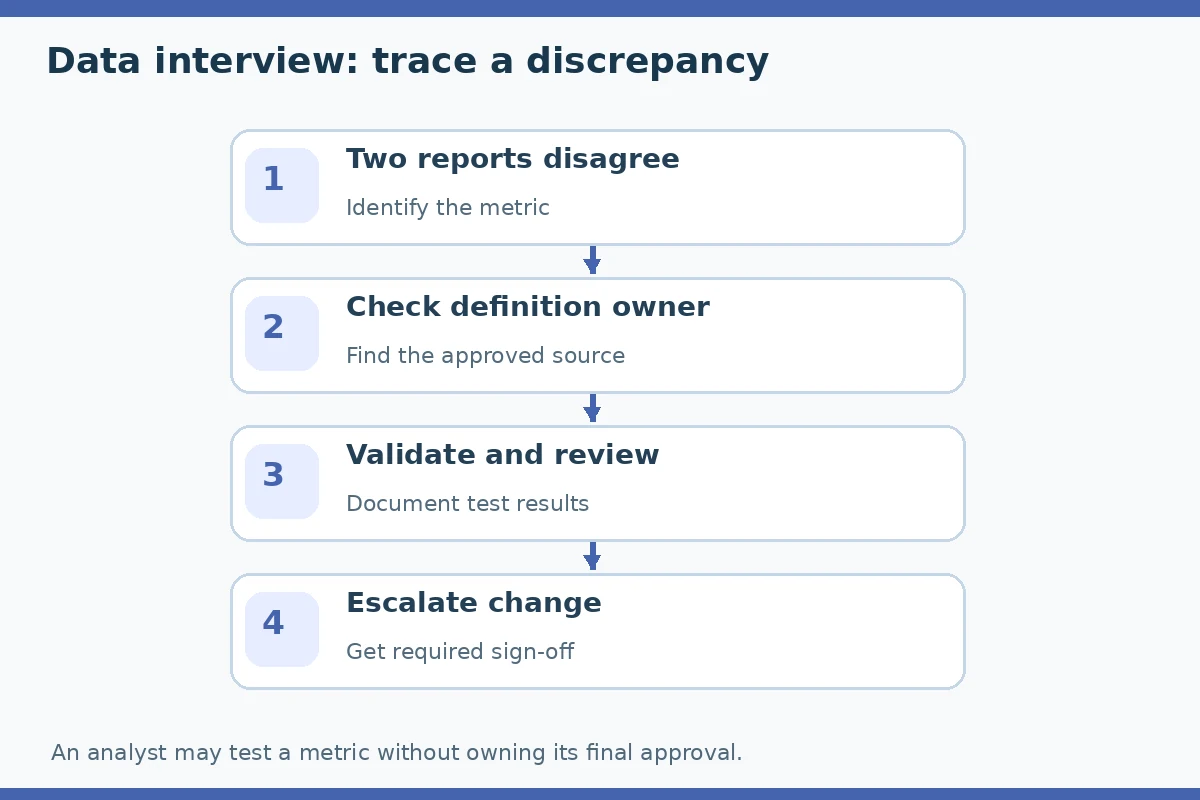
Use a short conversation script and record what remains unknown
A practical opening is: “I noticed this role includes several kinds of work. Could you walk me through how the team handles a conflict between two reporting definitions?” Listen without interrupting, then ask one follow-up tied to the answer. If the question concerns confidential records, individual customers, or students, ask for a general process or an anonymized example. You do not need private cases to evaluate the work environment.
At the end you might say: “Thank you, that helps me understand the role. What are the next steps and the expected hiring timeline?” This asks for procedural clarity without implying that an offer has been made. After the interview, compare your notes with the written posting. Separate confirmed responsibilities from areas that require another conversation, and use that distinction if you are later evaluating an offer.
How We Research Interview Questions
We consulted University of Georgia interview questions, University of Minnesota interview guidance, O*NET: Business Intelligence Analysts, BLS occupational duties on October 30, 2026. The university career services sources provide a basis for asking about role expectations and support. The occupation and safety sources describe relevant duties or constraints; the example questions and interpretation guidance are editorial applications, not quotations from those sources. Employer-specific schedules, permissions and policies must be verified directly.
The questions and example conversation are illustrative, not accounts of actual employers or guaranteed interview outcomes. We do not claim to know an employer’s internal rules, hiring decisions or training program. For website transparency, see our affiliate disclosure.
Related Guides
- Data Analyst Cover Letter: Connect Data Quality Checks to Useful Decisions
- Data Analyst Interview Questions: Validate Results and Explain Decisions
- Data Analyst Interview Questions About Accuracy and Clear Insights
- Tell Me About Yourself in a Data Analyst Interview: Project to Decision
- Questions to Ask in a Customer Service Interview: Escalation, Quality, and Coaching
No. Tools are useful context, but validation and stakeholder ownership reveal what the daily work requires.
Ask for a publicly shareable or anonymized demonstration; do not request confidential production records.
Yes. That is an appropriate way to clarify governance and prevent accidental reporting changes.
Ask about refresh, incident response, definitions and how new analyses enter the roadmap.
Yes, but distinguish the analysis you provide from the decisions owned by business stakeholders.