
In a dental assistant interview, ask questions that reveal who trains you, what your actual daily responsibilities are, and how the practice defines safe patient care. Start with: “How is time divided between chairside assistance, room turnover, and front-desk support?” Then ask who verifies competencies and what the office expects before you perform any duty that needs additional qualifications. Your questions should help you compare the specific job against your current training—not sound like you can perform every dental procedure on day one.
Ask how a normal patient visit is staffed
“Could you walk me through an ordinary appointment and the assistant’s handoffs?” is more informative than “What is a typical day?” Listen for preparation, seating the patient, supporting the dentist, cleaning the work area, documenting permitted information, and transitioning to the next appointment. Follow with “Which duties are primarily chairside, and which belong to scheduling or records?” An answer that distinguishes these streams helps you anticipate interruptions and the support available in a busy practice. BLS describes both patient-facing and administrative responsibilities, but an individual office may assign a different mix. Do not infer that every office uses the same team arrangement.
Verify orientation and who checks your skills
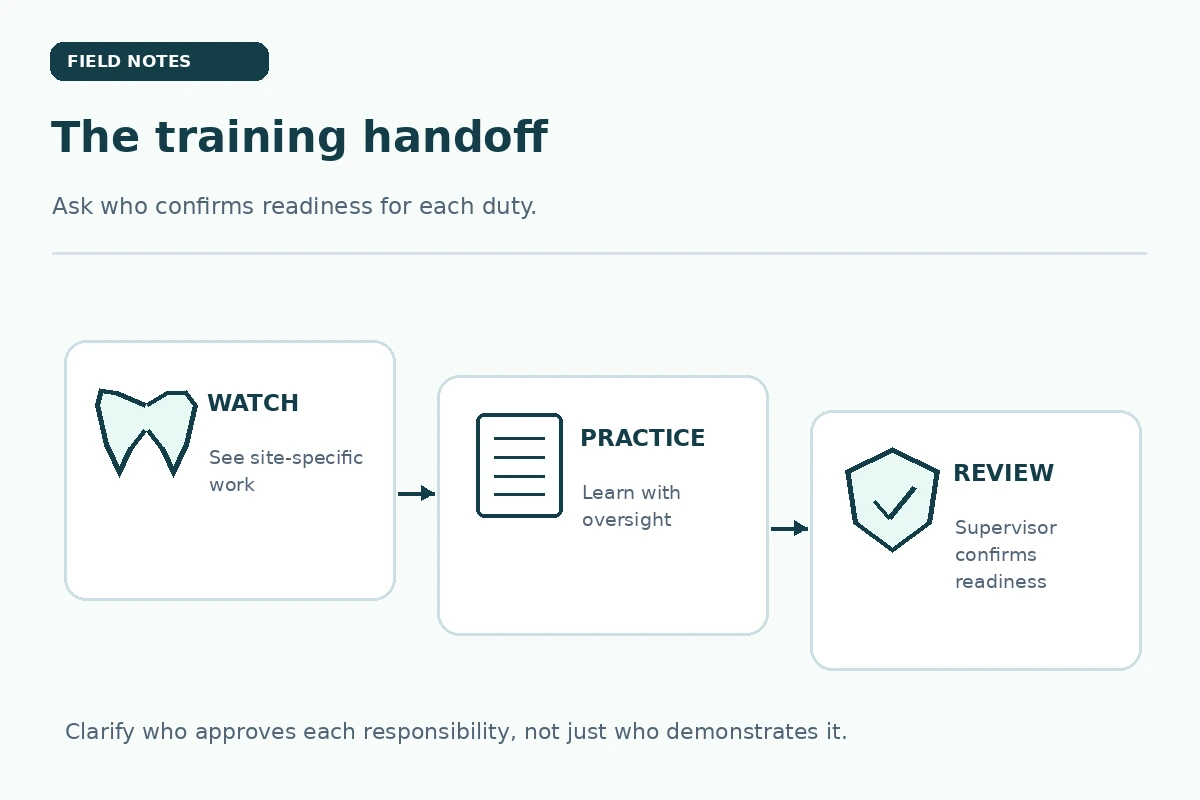
Ask: “What does the first week of orientation cover, and who signs off on a new assistant’s competency?” A useful reply identifies a supervisor or experienced trainer and describes practice-specific systems, checklists, and opportunities to ask questions. If you trained with one instrument setup, ask how a new office teaches its own layout and procedures. Candidates changing specialties can ask how the office handles unfamiliar materials or treatments. Avoid saying you can handle unfamiliar tasks independently simply because you completed a program. Training is not proof of authorization for every task, and understanding the review route is a strength rather than a weakness.

Ask about Standard Precautions without requesting shortcuts
A practical question is: “How do new staff learn and follow your infection-prevention procedures, including room turnover and instrument processing?” CDC’s Standard Precautions include hand hygiene, protective equipment, sharps safety, sterile instruments, and environmental cleaning. You are asking about training, responsibilities, and oversight—not requesting medical or procedural instructions during an interview. You can follow up with “Who should I alert when an instrument pack, supply, or workstation seems unready?” The response should make the reporting path clear. Do not assume that an interview answer substitutes for the actual policies, competency checks, or required workplace instruction.
Separate routine support from credential-dependent duties
Ask: “Which responsibilities require a state credential or additional qualification, and how does the office verify eligibility?” BLS notes that requirements differ by state and that certain duties can involve additional registration, licensing, or certification. Do not generalize one state’s radiography or expanded-function rules to the whole country. Ask the practice to state the position’s precise duties, and check the relevant state dental board independently if the answer affects whether you can perform them. If you have not earned a required credential, say so plainly and ask whether supervised training or a different assignment is appropriate. A job title alone is not permission to practice.
Find out how unexpected patient needs are escalated
Consider: “When a patient is distressed or a situation changes, which team member takes the lead and how do assistants communicate concerns?” You are not asking to diagnose or decide treatment. Listen for a clear handoff to the dentist, hygienist, or another authorized professional as appropriate. If the role includes telephone calls or patient records, ask when an assistant documents a message and when it must be reviewed by clinical staff. Candidate examples should describe communication and escalation rather than invented clinical authority. A clear boundary between noticing, recording, and deciding makes the day easier for both the patient and the team.
Understand the schedule and handoff constraints
Ask how start-of-day setup, appointment overruns, instrument turnover, and end-of-day close are scheduled. “When an appointment runs late, who reprioritizes rooms and staffing?” is a focused way to learn whether priorities are communicated or simply assumed. If the advertisement mentions evenings or multiple locations, ask which site or schedule the role actually covers. Follow with how the office notifies assistants of a provider schedule change. Treat the information as practice-specific; do not infer predictable hours from another clinic’s experience. Knowing the coverage model helps you explain your actual availability without promising shifts you cannot reliably work.

Tailor one follow-up to the interviewer’s role
A lead assistant can often explain what makes training successful or where handoffs fail. An office manager can describe staffing, appointment flow, and who owns administrative changes. A dentist may explain how assistants support the clinical workflow, within permitted scope. Instead of repeating every question to every person, choose one or two that match that person’s responsibility. For example, to a lead assistant: “Which tasks usually need the most coaching for someone new to your office?” To the office manager: “How do you handle a front-desk request when chairside coverage is tight?” This makes the discussion concrete rather than performative.
Leave with a decision record, not a checklist score
After the interview, write down the stated work mix, training contact, infection-control orientation, credential questions to verify, and any promised follow-up. Mark each answer “clear,” “needs clarification,” or “verify externally”; this is an organizing method, not a rating of the employer. If someone could not answer a technical or credential question, ask who can provide the authoritative clarification. A hypothetical closing line is: “Thank you for explaining the room turnover process. Could you tell me who would review the additional qualification required for the advertised duty?” Keep your notes private and avoid identifying patients or describing confidential records.
Practice a short, role-aware closing conversation
Choose three questions based on what remains uncertain after the conversation, not ten questions you could have found on the practice website. One might address the first-month training plan, one the chairside-to-front-desk split, and one the verification path for a special duty. If the interviewer has already answered one, replace it with a meaningful follow-up. You can say, “You mentioned new staff shadow a lead assistant. What signs tell you a new colleague is ready for the next responsibility?” That invites an observable description and does not claim any employer guarantees. The interview is a two-way evidence-gathering conversation.
How We Research Interview Questions
We compare official occupation descriptions, safety or professional guidance where relevant, and career-center interviewing resources with the specific responsibilities of this role. Every question is a suggested conversation starter, not a quote from a real hiring manager or a verified claim about an individual employer. Hypothetical examples are clearly presented as examples. Candidates should verify duties, credentials, policy and terms with the organization and competent authorities when applicable.
Sources consulted November 11, 2026: bls.gov — BLS describes dental assistants performing patient preparation, instrument handling, scheduling and recordkeeping; permitted tasks and credentials differ across states.; cdc.gov — CDC identifies Standard Precautions for dental settings and the importance of education and training for infection prevention.; onetonline.org — O*NET describes chairside, patient and office support tasks within the dental assistant occupation..
This is informational interview-preparation guidance, not a hiring endorsement. See the JobAsk affiliate disclosure for relationship policies. The internal links here are not paid recommendations.
More Interview Preparation Guides
Ask how the assistant supports a normal visit and how time is divided between chairside, room turnover, and administrative work.
Yes. Ask about the practice’s training, review, and escalation process rather than requesting shortcuts or assuming a procedure.
No blanket assumption is safe. Credentials and permitted duties vary by state and task; verify the specific requirement with the practice and relevant dental board.
Describe the training accurately, ask about orientation and supervision, and do not claim independent experience you have not gained.
Prioritize two or three unresolved, job-specific questions; use the time and earlier answers to decide what to ask.