
Quick answer. If you want an entry-level accounting job, decide first whether you are targeting transaction-support work or professional accountant work. Search for accounting clerk, accounts payable assistant, accounts receivable assistant and bookkeeping assistant when the posting emphasizes record accuracy and supervised processes. Search for junior accountant or staff accountant only after checking the education and technical requirements. Entry-level is not a promise that every role is open to candidates with no accounting preparation.
The useful first step is not to send the same resume to every financial job title. Build an evidence sheet with the bookkeeping or spreadsheet tasks you can actually perform, the examples you can discuss and the gaps you still need to learn. The role distinctions below follow U.S. Bureau of Labor Statistics occupational descriptions, not a claim about any specific employer or current opening.
Separate Accounting Clerk Work From Accountant Work
The Bureau of Labor Statistics describes bookkeeping, accounting and auditing clerks as people who classify and record transactions, check postings and help maintain accurate financial records. Some employers accept a high school diploma while others seek college coursework or a related degree. An accounting clerk opening may therefore be more realistic for a candidate whose strongest proof is accurate spreadsheet work and systematic record handling. Our guide “Part-Time Bookkeeping Jobs” covers how to check skills, scope, and hours.
An accountant or auditor role is a different track. BLS says a bachelor’s degree in accounting or a related field is typically needed. Do not treat the words “junior” or “entry-level” as evidence that a degree requirement disappears. Read the actual duties, required credentials and level of independent responsibility. When the posting includes preparing financial statements, interpreting accounting standards or leading reconciliations, check whether the employer expects broader training.
Use Job Titles as Filters Rather Than Promises
Search titles such as accounts payable clerk, accounts receivable clerk, accounting assistant and bookkeeping assistant. Each points to different work: invoices and vendor details, customer payments, record maintenance or a mixture of bookkeeping tasks. Job titles are not standardized, so the same label can refer to very different responsibilities. Compare three actual descriptions before deciding what is realistic for your current experience. For the next step, our guide “Entry-Level Bookkeeping Jobs” explains how to compare clerk duties and skill proof.
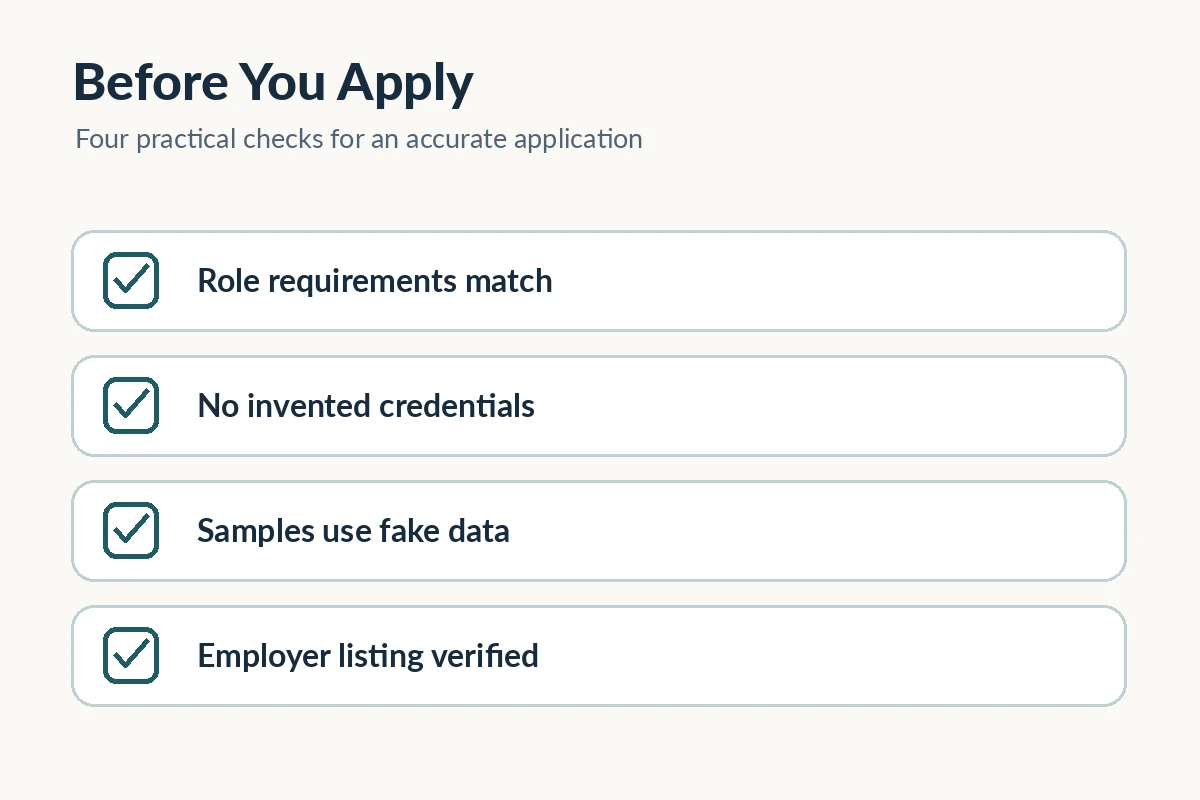
A good screening pass asks whether the job involves data entry with review, preparing records from source documents, correcting discrepancies or independently closing accounts. The first set may support supervised entry; the latter may demand more judgment and training. Also separate a role’s minimum qualifications from preferred qualifications. Never claim a degree, software certification or system access you do not have just to match a listing.
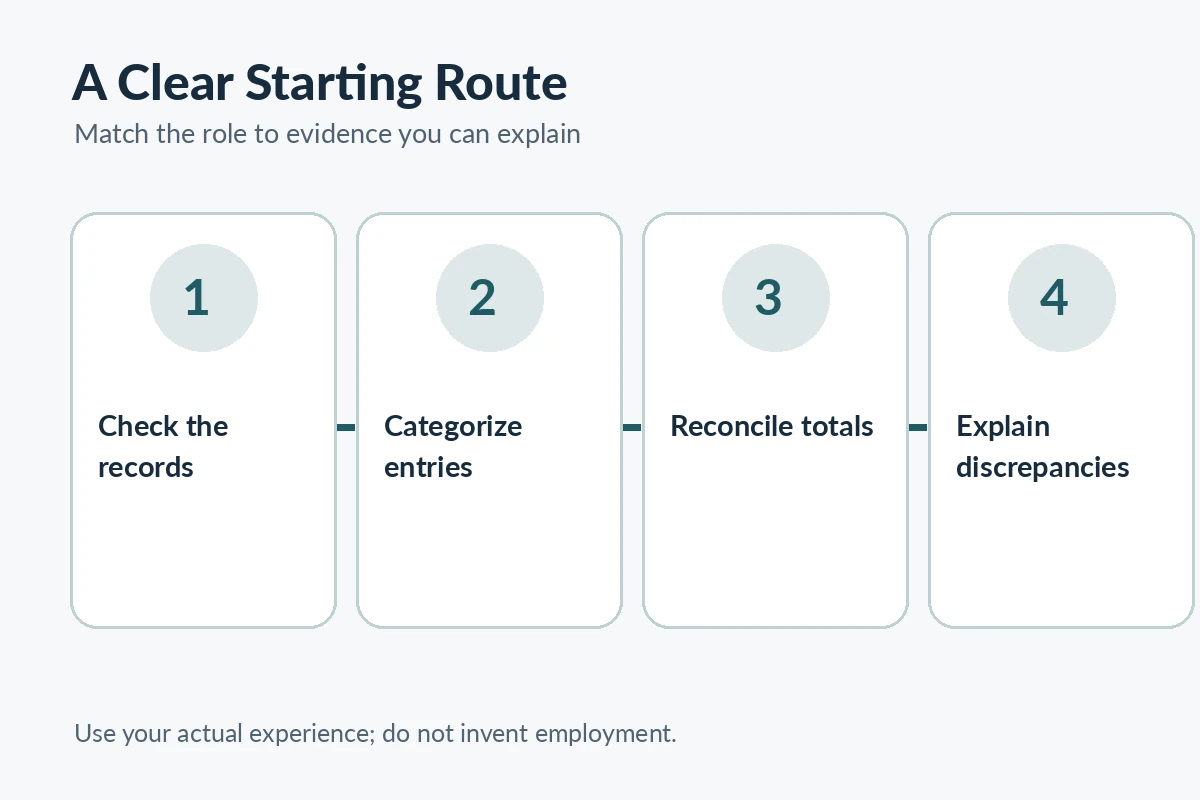
| Search title | Task lens | Evidence to prepare |
|---|---|---|
| Accounting clerk | Check the records | Fictional transaction log |
| Accounts payable assistant | Categorize entries | Error-check worksheet |
| Bookkeeping assistant | Reconcile totals | Short audit notes |
Build Financial Accuracy Evidence Without Inventing Experience
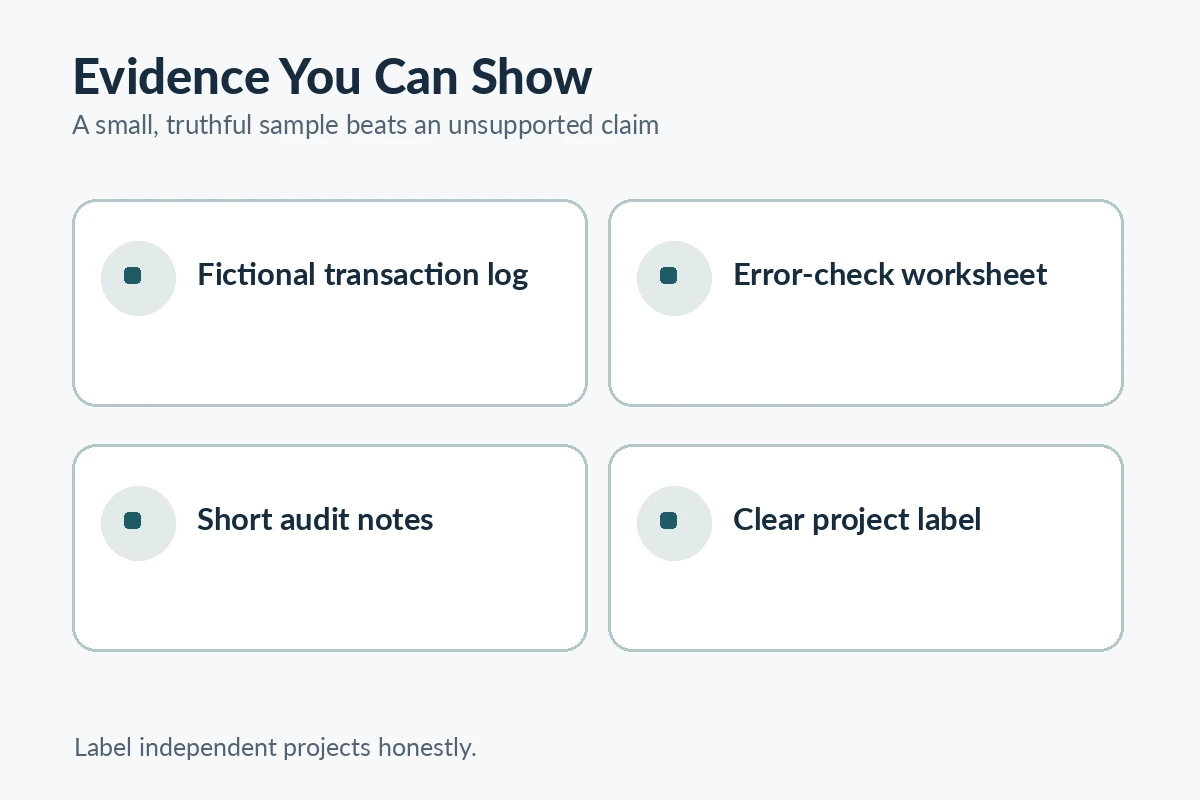
Create a practice ledger using fictional transactions: invoices, payments and refunds. Record each item with date, document number, category and amount. Add a separate reconciliation sheet that compares expected totals with entered totals, then deliberately introduce a simple error and show how you located it. Use entirely fictional records; do not publish an employer’s real customer or banking information.
Keep one short explanation of your checking process: where the data came from, what you verified, what changed and what limitation remained. The value of the exercise is showing care and transparent handling, not pretending a classroom or personal spreadsheet was an employer’s real ledger. If your real evidence comes from cash handling, student organization budgeting or coursework, name that context accurately.
Translate Transferable Tasks Into Resume Evidence
An accounting-focused resume benefits from precise verbs: recorded, reconciled, checked, categorized, documented and corrected. Choose only verbs that match work you personally completed. A hypothetical bullet might read: “Checked a practice invoice log against a fictional payment list and documented discrepancies for review.” Label it as an independent project, not paid accounting employment.
If you worked in retail, food service or administration, you may have relevant experience checking receipts, following cash-handling procedures or keeping organized records. Describe what you actually controlled, not a finance responsibility you never held. A hiring reader should understand both the evidence and its scope. Remove invented percentages, automated ATS claims and unverified claims such as “ensured full compliance.”
Target Applications Using a Requirement Matrix
For each opening, write down three must-have capabilities and one preferred capability. Next to each, record your proof: a completed course, a spreadsheet sample, genuine workplace responsibility or a candid “learning now.” Apply when your genuine qualifications reasonably cover the essential requirements. If a license or degree is mandatory, do not describe a practice project as its substitute.
Personalize a short application note with one specific match. For example, a hypothetical candidate applying for accounts payable support might mention careful invoice verification from coursework and the ability to explain their practice checking process. They should not say they processed company invoices if no such experience occurred. Save the vacancy title and source link before submitting because descriptions may change.
Prepare for Accuracy and Confidentiality Questions
A useful interview story explains how you spotted a mismatch, checked against an original record and asked for guidance when something fell outside your authority. If the story came from school or a personal project, say so at the start. Accounting teams need reliability, but a convincing answer is an honest sequence rather than an invented achievement with a large financial number.
Expect to explain basic spreadsheet functions you have truly used and how you would handle confidential records. Avoid sharing screenshots containing real payroll data, supplier accounts or identity documents. A safe response to an unfamiliar procedure is to consult the team’s documented process and escalate the exception, not to guess a journal entry or change a sensitive record silently.
Run a Focused Two-Week Search Experiment
In the first few days, compare a small set of genuine accounting-support postings and group their recurring skills. Spend the next several days completing one small, checkable record-accuracy example and rewriting your resume around it. Apply to matching positions, track each employer and follow its posted method rather than purchasing an advertised “guaranteed placement” program. Our guide to accounting clerk cover letter adds more detail on this.
At the end of the experiment, examine the requirements you repeatedly miss. If most targeted openings demand education you do not have, adjust the title family or consider appropriate training. If the mismatch is a tool or process, practice that skill with non-sensitive fictional data. Changing the search based on evidence is more useful than sending many identical applications without reviewing their requirements. Our guide “Entry-Level Human Resources Jobs” covers how to find an HR assistant path without guesswork.
How We Research These Entry-Level Paths
We compared this specific role family with the published occupational descriptions and checked the sources on October 20, 2026: BLS occupational guidance. BLS occupational guidance. FTC fraud-prevention advice. These sources explain occupational tasks, usual preparation or fraud red flags; they do not certify any employer vacancy or guarantee hiring. The fictional examples are original teaching aids, not employer case studies.
JobAsk provides independent informational guidance. No hiring outcomes, partner approvals, paid recommendations or affiliate relationships are implied. Read our affiliate disclosure. Requirements vary by employer and change over time; verify each real job description and application channel before sharing sensitive information.
Related Job Search Guides
- Entry-Level Remote Jobs: Find Genuine Training and Prove First-Role Skills
- Entry-Level Customer Service Jobs: Match the Channel and the Skills
- Entry-Level Bookkeeping Jobs: Choose Clerical Routes and Show Accuracy
- Entry-Level Editorial Assistant Jobs: Show Fact-Checking and Workflow Skills
- Entry-Level Public Relations Jobs: Choose Writing and Media Support Roles
Some clerical positions may accept a high school diploma or college coursework, depending on the employer. BLS says professional accountant roles typically require a bachelor’s degree. Check each real posting.
No. The tasks and usual preparation differ. A bookkeeping or accounting clerk role may focus on recording and checking transactions; junior accountant jobs can ask for broader accounting education.
A clearly labeled fictional invoice log, reconciliation worksheet and explanation of how you checked errors can demonstrate practice. Never present it as client work.
Prioritize the systems repeatedly named in the roles you are targeting. Practice permitted demos or coursework and describe your actual skill level; no tool guarantees hiring.
Use concrete truthful responsibilities, such as balancing a register or checking receipts, and explain how that accuracy relates to the advertised role without renaming the experience accounting employment.