
Quick answer: To find customer success entry level, start with the tasks you can honestly demonstrate, then confirm the employer’s actual expectations, training and review authority. This guide focuses on new-customer onboarding and accurate service handoffs, not promises that any application will be accepted. All sample situations and application lines here are hypothetical.
An “entry-level” label is not proof that a position requires no preparation. Read the work described, check what must be approved and compare the posting with education, software or portfolio requirements. Start with a short evidence list: one role-specific task you have done, one work sample you may share, and one question about work boundaries. That is a more useful starting point than sending identical resumes to every employer.
Decode Customer Success Titles Carefully
Customer success is a commercial team label, not one uniform occupation. Some junior associates schedule onboarding calls, maintain action lists and check whether customers received instructions. Others primarily answer support requests, while some are assigned revenue or renewal targets. Review the actual job posting for the specific customer lifecycle stage and outcome. Do not assume “success” means that a new hire can alter contracts or promise a particular result.
O*NET’s customer service profile covers inquiry handling, transaction records and routing unresolved problems; it is useful for identifying transferable service tasks, but it is not an official definition of every customer success job. Ask which responsibilities are handled by support, the account manager, implementation specialists and the junior hire. This role map prevents you from applying to a disguised senior account-owner position.
Compare Titles, Tasks, and Review Responsibility
The same keyword can lead to several job types. Use the assignment rather than a glamorous title to identify a realistic first role. The rows below are common task distinctions, not confirmed vacancies and not a promise that a particular employer will offer supervision.
| Posting language | What you may do | Review boundary |
|---|---|---|
| Customer success associate | Schedules onboarding contacts | Flags adoption blockers |
| Onboarding coordinator | Tracks setup milestones | Routes technical issues |
| Account support specialist | Maintains action notes | Does not promise pricing terms |
Write down what the listing actually says about reporting lines, production systems and quality checks. If you cannot identify who handles an exception or signs off on a public-facing decision, ask during screening. Some workplaces combine functions, so verify which responsibilities are truly assigned and which belong to the named manager or qualified specialist.

Make Onboarding Evidence From Legitimate Experience
For a starter portfolio, use a fictional, clearly labeled product onboarding case. Describe the customer’s stated goal, what setup information is needed, how you track questions and when you would route a technical or billing issue. A good sample includes an onboarding checklist and a customer-facing follow-up message, both free of private account details and invented business results.
If you have worked in retail, volunteered at an event, supported classmates or handled approved customer inquiries, identify the actual task you performed: explained a process, confirmed a next step, documented a request or brought in the correct specialist. Be honest about customer ownership. Helping someone complete setup is not the same as signing a contract or proving long-term retention.
A portfolio does not need to pretend to be paid professional work. Two small, accurate exercises with explicit context and review notes will often demonstrate more than a stack of decorative screenshots. Name the tools you used, the assumptions made, and whether anyone evaluated your result. Keep private customer, employer, student, medical, or unpublished material out of public samples unless you have clear permission.
Map the Handoff Between Teams and Customers
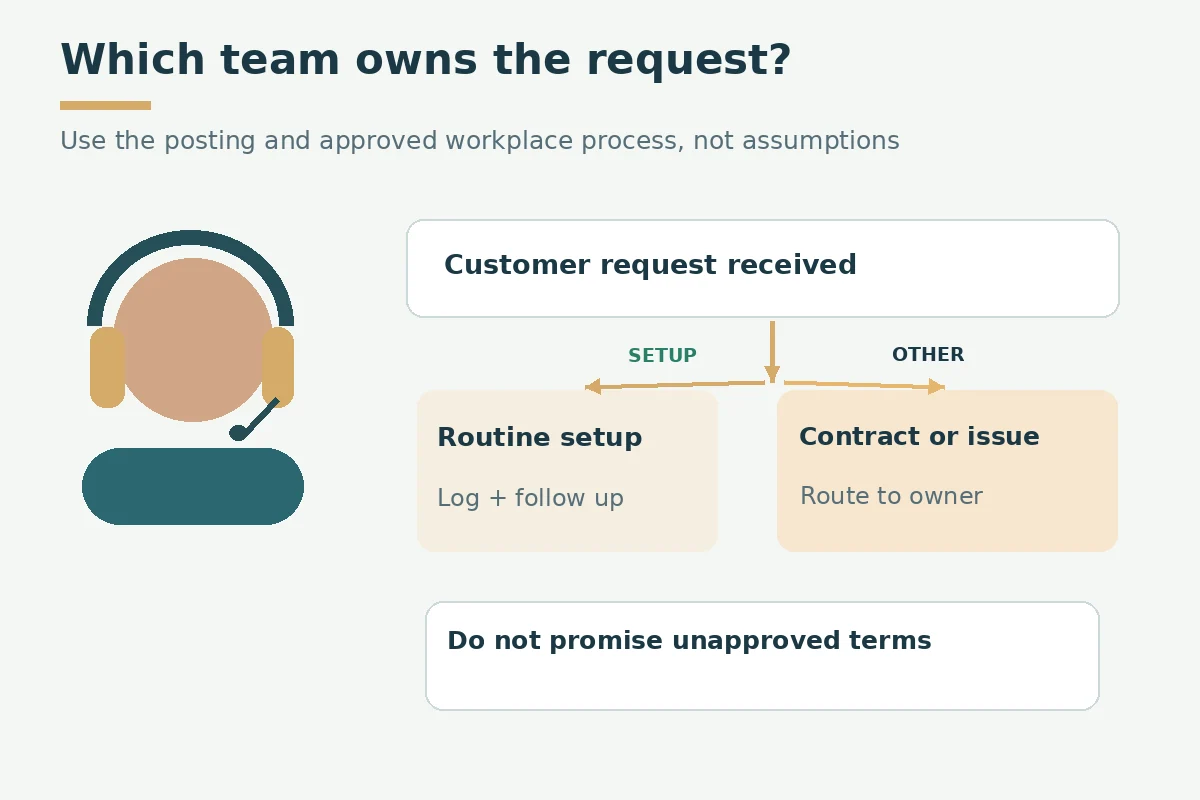
Consider a hypothetical customer who cannot finish setting up an account. The customer success associate can acknowledge the problem, verify the stated goal and record the issue in an approved system. The technical support team may diagnose a fault; a commercial owner may clarify contractual scope. The associate follows up when the responsible team has provided an authorized answer. The important outcome is an accurate handoff, not an unsupported promise of resolution.
Ask recruiters what system tracks ownership, how the team handles repeated issues, whether check-ins are scheduled or reactive, and who can agree to discounts or contract changes. A high volume of accounts with no documented escalation path may be difficult for a beginner, particularly when the advertisement simultaneously promises personal ownership of complex enterprise customers.

Before (unreliable): “Owned renewals and guaranteed higher retention.” This example implies authority, external results, or work history that the candidate may not have. After (hypothetical): “Recorded a hypothetical onboarding checklist and escalated unresolved setup questions to the assigned owner.” Use that wording only if it truthfully describes work you personally completed; otherwise replace it with your own verifiable task.
Understand Metrics Without Claiming Outcomes
Listings may refer to onboarding completion, customer satisfaction surveys, product usage, account renewals or churn. These are different measures; a junior employee may only have access to part of the evidence. Ask how the team defines each measure, what data is actually available and whether your performance is assessed on supported actions or outcomes outside your control.
If you lack paid account experience, do not create a “retention increased by 30%” story. Instead, demonstrate your ability to maintain a clean action log, separate customer requests from assumptions and follow up within a stated deadline. The employer should explain its training arrangements, confidentiality expectations and how an associate escalates customer information safely.
Check Employer Identity Before Sharing Documents
A role can sound specific and still be fraudulent. Independently find the employer’s real website, compare the job title and recruiting contact with the official listing, and verify the destination before submitting personal information. The Federal Trade Commission’s job-scam guidance explains why unexpected offers, requests for payment to obtain work, and schemes involving personal information should trigger extra caution.
Do not use an employer’s logo, claimed partnership or recruiter photo as proof by itself. When a message asks you to buy equipment from a specified person, move the conversation to a private messaging app, deposit a check and send money back, or pay for an interview, stop and verify through an independent channel. A trustworthy employer can explain the hiring process, role expectations and normal next step without requiring the applicant to prepay for employment.
Apply Only to a Role You Can Explain
Compare the job description with your transferable proof. Communication skills become credible when paired with a verified example of clarifying a question; organization becomes a maintained checklist; problem solving becomes appropriate escalation. Match those specific actions to onboarding and account coordination language rather than using generic sales claims. A concise cover letter can discuss what you do when you do not know the answer: confirm the problem, consult an approved source, then follow up.
For the interview, practice a five-minute scenario: a customer says promised features are missing. Do not concede a refund or invent a contract term. Read the approved scope, document the report and involve the responsible decision maker. That is the type of boundary employers should be able to explain clearly when they advertise an entry-level customer success role.
A Short Application and Interview Checklist
Before applying, verify four things: the employer and posting, the work actually assigned, one truthful example of your contribution, and any qualifications you have not yet met. Tailor your resume to the required tasks rather than copying a job title you never held. Attach only permitted samples and remove identifying information. If the application asks about experience, distinguish paid, volunteer, classroom and independent practice work.
At an interview, ask this role-specific question: Does this role coordinate customer progress, provide support, or own commercial renewal decisions? Then ask how a new hire receives feedback, how errors are corrected, and who resolves unusual cases. A vague response may signal a mismatch; it is not automatically proof of wrongdoing. Take notes, compare the answers with the posting, and decide whether the role still matches your preparation.
How We Research Entry-Level Occupations
We compared the occupation-level duties described by this primary occupational reference with the task and review descriptions in a second source, then used FTC consumer guidance for application-safety recommendations. Occupational profiles describe typical work, not a guarantee about any individual job posting. This page does not list live vacancies, guarantee employment, or estimate individual earnings.
Sources were consulted on October 29, 2026. Reader examples and workflow illustrations are editorial teaching aids, not quotations from an employer or certified professional procedures. JobAsk may discuss services elsewhere; see our affiliate disclosure. No external product or paid referral is endorsed in this article.
Related Job Search Guides
- Entry-Level Public Relations Jobs: Choose Writing and Media Support Roles
- Entry-Level Editorial Assistant Jobs: Show Fact-Checking and Workflow Skills
- Entry-Level Technical Writer Jobs: Build Proof Through Clear Instructions
- Entry-Level CAD Drafter Jobs: Evaluate Drawing Tasks and Review Limits
- Entry-Level Customer Service Jobs: Match the Channel and the Skills
Not necessarily. Customer success may emphasize onboarding and ongoing use, while customer service often handles incoming questions. Titles vary by employer.
Sometimes, especially in junior coordination roles, but verify required product knowledge, training and industry-specific prerequisites in each posting.
Do not assume so. Ask who controls terms, pricing, renewal decisions and escalation for each account.
Discuss metrics you understand and have actually observed. Do not invent retention, satisfaction or revenue results.
Acknowledge the request, log it through the approved channel and refer commercial commitments to the authorized owner.