
Entry-level estimator jobs usually begin with gathering measurable inputs—not signing off on a bid. Search for estimating assistant, junior estimator, takeoff assistant, project estimating coordinator and trainee estimator. A takeoff is a method of identifying quantities from plans or specifications; it is not the same as deciding final costs. Training, degree requirements and experience expectations depend on whether the employer estimates buildings, specialty trades, manufacturing products or services.
The U.S. Bureau of Labor Statistics says cost estimators analyze materials, labor, time and other inputs; it also reports that a bachelor’s degree is typical for full estimator roles, while some construction workers qualify through substantial industry experience. That distinction matters for beginners. A trainee opening may accept coursework or practical construction knowledge, whereas a job described as “entry-level” may still require a technical degree or prior estimating exposure. The actual advertisement wins over the label.
Choose the Right Kind of Estimating Role
Construction estimators read drawings and scopes to identify materials, labor categories and other project factors. A specialty subcontractor may emphasize one trade, such as interiors or electrical systems. Manufacturing estimators may study process steps, component counts and production times. Look for the type of quantity the team measures, the estimating software named, and whether the listing calls for checking vendor quotes or managing a bid package.
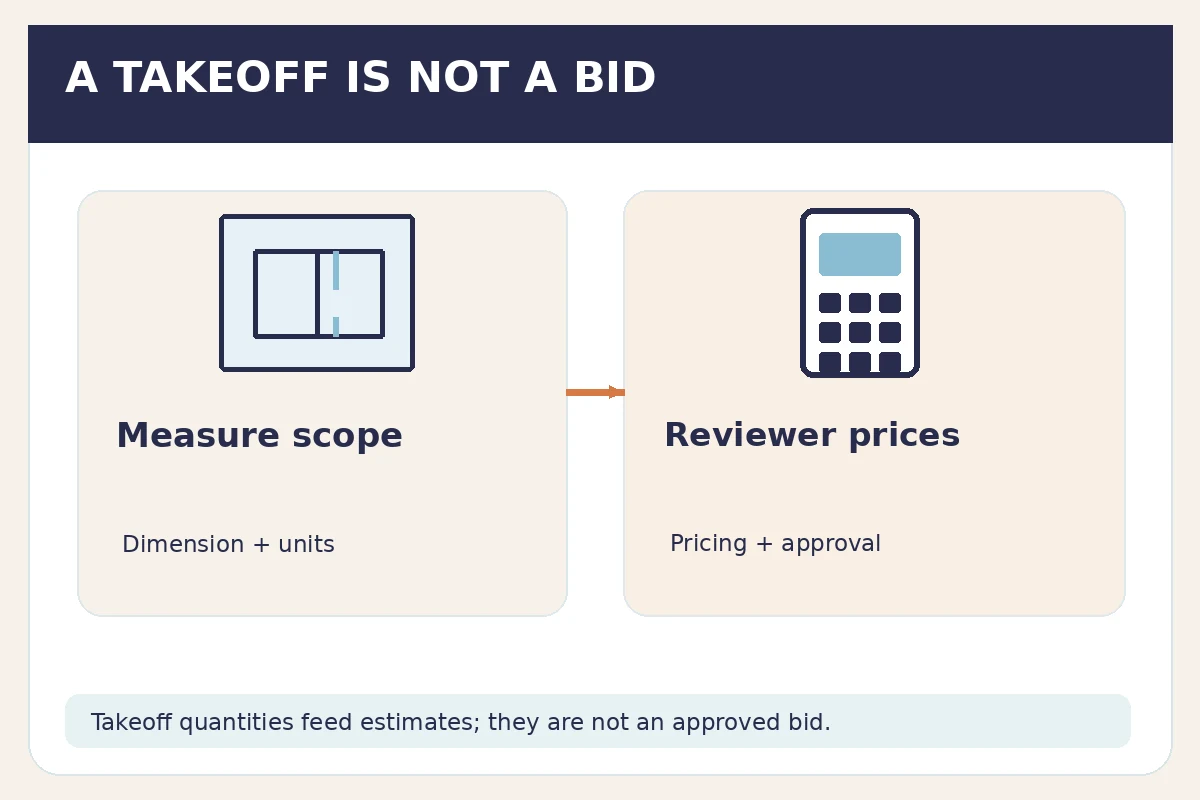
For a novice, the crucial question is who owns the final number. A junior person might measure quantities, enter supplier pricing from authorized sources, maintain a change log and flag missing details. A senior estimator or manager may set commercial assumptions, make judgment calls about contingencies and approve a customer-facing quote. Do not promise that you will independently submit bids, certify quantities or interpret design requirements without training and authorization.
Read Prerequisites Instead of Trusting “Junior”
Check the posting for required degree, trade experience, drawing literacy, spreadsheet skills and software. Cost estimator jobs often seek business, engineering or construction education, according to BLS; an assistant path may instead stress organized measurements and willingness to learn. If an ad asks for both entry-level experience and independent client pricing, treat that as a mismatch to clarify rather than assuming the employer will train everything.
Build a requirements grid with three labels: required now, trainable after hire and authority restricted to reviewers. For each tool listed, state whether you have used it in paid work, a class, a mock project or not at all. A self-taught spreadsheet is useful evidence for formulas and checking sums; it does not prove professional competency with an estimating platform. When you are unfamiliar with drawings, consider introductory, properly supervised plan-reading coursework before claiming advanced takeoff ability.
Make a Small and Honest Quantity Sample
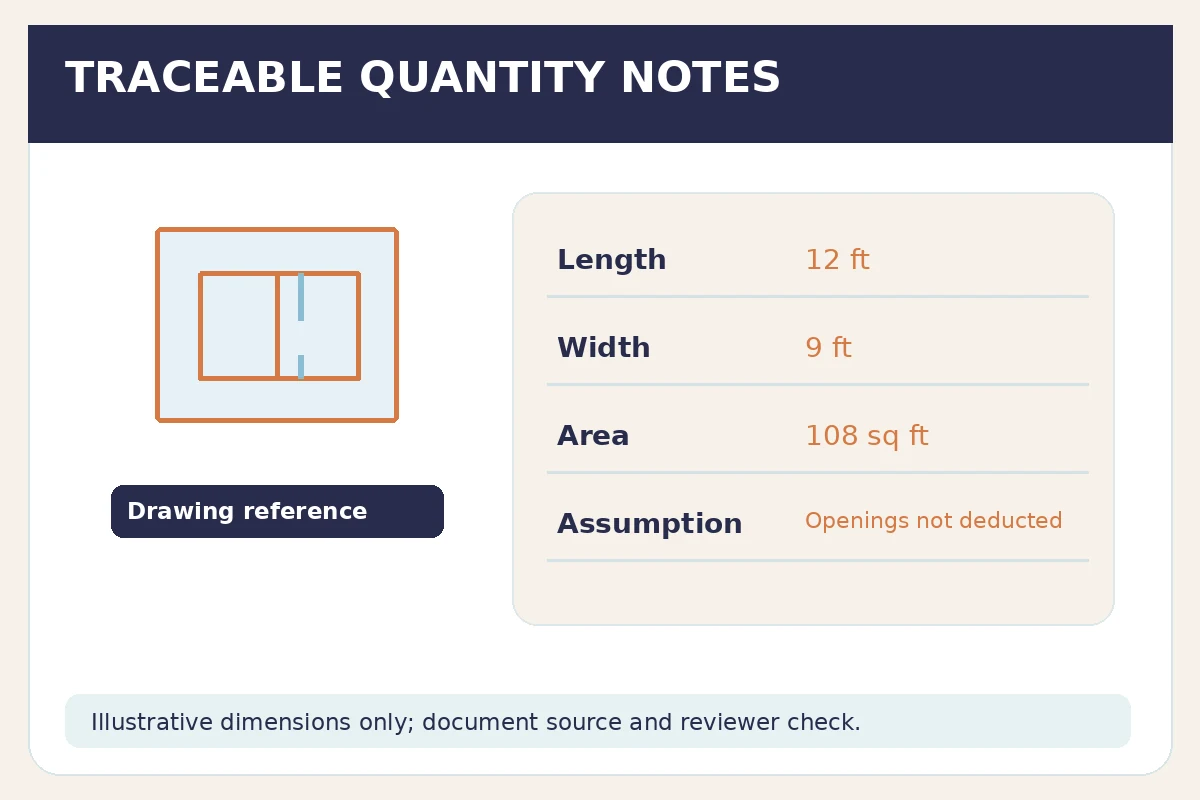
Create a clearly labeled hypothetical room-finish exercise from a fictional plan that you drew yourself or a publicly reusable learning example. Record dimensions, units, scope exclusions and assumptions, and ask an instructor or qualified reviewer to check the method. For example, separate floor area, baseboard length and a count of doors rather than combining incompatible units. The point is traceability: a reviewer should be able to see where each quantity came from.
Keep quantities and commercial cost decisions separate. If you calculate an area as length multiplied by width, note the measurement source, rounding convention and whether openings were included. If a plan is ambiguous, mark “requires confirmation” rather than quietly selecting the number that makes a total look better. Never present invented material prices, vendor quotes, labor productivity or bid margins as real market data. The sample can demonstrate clear assumptions without pretending to price a live contract.
Track Changes Without Hiding Uncertainty
Estimates are sensitive to scope revisions. A beginner may help record plan version, date, revised material quantity and questions that affect takeoffs. Use a change log in which each row identifies the source document and status: not checked, checked, clarification requested or reviewed. If two sheets conflict, log the discrepancy and ask the designated estimator; do not pick a sheet based on convenience. A clean version history is more valuable than a polished total with no traceable source.
An illustrative handoff might read: “Drawing revision C changes the corridor length shown on sheet A-201; flooring quantity may be affected. I have not changed the approved estimate pending review.” That statement accurately communicates uncertainty. Do not claim engineering design approval, signed takeoff certification, purchasing authority or supplier negotiation simply because the advertisement lists “assist with bids.” Ask what level of direct supervision and independent checking is expected.
| What the posting asks | Beginner proof | Approval boundary |
|---|---|---|
| Read technical drawings | Labeled classroom plan takeoff | Verify ambiguous symbols |
| Use spreadsheets | Units, formulas and checking notes | Reviewer checks scope assumptions |
| Track revisions | Versioned fictional change log | Do not alter approved bid |
| Gather quotes | Explain quote comparison exercise | No claim of purchasing authority |
Show Calculation Discipline on Your Resume
A first estimator resume can feature a technical class, shop project, student construction exercise or spreadsheet budget if it demonstrates precise measurement and checking. Name the context: hypothetical classroom assignment, personal learning project or actual paid project. An honest bullet is “Prepared a class quantity worksheet for three finish types, documented measurement assumptions and revised the table after instructor feedback.” This is more informative than “delivered accurate project bids” when no live bid work occurred.
Attach a tidy one-page sample with dimensions, units, source labels, highlighted ambiguities and a reviewer note. Remove client drawings, confidential unit prices and nonpublic project details. Explain your own contribution if it was a group project. Employers may ask how you found and corrected a counting error; prepare a short example that shows recalculation and checking rather than a fictitious savings percentage. References should be able to confirm the work you actually performed.
Ask the Team How Estimates Are Reviewed
During an interview, ask which trade or product line the junior role supports, who reviews quantity takeoffs, and what the procedure is for a conflicting plan note. Ask whether the company provides structured software training and whether assistants contact suppliers directly or route questions through a lead. A request for “complete pricing ownership on day one” may indicate a position beyond your present preparation; it is appropriate to explore that before accepting.
Also distinguish time at a desk from site visits or plant observation. BLS notes that many estimators work in offices and some visit project locations. If travel or site access appears in the job description, ask about onboarding, supervision, personal protective equipment and permitted tasks rather than assuming you can enter any active work area. Confirm the actual schedule and reporting relationships with the employer, not with an aggregator that reproduces only part of the ad.

Run a Search Built Around Proof and Review
Start with a focused search for estimating assistant, trainee cost estimator or quantity takeoff assistant in the industry you can explain. Keep a record of the software and drawing prerequisites found in several real postings. If a role requires capabilities you have not demonstrated, adjust your learning sample or target a support opening; do not falsify a course completion or claim proprietary tools you never used.
After applying, save the posting, your sample’s version and your claimed skills in a private folder. A reasonable follow-up asks about the review process and expected training only through the hiring contact the employer provides. Reject requests to buy a guaranteed placement or send money to unlock an interview; FTC guidance treats payment for the promise of work as a red flag. Your strongest signal is the ability to explain every quantity and to state which judgment belonged to someone else.
How We Research and Verify Entry-Level Routes
This U.S.-focused guide was reviewed on 2026-11-13 using occupational and consumer-protection materials: BLS occupational guide. BLS occupational guide. FTC job-scam guidance. Role labels and duties are illustrative comparisons, not listings of current openings. Always verify live requirements, local jurisdiction rules, access permissions and application steps directly with the employer. Example records and portfolios in this article are fictional unless clearly identified otherwise. See the affiliate disclosure for site relationship information; no paid placement or employment outcome is promised.
Related Job Search Guides
Some construction estimators enter after substantial relevant experience, but BLS says a bachelor’s degree is typical. Check each specific role.
A takeoff measures quantities from scope documents. A bid adds pricing assumptions and commercial approval, often handled by experienced staff.
List only software you have actually used, and distinguish class projects from production experience.
Yes if you clearly label it hypothetical, show assumptions and do not pass off fabricated prices or restricted drawings as real.
Ask for clarification on scope, review and training; do not assume the advertised title reduces responsibility.