
An entry-level resume summary can be useful even if you have never held a paid job. Describe a relevant project, volunteer responsibility, technical exercise or education-based skill, and connect it to the real tasks in the posting. The important distinction is what you actually did: coursework is coursework, volunteering is volunteering, and a simulated exercise is not client work.
Duke’s summary guidance focuses on relevant value rather than a glamorous prior title, and Columbia’s career guidance encourages a snapshot of evidence. This page tackles the short paragraph at the top of a first-job resume; for a complete resume structure, use JobAsk’s separate first-resume resources. No sample below describes a real person or documents a hiring outcome.
Start From the Tasks in the Actual First Job
An entry-level advertisement can mention customer inquiries, filing, stock counts, basic research, simple software or dependable follow-up. Identify two tasks that recur and check whether you have done comparable work in school, volunteering, a community project or home responsibilities that you can appropriately describe. A student who collected responses for a class survey may have evidence of careful data entry, but that does not mean they performed commercial data analysis.
Distinguish the employer’s required qualification from something merely preferred. If a job requires a certificate you do not have, the summary cannot replace it with enthusiasm. If a duty requires handling confidential data, avoid implying access to sensitive records simply because you organized a student sign-up sheet. Your summary is a small relevance argument: these particular experiences prepare you to discuss these particular tasks.
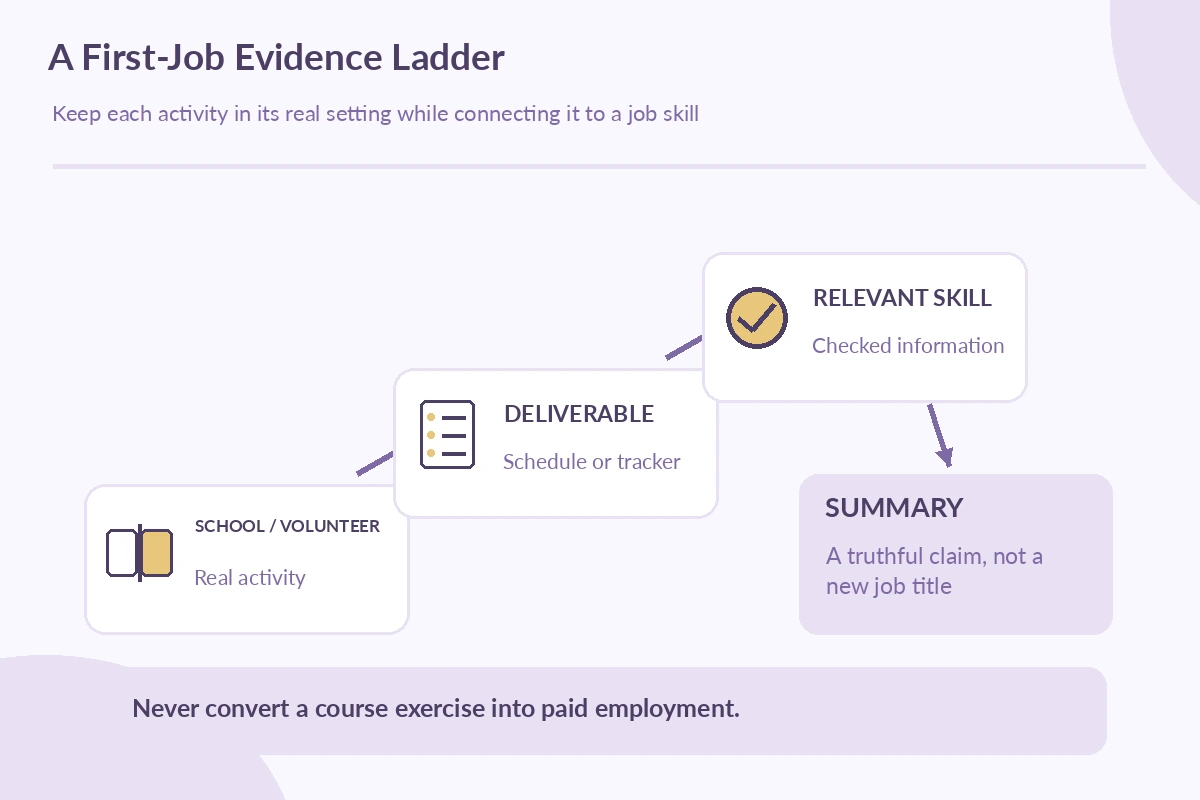
Build an Evidence Ladder From Real Activities
Write down one concrete action from a course, project, community event or personal portfolio. Identify what you produced: a schedule, inventory sheet, slide deck, working webpage, signed-in visitors list or updated instruction page. Next identify what it shows—documentation, communication, careful checking, use of a tool or a consistent follow-through practice. State the setting so a reader does not mistake a classroom exercise for paid employment.
For example, “recorded attendee counts for a volunteer event” can support organizing information. It does not by itself justify a claim that you managed company finances. A project conducted only on sample data can still be legitimate if labeled as such. Keep a portfolio link only if it is appropriate, accessible and safe to share. Never invent customers, payroll responsibilities, employer names, dates or a performance percentage to make the opening sound professional.
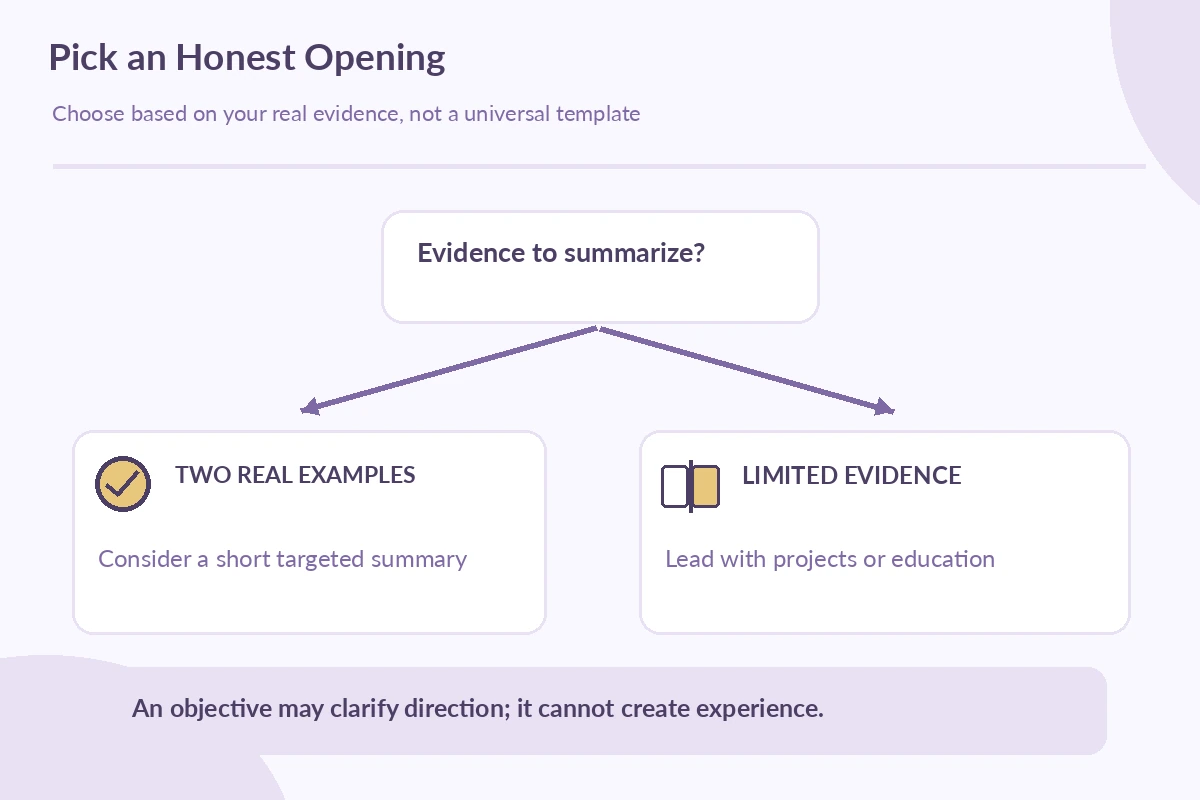
Write an Honest Two-Line Summary From the Ladder
The first line might name your status and relevant focus: a recent learner in a technical program, a student who coordinated club activities or a volunteer with public-facing experience. The next line selects a documented activity and connects it to the new job. It is fine to avoid a status label entirely when a specific project tells the story more clearly. The line should not rely on “passionate,” “motivated” or “quick learner” without supporting behavior.
Hypothetical example: “Entry-level administrative candidate with volunteer experience tracking event sign-ups and preparing weekly schedules. Comfortable checking records for missing details and referring changes to the organizer.” The fictional applicant never claims paid office employment or supervisory authority. If your event used different tools or you never checked records, rewrite the line. A believable short summary is more useful than a fluent but untrue description of work.
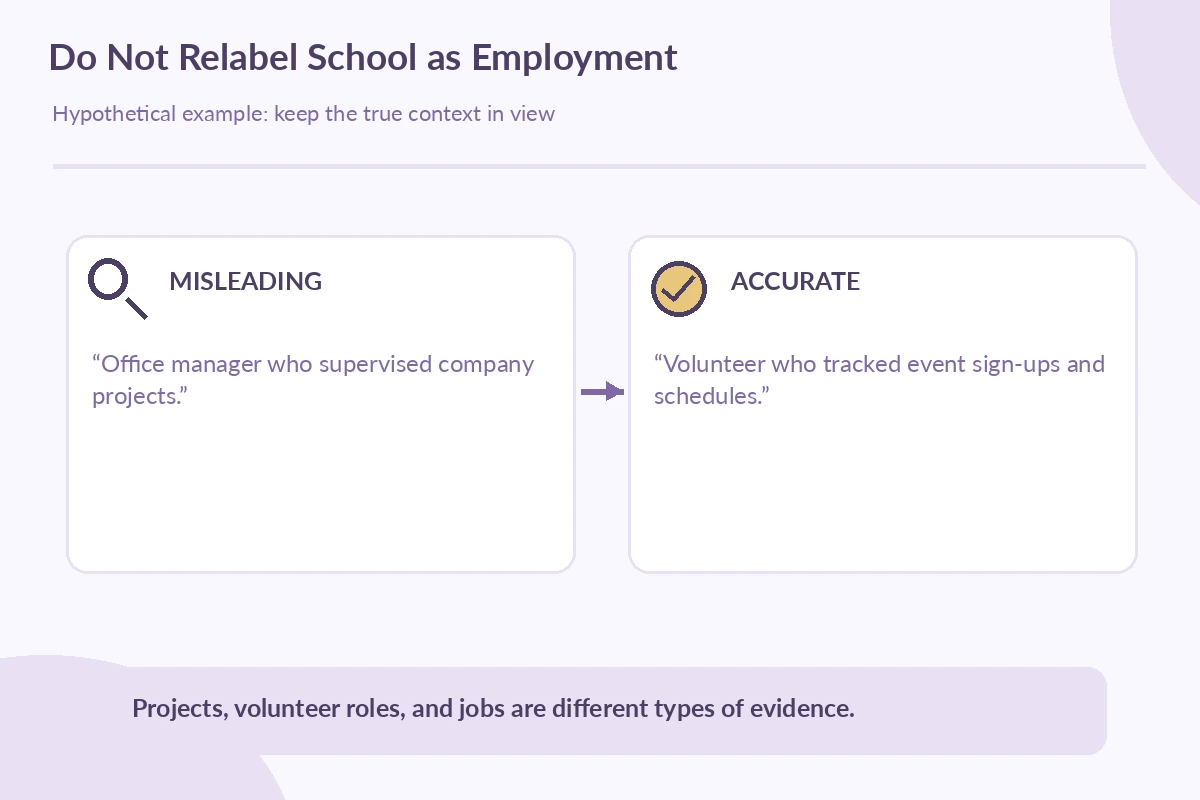
Separate Training, Practice, and Workplace Experience
Make the context clear for every technical tool. “Created a spreadsheet tracker for a class project” differs from “maintained the employer’s inventory system.” “Completed a customer support simulation” differs from “resolved live customer complaints.” Training can demonstrate readiness to explain a process, not necessarily independent competence under workplace pressure. Place any credential with its actual name and status; a course in progress is not a completed certification.
If you have a personal programming or design project, identify the project purpose and what you personally built or tested. If you volunteered with a group, distinguish the group’s achievement from your own work. An instructor’s positive comments can matter to you, but do not quote endorsements as verified outcomes without consent and documentation. A beginner can demonstrate problem-solving through decisions and revisions even when no business impact was measured.
Choose Summary, Objective, or No Introduction
A short summary fits when you can identify at least two relevant examples. A brief objective may be more transparent when the immediate direction matters and the available evidence is limited; even then, include a useful qualification rather than only “seeking an opportunity.” If neither format adds meaning, let education, training or projects lead the page. The decision is about clarity, not a rule that every first-job resume needs a decorative paragraph.
Do not copy a broad “career-minded professional with extensive experience” paragraph from a template. Compare your candidate opening with the job description: would a hiring reader know what task you can discuss? If not, swap one adjective for a real activity or remove the paragraph. Resume format and review requirements are employer-specific; a summary by itself does not change eligibility for jobs that require a license or legal permission.
Proofread as If Someone Will Ask for the Example
Imagine an interviewer points to the summary and asks, “Tell me about the schedule you maintained.” Could you show an appropriate document, explain the constraints and identify your role? If not, the wording is too large for the underlying evidence. Check the education and experience sections for the same project names, dates and tools. Use short everyday terms where possible instead of a wall of abbreviations.
Have someone familiar with your projects review factual accuracy, not just grammar. Keep private volunteer contact lists and classmates’ information out of public portfolios. If a position is genuinely entry level, you can be specific about learning while showing what you already know. Your first summary should signal what you can demonstrate today and leave room to explain what you hope to learn tomorrow.
How We Research Resume Summary Guidance
This article combines a professional or first-party source with a second relevant source and the additional references linked above. They support the role of summaries or the described occupational tasks; they do not validate the performance of a hypothetical applicant. Sources were checked on October 26, 2026. The matrices and sample statements are independent educational examples, not recruiter endorsements or tested hiring strategies.
All model candidate statements in this article are explicitly hypothetical. No made-up employer, performance number, credential, hiring advantage, or universal software screening result is represented as fact. Job postings and qualifications vary. No paid affiliate partnership is claimed. See the affiliate disclosure for site policy.
More Resume and Cover Letter Guides
- Electrician Resume Summary: Show License Level and Verified Work Scope
- How to Write a Professional Resume Summary With Evidence, Not Buzzwords
- Recent Graduate Resume Summary: Use Coursework and Project Evidence
- Project Manager Resume Summary: Explain Scope, Delivery, and Your Role
- Project Coordinator Resume Summary: Show Milestones and Ownership
Yes. Use relevant education, coursework, projects or volunteering, clearly labeled and explained.
No. Describe them as academic or personal projects and specify your actual contribution.
Describe a real deliverable, process or skill honestly; never invent performance percentages.
Sometimes. A short objective can clarify direction when the summary would have little evidence; it is not mandatory.
Yes, if relevant, but label it in progress and do not imply it has been awarded.