
An executive resume should show the scale of decisions you were accountable for, the teams or functions you led, and the results you can support. Begin with a precise leadership headline and a short scope summary; then use selected positions and accomplishments to explain the story. Grand adjectives such as “visionary” or “transformational” do not replace evidence, and organization-wide achievements should not be presented as personal work without attribution.
In its senior-level resume guidance, SHRM recommends clarifying the size and context of organizations and emphasizing specific achievements. Harvard career guidance likewise favors fact-based language and easy-to-scan organization. None of these principles proves a claimed executive outcome; your underlying record must.
Establish Scope Before Listing Achievements
A hiring committee needs to know whether you owned a budget, advised on it, or simply worked in a large company with a substantial budget. Near the top, identify your leadership domain and the relevant scale of responsibility. This might include reporting relationships, functions led, geographies covered or operating context, but only when those details are truthful and permissible to share. Omit private or sensitive organizational data rather than manufacture proxy numbers.
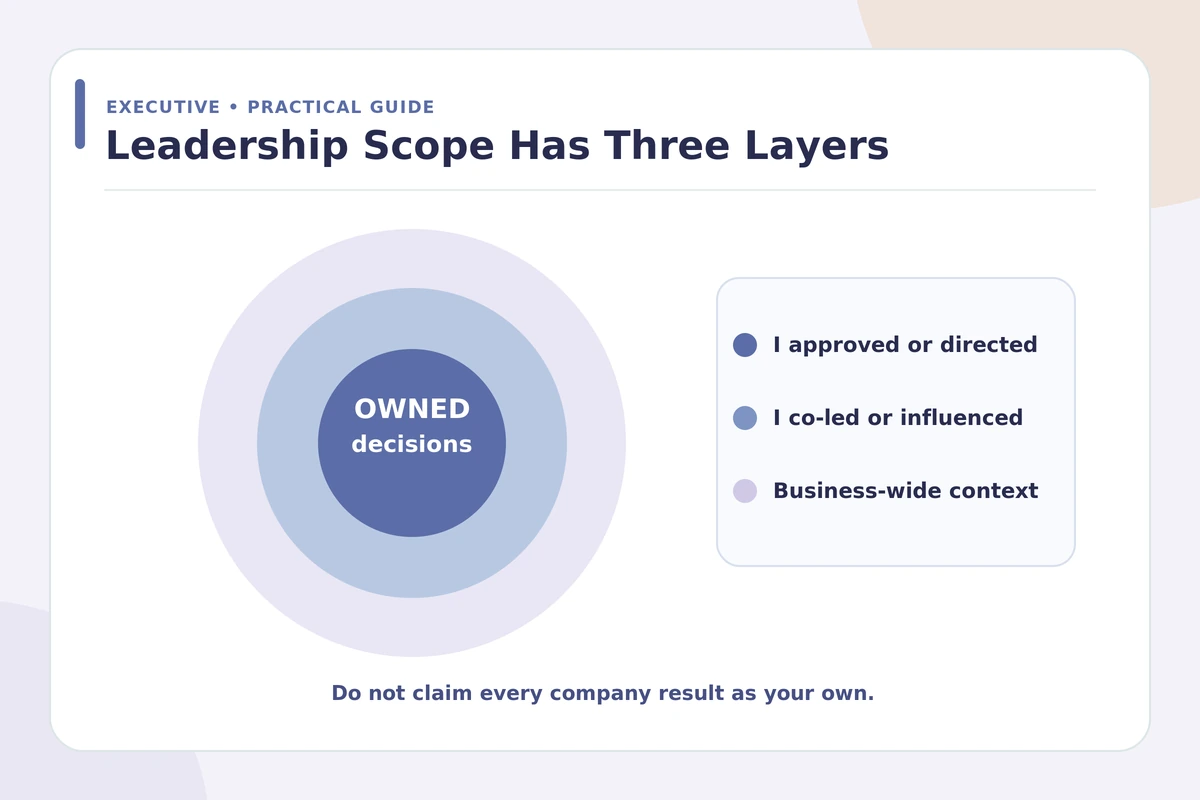
Think in three concentric circles: decisions you personally owned, outcomes you materially influenced, and company context that helps a reader interpret the role. Use different verbs for each circle. “Led” fits accountable leadership; “partnered with” can describe shared ownership; “operated within” describes context. A leadership summary that merges all three into one boast can create an impression that the evidence does not support.
Build a Short Evidence-Based Leadership Header
Include your name, current contact details and professional profile link if it helps. Add a role-aligned headline such as operations executive, divisional finance leader or technology transformation director only when it describes your actual professional background. Follow with two or three lines naming the most relevant responsibilities and strengths. Avoid vague slogans, keyword chains or unsupported claims of universal expertise.
The first portion of the page should explain why the reader should inspect the work history. A target role in a regulated industry may need proof of applicable experience and compliance responsibility; another role may emphasize organizational change or commercial operations. Tailor the order, but retain the exact job titles you actually held. Do not turn an interim role into a permanent appointment or a project sponsorship into sole executive authority.
| Claim type | Use wording such as | Evidence needed |
|---|---|---|
| Owned decision | Directed / approved / led | Role mandate and decision record |
| Shared initiative | Co-led / sponsored / partnered | Team roles and contribution |
| Organizational context | Worked across / supported | Accurate, non-sensitive scope |
Tie Results to Decisions and Constraints
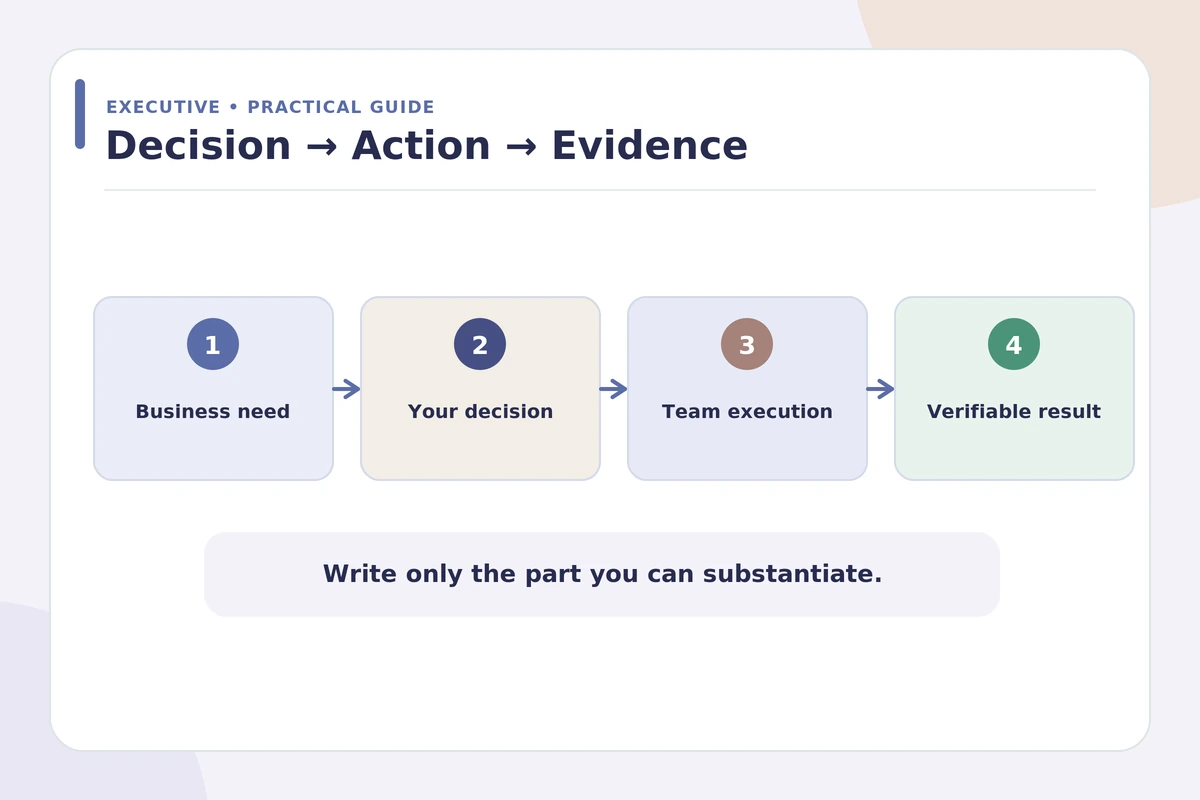
For each major role, select a few concrete stories: what business problem existed, which decisions fell within your remit, what action you took, and what happened afterward. A documented result can be quantitative or qualitative. If an improvement figure is used, know its baseline and period. If the company announced a broad revenue gain, do not attribute the entire amount to your team unless that attribution is supportable.
Hypothetical example: “Coordinated leaders across three departments to standardize an internal reporting cycle; created a shared review process and documented ownership of exceptions.” This demonstrates scope and process, not a verified accomplishment by a real person. A truthful narrative can be compelling without fabricated financial percentages, confidential deal amounts or self-bestowed awards.
Separate Accountability From Shared Credit
Senior leaders are frequently involved in work delivered by dozens of people. Explain the distinction between accountable decisions, co-sponsored initiatives and organizational outcomes. For instance, sponsoring a procurement review does not mean you personally negotiated every contract. Your resume may legitimately mention the program result while naming your role as sponsor or steering committee member. This clarity is a strength, not a concession.
Where an achievement depends on a metric your company did not publicly release, decide whether you have authority to include it. You can convey leadership scope through headcount responsibility, number of locations or process complexity only when those are verified and sharable. Replace restricted figures with truthful, non-sensitive descriptions, not invented ranges. Check your organization’s confidentiality obligations before finalizing any case example.
Compress Early Roles Without Hiding the Path
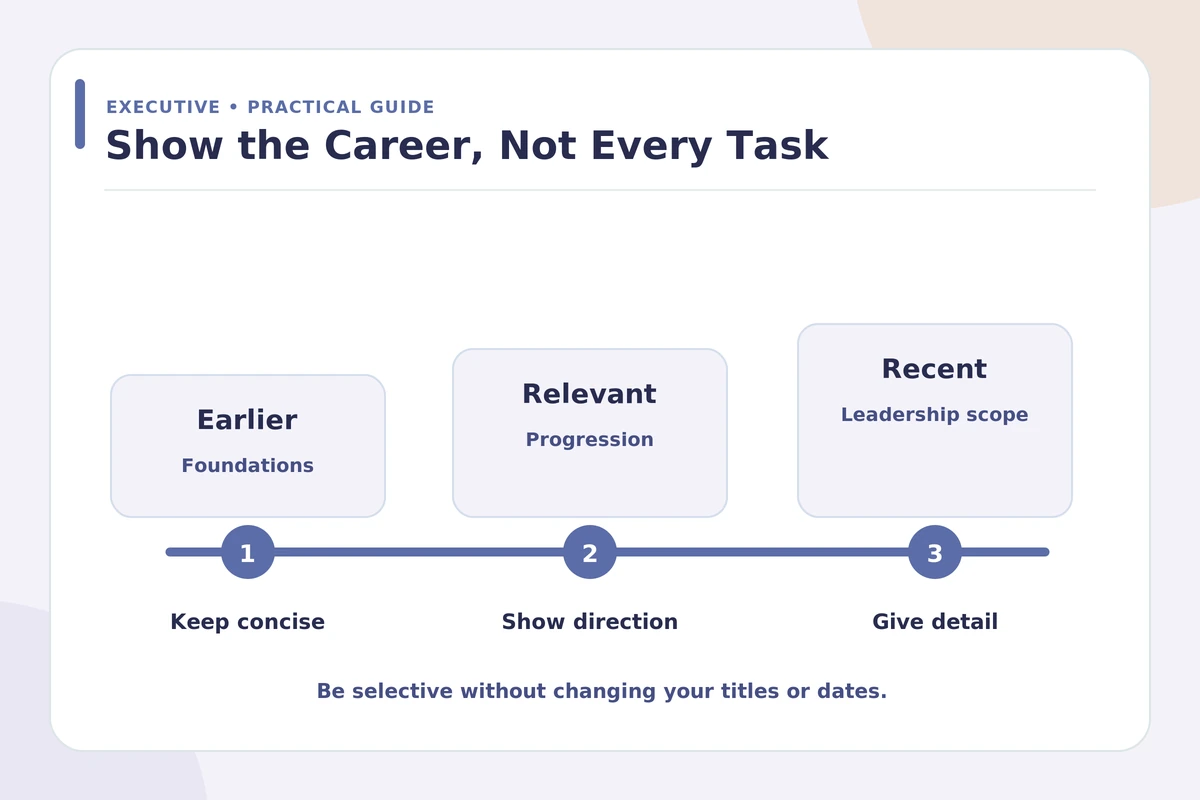
The largest portion of a senior resume should generally focus on recent and relevant leadership work. Earlier operational positions can be summarized to explain how you developed the capabilities required for the target role. Give more space to an older role when it is unusually relevant, but do not force equal bullet counts across twenty years of experience. Readers need an intelligible trajectory, not an exhaustive archive of every duty.
Keep employers, dates and titles accurate. A merged “earlier career” line can be helpful for readability where appropriate, but should not conceal a material fact or create a false uninterrupted executive tenure. Add board service, credentials, talks or publications only when relevant and genuine. If dates are complex because of acquisitions, contract work or overlapping board appointments, resolve the chronology explicitly rather than smoothing it into a misleading story.
Tailor for the Decision-Making Audience
Different readers look for different evidence. A board may prioritize governance, risk and strategic accountability; a functional executive manager may prioritize operating processes and specialist depth; a search consultant may need a concise career story with credible scope markers. Choose role evidence to answer those needs, but do not imitate the language of a job description where it would exaggerate your history.
Use one clear typographic hierarchy with ample white space. Dense paragraphs and decorative visual dashboards can hide the evidence; the explanation diagrams here help with planning, but the actual resume should remain simple and readable. A substantial career may merit more space than a student resume, yet a page limit stated by an employer or recruiter takes precedence over a universal length rule.
Run a Leadership Claim Audit
For each accomplishment ask: Is the decision mine, shared, or only in the organization’s background? Do I have a reliable record for a number? Does the wording imply authority I did not hold? Would the team recognize the account as fair? These questions surface exaggeration before it becomes an interview problem. Use precise verbs and acknowledge cross-functional contributions when they matter.
Before submission, verify current contact information, title chronology, board appointments, credentials, date alignment and online profile consistency. Remove confidential financial data and claims that depend on private material you cannot discuss. Aim for a strong, supportable leadership narrative rather than an overproduced document promising exceptional success. There is no reliable resume format that guarantees a senior hiring decision. Our guide “Leadership Skills on a Resume Without a Manager Title” adds more detail on this.
How We Research These Resume Decisions
We reviewed the public professional and university sources linked in this guide on October 22, 2026: professional guidance and professional guidance and source guidance. The visual decision aids and all writing examples are original editorial illustrations, not independent evidence that any candidate achieved a result. Source recommendations concern document conventions or eligibility context; they do not prove hiring success, software screening outcomes, or a specific personal claim.
Disclosure and limits: Every illustrative applicant or sample accomplishment in this article is hypothetical; replace it with your own verified record. No hiring outcome, employer endorsement, guaranteed screening performance, or affiliate relationship is claimed. Read the affiliate disclosure. Employers may impose different requirements; review those and your supporting documents before applying.
More Resume and Cover Letter Guides
- One-Page Resume Layout: What to Keep, Cut, and Check
- Architecture Resume Layout: Connect Project Roles to Portfolio Proof
- Two-Column Resume Layout: When to Use It and How to Check It
- Leadership Experience on a Resume: Prove Actions, Not Titles
- Resume Formats Compared: Choose a Layout That Makes Your Experience Clear
A brief, accurate scope summary can help readers understand the level and relevance of your experience.
Only with truthful context and appropriate permission; do not claim sole responsibility for an organization-wide result.
Prioritize recent and relevant roles, while preserving an accurate chronology and necessary earlier context.
No. Use verified quantitative or qualitative evidence, not invented percentages or private numbers.
Yes when real, relevant and disclosed accurately, with clear separation from paid executive responsibilities.