
After a faculty interview, write a concise thank-you email to the search committee chair, and send short personalized notes to people with whom you had substantial conversations when appropriate. Thank the department for the visit, mention one genuine teaching or research discussion, and confirm interest only if you still have it. A faculty campus visit may involve a research seminar, teaching demonstration, meetings with staff, and conversations with students; a generic corporate-style note misses that context. This guide helps you route the right message to the right academic contact without turning the follow-up into a second application dossier.
Decide who should receive the campus-visit note
Start with the itinerary rather than the entire department directory. The committee chair or designated contact usually has the clearest responsibility for the search. Send that person a direct thanks for hosting the visit, referring to the actual position and a meaningful discussion. If a faculty member held a longer one-on-one meeting, a separate, short note can mention what you discussed. A brief handshake in a corridor does not always warrant a personal email. University of Washington guidance distinguishes substantial individual contacts from momentary group interactions; local search committee instructions still take precedence.
A faculty administrative coordinator often arranges travel, rooms, accessibility details, and schedules but may not evaluate research or teaching fit. Thank that person for the logistics rather than addressing a hiring argument to them. If you were told to route all correspondence through one search contact, honor that request. Do not copy the entire committee into an identical message and assume everyone needs a reply. Map recipients to their actual roles and keep travel reimbursement or missing-receipt questions in a separate operational thread.
Name the right academic evidence from the visit
A research-intensive position calls for a different sentence than a teaching-focused appointment. A candidate who discussed the department’s shared instrumentation might thank the committee for explaining available facilities and mention a feasible collaboration they actually discussed. A lecturer applicant might point to a conversation about first-year course structure, inclusive classroom participation, or a teaching demonstration. University career guidance recommends learning the institution’s teaching and research priorities; in a thank-you email, reflect an authentic connection rather than promising an unapproved course, grant, or collaboration.
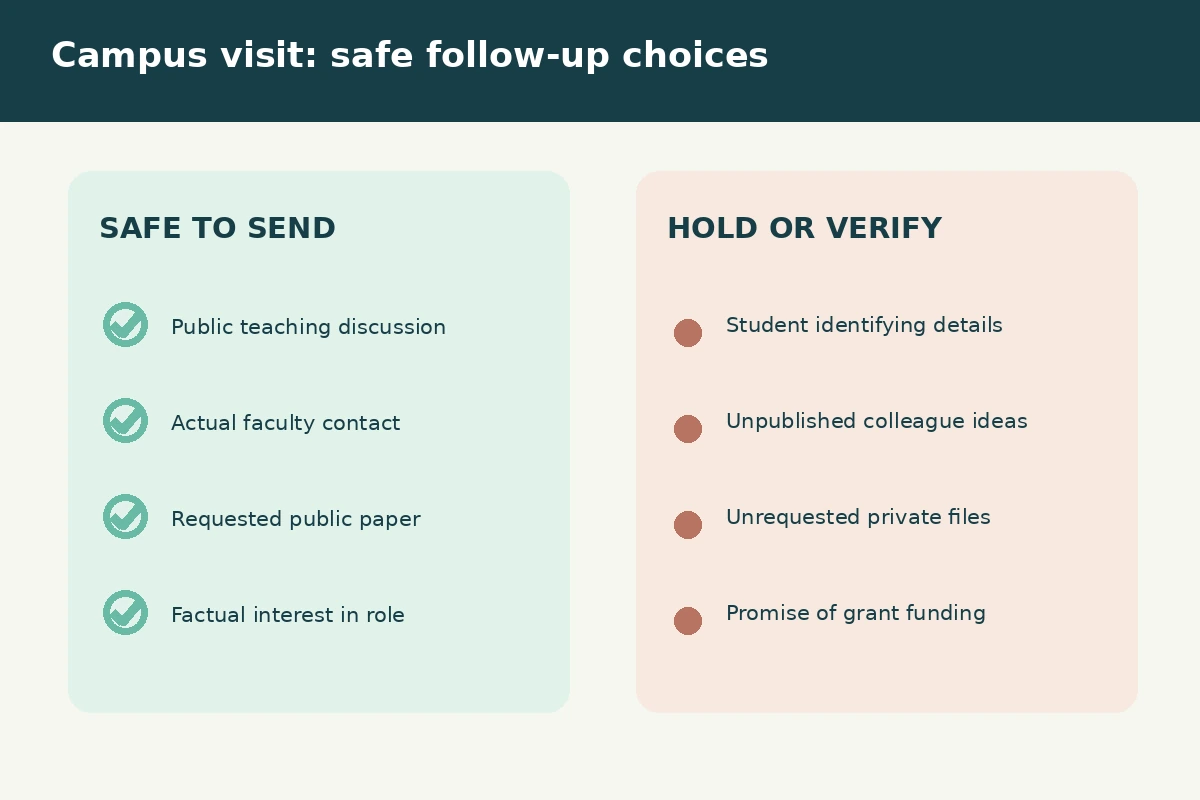
Use one concrete anchor: a question asked during your job talk, a teaching challenge discussed with faculty, or an aspect of student advising that changed your understanding of the role. Do not publish an interviewer’s unpublished research concept, disclose private student details, or write as though informal hallway suggestions were approved departmental plans. The point is to show you listened. If you cannot recall an accurate specific detail, a brief note acknowledging the conversation and the opportunity to learn about the department is stronger than a fabricated personal reference.

| Situation | Good evidence to mention | Boundary to check |
|---|---|---|
| Search chair | Thank the committee and cite visit focus | Main interview follow-up |
| Faculty member | Refer to your actual one-on-one discussion | Short individualized note |
| Coordinator | Appreciate scheduling and logistics | Separate administrative thread |
Write a chair-focused email with a clean subject line
Hypothetical model, not a message from a real applicant: Subject: Thank you — Assistant Professor interview, [Your Name]. Dear Professor [Last Name], thank you for the opportunity to visit the department and speak with the committee about the [discipline] position. Our discussion of [specific teaching or research priority actually raised] helped me understand how the role supports [real departmental need]. I appreciated meeting the faculty and students and remain interested in the position. Please let me know if the committee needs any material I offered to provide. Best regards, [Your Name]. Replace every bracketed item before sending; do not claim the committee requested something it did not.
This sample is intentionally modest. It does not restate a research statement, summarize every panel question, or demand feedback about the selection. If your strongest meeting was with a teaching-focused department, replace research talk with a real course or pedagogy discussion. If you no longer want the role, do not send false language about being excited to join. A plain acknowledgment of the academic community’s time is enough while you decide how to communicate your candidacy status through the proper channel.

Handle individual notes and promised supporting files separately
A note to a potential collaborator can be one or two sentences more specialized: ‘Thank you for discussing the department’s current work on [public research topic]. I appreciated hearing how your group approaches [public method].’ Avoid pitching a speculative joint grant or implying a commitment. A note to the teaching demonstration host can thank them for explaining the classroom context and point to one real instructional choice. Each note should be recognizably different if recipients compare it, but differences should come from the real conversation, not decorative flattery.
If you promised a teaching evaluation, publication, accessibility document, or other supporting item, follow the search instructions for file format and delivery. University of Washington notes that promised materials can accompany follow-up when appropriate. Check whether the recipient actually requested the file, whether it is public or cleared to share, and whether your department has a secure upload route. Don’t email student evaluations with identifying information or send unpublished coauthor work without permission. Travel reimbursement documents may contain private financial information, so use the institution’s prescribed route, not an unsolicited committee-wide attachment.
Choose prompt timing without manufacturing urgency
Write notes while the visit is fresh. Texas A&M’s academic interview resource suggests emailing the committee chair and committee on the same day when possible; University of Washington describes a 48-hour window. These are examples of campus-career guidance, not universal employer requirements or evidence of how a committee will rank you. If a weekend, international travel, accessibility need, or exhaustion delays you, send a thoughtful note as soon as you can. An honest delayed email is better than a hastily incorrect one containing a wrong faculty name.
Do not turn a thank-you email into a status inquiry the next morning. If the committee gave an expected timeline, record that separately and check again only when an appropriate interval passes. If you need to clarify a genuine deadline from another offer, contact the designated search representative and explain the actual date without inventing competing offers. Keep your post-interview notes private; they may include candid impressions about colleagues or students that should never be forwarded to a hiring committee.
Finish with a faculty-specific quality check
Before sending, verify the university and department names, the academic title, the people addressed, and the interview type. Confirm that the teaching, research, and service references are true to your conversations. A faculty candidate can mention a clear academic contribution without overpromising grant funding or lab space. Delete anything that reads like a second cover letter. A few accurate sentences with a useful subject line and a correct signature are easier to process than an unsolicited packet of lengthy attachments.
Keep copies of sent messages and any explicit requests for next steps. If a department asks that all questions go through its coordinator, respect the channel even if individual faculty members were friendly. Recheck any promised supporting documents against your original application and protect unpublished intellectual work. The unique value of the email is not its length; it is the accurate connection between the position, what you learned during the campus visit, and the genuine evidence you could bring.
How We Research This Interview Email Guide
We reviewed the following university, professional and occupational sources on November 16, 2026: Texas A&M career guidance on a faculty search visit and the committee-chair thank-you. University of Washington academic interview guidance on thank-you recipients, timing and promised materials. UCSF career guidance on research and teaching interviews and follow-up. We also reviewed the supplied WordPress list, including drafts, to avoid repeating existing article titles and search intents. Guidance from different career offices can vary; where it differs, follow the employer’s actual process. All sample emails are hypothetical and require personalization. No paid services are recommended here. See the JobAsk affiliate disclosure.
More Interview Preparation Guides
Not necessarily. Prioritize the committee chair and people with substantial individual interaction; follow the department’s communication preferences.
Yes, if the content reflects real differences. Reference one authentic discussion in each note and keep it concise.
Use the designated search contact or ask the coordinator which address should receive academic follow-up.
Only if requested or promised and permitted to share; otherwise offer the material and use the required submission channel.
No universal rule requires one. Academic career offices recommend timely, professional thanks, but hiring procedures and norms vary.