
Finance manager career goals should improve how financial information becomes a trustworthy decision, not just promise higher profits. A practical goal could be to review forecast assumptions with their owners, document significant changes, and prepare a one-page explanation of unresolved uncertainty for management. That is more defensible than “increase revenue by a large percentage” when the manager cannot control the outcome alone.
The Bureau of Labor Statistics describes financial managers as preparing reports and forecasts, reviewing financial performance, supervising work, and advising on decisions. These responsibilities require attention to data quality and delegated authority. A good development plan identifies which report you can review, who approves decisions or disclosures, and how your team will verify figures before presenting them. Learning a tool is useful only when paired with a stronger review practice.
Choose a Forecast Decision Instead of a Vague Target
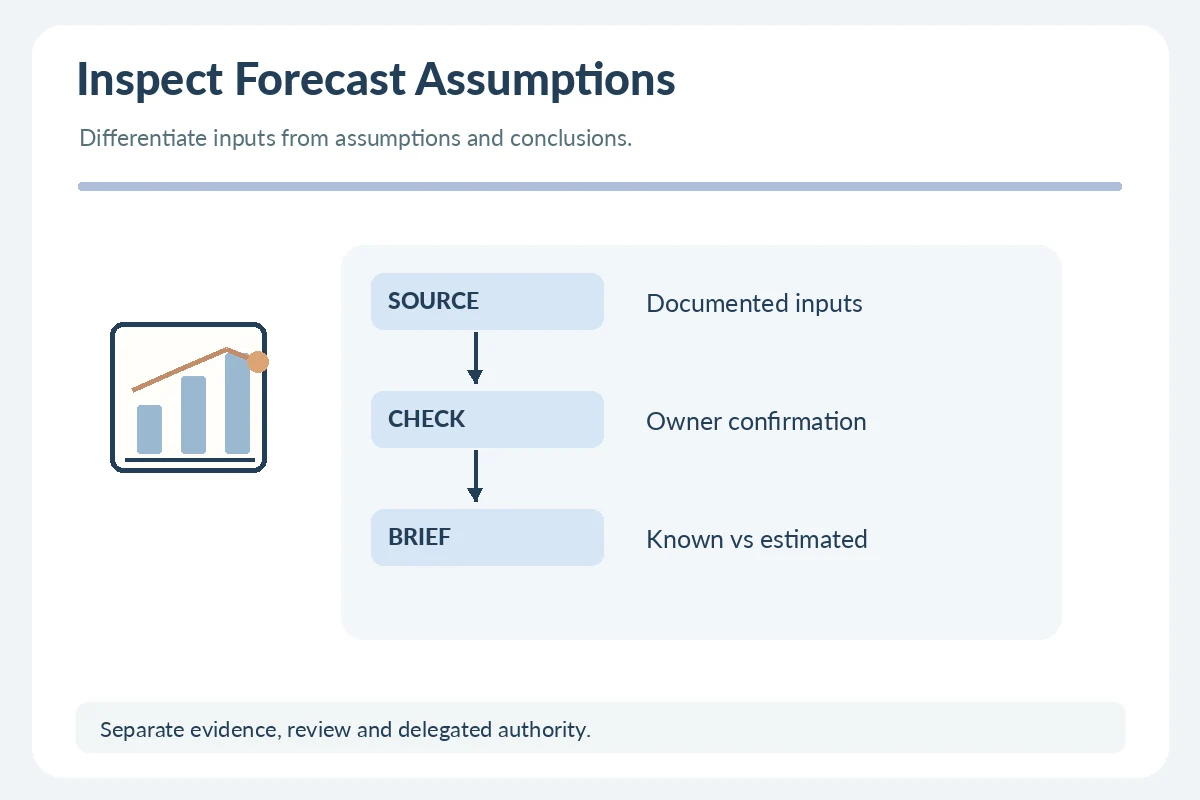
Start with one forecast used by actual decision-makers, such as a departmental expense outlook or cash planning scenario. Ask what question the forecast is meant to answer, which assumptions matter most, and who owns each input. Some variables are estimates; others come from recorded activity. Your goal is to improve transparency about those differences, not to manufacture precision.
Create a small assumption register with the source, date, owner, and open question. When an input changes, preserve enough version context to understand why the projection moved. The manager responsible for the forecast may not be the authorized approver of spending, external statements, or investment action. State those approval boundaries clearly and route unresolved material assumptions to the proper reviewer.
| Career growth area | Reviewable proof | Boundary to preserve |
|---|---|---|
| Forecast assumption | Source, owner and review date | Not an approved prediction |
| Control exception | Document discrepancy and reviewer | Do not authorize own correction |
| Management brief | Known facts, alternatives, decision needed | No unsupported approval claims |
Build a Repeatable Review of Exceptions
Controls are easier to strengthen when the team knows what exception warrants investigation. Define the check in plain language: missing source document, mismatched period, unexplained manual change, or inconsistent category mapping. Record the exception and route it to the person responsible for correction or approval. Do not assume a junior analyst can both create and authorize a material change simply because a spreadsheet permits it.
An illustrative goal is to pilot a reviewed exception log for one reporting cycle and ask internal stakeholders whether it helped them locate unresolved items before sign-off. Avoid a made-up “zero errors” promise; data quality depends on multiple people and systems. Your evidence may be the clearer handoff and traceable closure, with real metrics only if they were legitimately collected and approved for use.
Turn Complex Numbers Into Decision-Ready Briefs
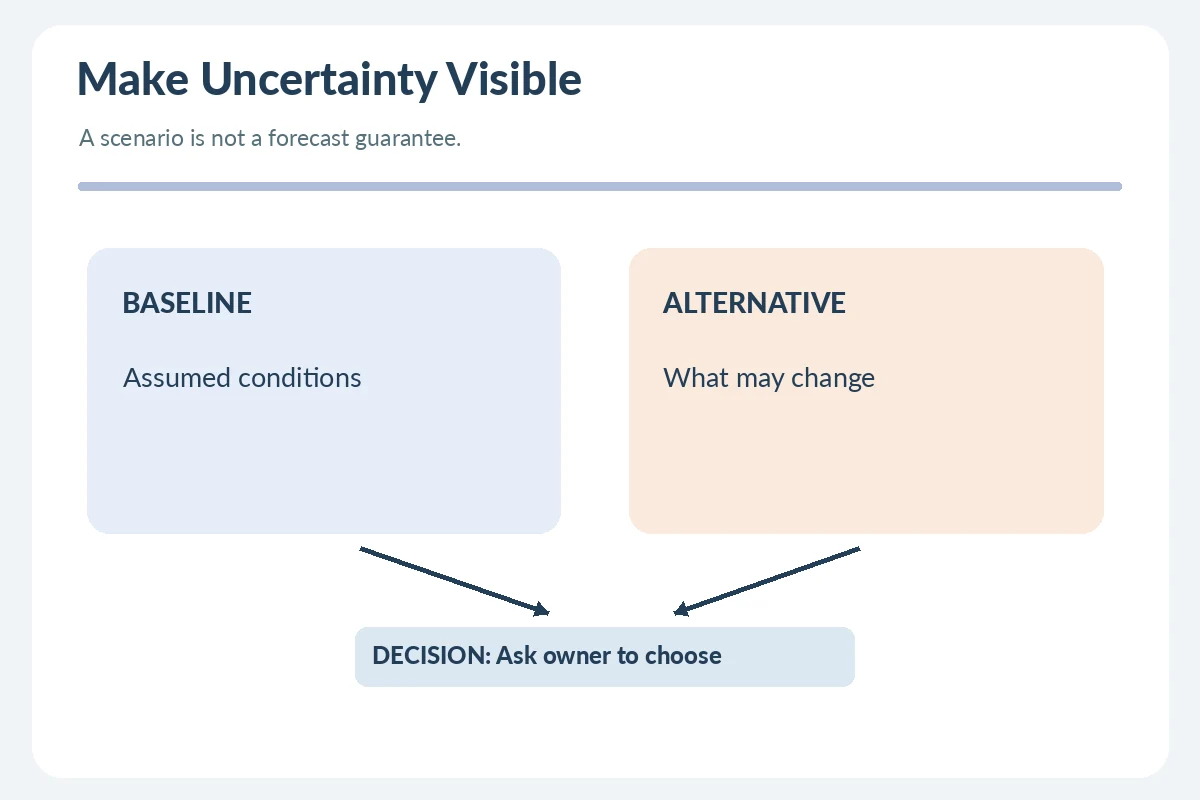
A management brief should distinguish known results, assumptions, sensitivity, and the decision requested. Imagine an expense forecast dependent on supplier timing. Instead of claiming a single definitive future figure, explain the baseline assumption and a plausible alternative, identify the affected decision, and mark the questions that still need owner confirmation. Label illustrations as fictional so the example cannot be mistaken for company guidance.
The communication goal could be: “prepare a one-page financial decision brief for a recurring internal review, include sources and open assumptions, and request structured feedback from the recipient.” Feedback should ask whether the brief separated fact from estimate and made the next step clear. Neither the brief nor a scenario chart should imply regulatory approval or a guaranteed business outcome.
Illustrative goal: “During the next reporting cycle, pilot an assumption register and reviewed exception log for one internal forecast, then collect manager feedback on whether the decision brief made uncertainty visible.” No financial outcome is promised.

Develop the Team Without Blurring Approval Rights
A finance manager’s growth includes coaching staff who prepare and check information. Clarify the separation of preparation, review, exception resolution, and final sign-off in the actual organization. Encourage analysts to document open questions and to escalate when records do not reconcile. A helpful coaching milestone is the quality of review notes rather than the claim that every trainee suddenly became a financial decision-maker.
Use sample or authorized internal material for practice. If the organization allows a fictional training worksheet, have a colleague trace a reported total back to its source and flag an intentionally missing assumption. Ask the reviewer which instructions were clear and which were ambiguous. Do not post employer statements, client names, bank identifiers, or unrestricted screenshots to show personal development.
Use Sensitivity Checks to Explain Uncertainty
A forecast can become misleading when its key assumptions are hidden. Choose one permitted scenario, document what changes when a major input moves, and explain what does not change. The objective is to communicate uncertainty proportionately, not to predict a future outcome with certainty. Verify that any scenario circulated internally has been checked by the appropriate owner and conforms to the organization’s reporting controls.
When presenting alternative scenarios, make the labels unambiguous: “illustrative planning case,” “assumption under review,” or “approved baseline.” Do not present unapproved assumptions as official company guidance. A strong manager recognizes when a question requires input from treasury, accounting, legal, operations, or leadership instead of giving the impression that a spreadsheet alone authorizes a business decision.
Evaluate Progress Through Reviewable Artifacts
A practical sequence may begin with an input-owner map, progress to a pilot exception log and forecast briefing, and end with manager feedback on clarity and auditability. This is a personal development schedule, not a reporting requirement. Retain only materials your employer allows and separate learning artifacts from confidential operational records. The point is to demonstrate a more reliable process, not to collect sensitive data as career evidence.
When discussing advancement, distinguish managing a reporting workflow from holding delegated financial authority. Your career goal might prepare you for broader budgeting responsibility, but readiness should be assessed through actual role requirements, coaching, and reviewed decisions. State what you did: designed the review, explained exceptions, supported a discussion, or recommended an improvement. Avoid taking sole credit for a financial result produced by the whole organization.
How We Research Career Development Guidance
We checked these occupational and professional-development sources on 2026-11-14: Bureau of Labor Statistics (BLS identifies financial reports, forecasts, monitoring, supervision and management advice as financial management duties.); National Association of Colleges and Employers (NACE supplies a general evidence-based career development framework emphasizing ethical technology use and critical thinking.); Bureau of Labor Statistics (BLS distinguishes preparation, checking and review of financial records from broader management judgments.). We also compared the topic with the provided JobAsk WordPress title inventory and recent local packages. The examples and time windows in this page are illustrative, not employer policies, promised outcomes, verified applicant histories, or permission to work outside a professional scope. Readers should confirm local licensing, delegation and privacy policies with their own supervisor or responsible authority. See the JobAsk affiliate disclosure; this page does not imply that any named organization endorses a product or relationship.
Explore Related Career Guides
Choose a reviewable responsibility such as clearer forecast assumptions, exception escalation, or better management decision briefings.
Not unless the measure, baseline, responsibilities, and attribution are supported. Forecast review is often a more defensible learning outcome.
Only if the organization’s actual controls and delegation permit it. A development plan should reflect existing review and approval roles.
Use a fictional or fully authorized example with no confidential inputs, customers, or unpublished company information.
It proves a learning activity, not decision authority. Add an approved practice exercise and feedback that demonstrate how the skill was used.