
“Fully remote” describes how work is organized, not necessarily every place from which a person may perform it. Before applying, check the approved residence or work location, required time-zone overlap, travel or meeting expectations, and whether the position is truly remote or hybrid. If any item is unclear, use the employer’s real careers page to confirm it rather than assuming that “anywhere” is implied.
All people, accomplishments, interviews, and sample situations in this guide are hypothetical unless expressly identified as verified source information. Adapt any example only to work you genuinely performed. Remote eligibility, hiring conditions, authorization, and workplace policies must be confirmed directly with the real employer.
Separate Work Arrangement From Geographic Eligibility
Begin with three distinct questions: Can the job be performed away from an employer office? From which locations will the employer hire? Must work occur during a stated set of hours? A listing can answer yes to the first and still restrict the second or third. Terms such as “remote,” “US remote,” “remote within selected states,” and “work from anywhere” communicate different possibilities; only the exact employer posting and written terms settle the question for a particular role.
Create a small grid for each vacancy with columns for work arrangement, approved geography, on-site attendance, time-zone overlap, and unresolved questions. Write “not stated” when a detail is missing instead of treating silence as permission. For example, “remote — Northeast US” does not establish eligibility for someone located in another region. Likewise, a global company is not proof that every open position can be performed from every country.

Why a Remote Employer May Name Approved Locations
Remote employment can create location-sensitive responsibilities for the organization and the worker. The National Conference of State Legislatures explains that state and local tax considerations can depend on where a person physically performs work. That does not tell an individual worker which location is allowed; it explains why the employer may have a specific approved-state list or relocation process.
Other constraints may include customer coverage, equipment shipping, secure access, scheduled office visits, and employment administration. Never assume that being able to log in is the same as having permission to work from a new address. Ask HR or the recruiting team about the applicable arrangement before planning a move. For work across countries, obtain the employer’s explicit policy and qualified advice rather than relying on a general career article to make immigration or tax decisions.
Screen the Job Posting With a Location Decision Tree
Read the title, work-location field, eligibility section, and the actual job description together. If the posting says “hybrid” or lists mandatory office days, do not classify it as fully remote simply because video calls are available. If it specifies a state or region, check your real working location against that condition. If it says “anywhere” but names required hours, decide whether you can work those hours consistently.
In a hypothetical search, two coordinator postings both display a “remote” search badge. Posting A says US-based and requires quarterly office visits; Posting B allows remote work only within a named state. A person outside that state should not proceed on the assumption that B is open nationwide. A person who cannot make quarterly visits should ask about A before applying. The best filter is not the label; it is the set of actual duties and conditions.

Verify the Employer and Application Route
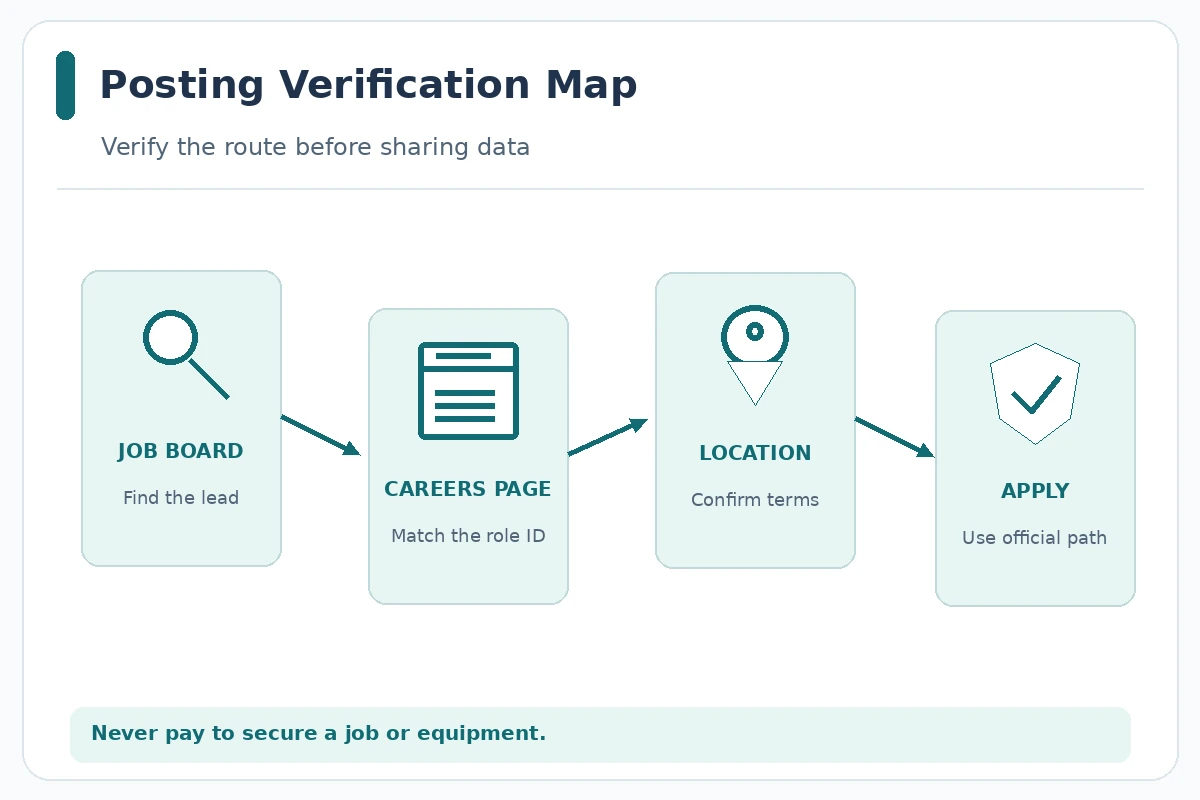
Use a job board to discover an opportunity, then independently locate the opening on the employer’s website when possible. Compare the title, requisition ID, location and application instructions. The FTC warns that scammers can impersonate real companies and arrange convincing-looking interviews, particularly for remote roles. Verification should happen before supplying sensitive identity or banking details.
A recruiter who pushes you into an unrelated messaging app, asks for equipment-payment money, or provides a check to be deposited and forwarded should not be treated as verified because a logo looks professional. The FTC’s 2026 alert describes fraudulent work-from-home offers initiated through unsolicited messages. Stop when an independent route cannot confirm the vacancy, and use the original platform’s reporting process if the listing appears fraudulent.
Ask Focused Questions Before Accepting the Role
When an employer responds, ask: “From which states or countries may this role be performed?” “What time-zone overlap is required?” “Are there mandatory onsite visits or training days?” and “What is the procedure for a future address change?” Keep each question neutral. Hiring teams may have an established policy that cannot be negotiated, and an individual recruiter may need to consult HR before answering.
Before signing any offer, compare the remote terms with the written documents: worksite, expected hours, possible travel, employer-provided equipment and who approves location changes. A verbal reassurance is not a reliable substitute for finalized terms. Save the posting and employer’s answer for your decision record, but do not share confidential offer text publicly.
Build a More Accurate Remote Search Filter
Start with a role you can actually perform, then use “fully remote,” “US remote,” a named state, or “work from anywhere” as a second filter. Exclude hybrids and roles requiring unsupported credentials. An application tracker can include the posting date, official employer link, location restriction, time-zone requirements, application status, and the next follow-up date. These columns help prevent confusion between similar listings.
Do not treat an online list of “best companies” as evidence that a role is currently available or open to your location. Search results become stale quickly. Your useful shortlist is the set of independently verified, still-open positions where the position requirements and your true circumstances match. If eligibility remains uncertain, mark the lead “needs employer confirmation,” not “eligible.”
A Practical Screening Worksheet You Can Reuse
For a real vacancy, write down the exact title and employer careers URL; authorized work location; required hours and travel; three core duties; one truthful example for each duty; software or training gaps; who supervises or approves sensitive work; and the next step or due date. If a field is unknown, write “ask the employer.” Do not fill missing information by guessing at a salary, employer policy, credential, or applicant eligibility.
A hypothetical candidate might rate one posting “match pending location confirmation,” another “not eligible: required hours conflict,” and a third “ready to apply: role and employer verified.” The purpose is to allocate time to real, defensible options. It does not measure the probability of receiving an interview and cannot guarantee a hiring outcome.
How We Research Remote Job Searches
We separate U.S. occupational descriptions from employer-specific remote rules. BLS describes occupations, not real-time openings or permission to work from any location. FTC consumer alerts establish potential scam patterns, not that any named posting is fraudulent. We checked these professional and primary sources on October 27, 2026:
www.ncsl.org — Explains how physical work location can affect state and local taxation.
consumer.ftc.gov — Explains how fake remote postings can impersonate legitimate employers.
consumer.ftc.gov — Describes fraudulent unexpected remote-job recruiting messages.
This article does not list verified live vacancies, provide legal or tax advice, certify recruiters, or guarantee placement. Some links may be editorial; no affiliate relationship is asserted. See the JobAsk affiliate disclosure before making purchasing or career decisions.
Related Job Search Guides
- How to Find Legitimate Remote Jobs and Check Their Real Requirements
- Remote Job Boards: Filter by Location, Time Zone, and Hiring Rules
- Entry-Level Remote Administrative Assistant Jobs: Show Calendars and Record Accuracy
- Remote Inside Sales Jobs: Check Territory, CRM Tasks, and Commission Terms
- Remote Bookkeeping Jobs: Check Reconciliations, Software, and Client Controls
Not necessarily. Check the exact countries approved for the role and get employer confirmation before moving or applying.
No. Hybrid roles include some onsite work; a fully remote role may have no regular office days but still require travel or specific locations.
Employers may have employment-administration, tax, operational, or customer-coverage constraints. The posting and authorized employer answer control the specifics.
You may ask whether the employer can consider your location, but never misrepresent your address or assume an exception has been approved.
Independently verify that the opening and application route belong to the real employer before sending sensitive information or money.