
The simplest greeting is usually enough
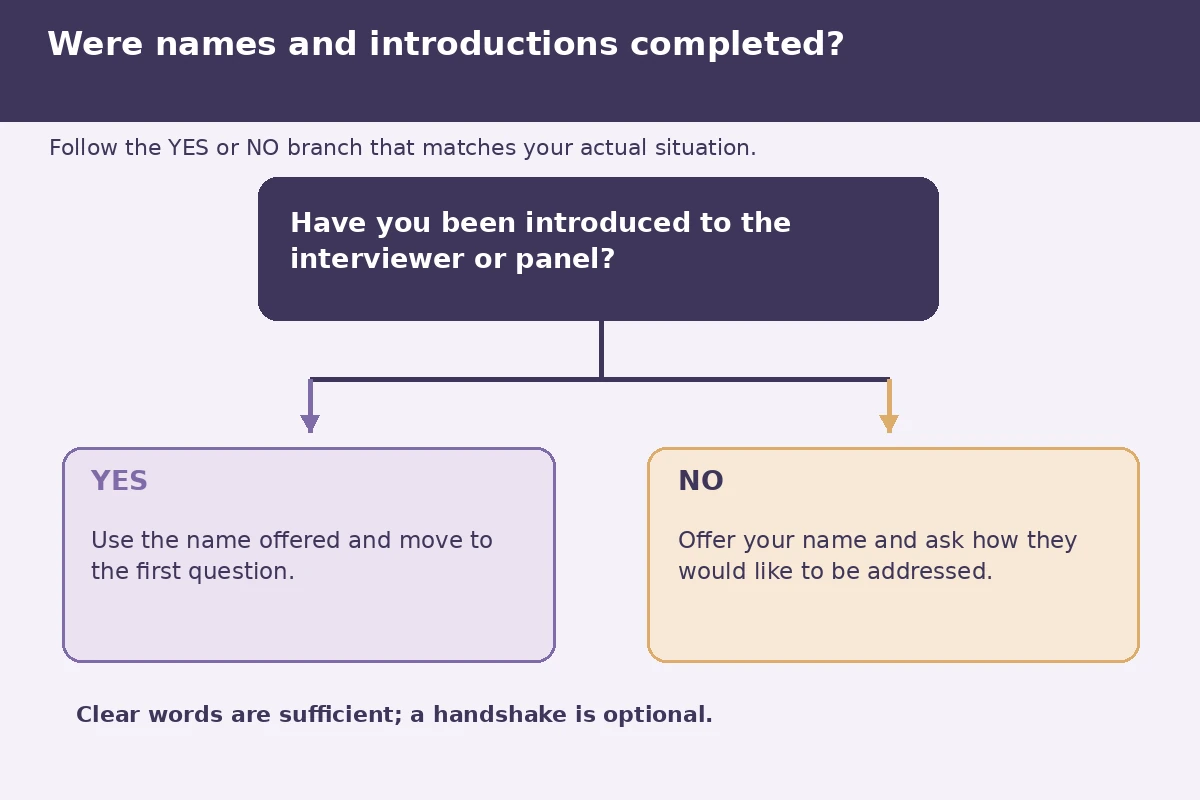
A professional interview greeting can be short: “Good morning, I’m Taylor Morgan. It’s nice to meet you, and thank you for having me.” Speak at a comfortable pace, then let the interviewer respond. That is more useful than trying to deliver a memorized speech in the doorway. Your greeting should identify you, acknowledge the meeting and make it easy to transition to the interview. Whether the setting is formal, informal or online, avoid assuming that eye contact, a handshake or a particular small-talk style is the only acceptable way to show respect. The aim is understandable communication, not an acting performance.
The front desk is a separate introduction
At a staffed office, the first person you meet may not be the interviewer. Tell the receptionist your name, appointment time and contact if requested: “Hello, I’m Taylor Morgan. I’m here for a 10:30 interview with the support team.” Follow the check-in process without treating the person as an assistant you can order around. If there is a sign-in tablet, enter only the requested information and do not photograph the screen. If reception asks you to sit, quietly prepare your notes. You need not recite your work history to the front desk or ask whether other candidates have already arrived.
Use names without guessing titles or pronunciations
If an interviewer introduces herself as “Dr. Rivera,” using “Dr. Rivera” initially is reasonable. If she invites you to use her first name, follow that preference. Avoid deciding based on appearance what title, pronoun or name someone uses. If you did not hear a name, ask once: “I’m sorry, could you repeat your name?” If you are unsure about pronunciation, a brief confirmation is more respectful than repeatedly guessing. Names can be noted on a small card or paper. The goal is to listen and respond, not to put every name into every sentence unnaturally.
Handshakes are optional, not a universal requirement
Some career-center advice mentions a firm handshake, but not every interview involves physical greeting. In virtual meetings, across a large desk, or when someone chooses not to shake hands, a verbal welcome is enough. If an interviewer offers a hand and you are comfortable, reciprocate briefly. If not, a warm “It’s good to meet you” can carry the introduction. Do not grab someone’s hand, comment on a disability, or judge the quality of an interview by grip strength. An employer’s reasonable-accommodation obligations and a candidate’s accessibility needs are more important than any rigid etiquette ritual.

Meeting a panel without losing the room
For a panel, greet the group first: “Good afternoon. Thank you all for meeting with me.” If names are given one at a time, listen and use the seating chart or introductions rather than trying to memorize everything instantly. Direct your answer primarily to the person who asked the question, while including the rest of the group naturally. Do not spend so long greeting each panelist that you delay the agenda. A brief note such as “I’m glad to learn more about how this team works together” can transition to substantive discussion. If a panelist joins late, acknowledge the introduction once and continue.
Starting a video interview cleanly
Join using the name on your application unless the employer instructs otherwise. When admitted, check that the microphone works, then say, “Hello, I’m Taylor. Can you hear me clearly? Thank you for meeting with me.” Pause for a reply before launching into your pitch. Avoid filling silence caused by a lag with repeated greetings. If you are placed in a waiting room, follow the host’s directions rather than repeatedly leaving and rejoining. Harvard career guidance advises checking your technology and finding a quiet setting in advance. Keep a phone or recruiter email available for a genuine connection failure.
| Check | What to prepare | Important boundary |
|---|---|---|
| Reception | Name and appointment | Avoid demanding immediate access |
| Interview room | Name, role and thanks | Match how people introduce themselves |
| Video or panel | Audio check and brief introduction | Address all panelists without rushing |
If the interviewer seems rushed or informal
Match the pace without surrendering clarity. If someone opens with “Hi, Taylor, let’s get started,” respond briefly and be ready for the first question. If they make light conversation while walking to a room, you can discuss your travel or the office without probing into personal lives. Avoid using scripted flattery such as “I’ve always dreamed of meeting someone as successful as you.” A useful greeting establishes respect while leaving space to learn about the role. The interviewer may have several meetings in a row; your ability to transition efficiently can be more useful than a long introduction.

Repair mistakes without making them bigger
People occasionally mishear a name, begin speaking while muted or greet the wrong person. Correct it once and continue. “Sorry, I said that incorrectly—Ms. Chen, thank you for the correction.” Or, on video: “I was muted. Good morning, and thank you for your patience.” Avoid elaborate apologies that consume the first several minutes. If an interviewer mispronounces your own name, you may offer a calm correction: “I pronounce it MAY-ah.” This helps the conversation move forward. A small stumble rarely tells the full story of your preparedness, and there is no need to pretend otherwise.
How to introduce your background in one sentence
A greeting is not the same as an answer to “Tell me about yourself.” If asked for a quick introduction, offer your role or current focus and a connection to the position: “I work on customer onboarding and recently coordinated a new training guide; I’m interested in how this team supports new clients.” Keep that example truthful and relevant. If you are a student or career changer, name the project or experience you actually have. Wait for the interviewer’s invitation before giving a longer story. An introduction is a bridge to the interview, not a substitute for evidence later.
Closing courtesy begins in the first minute
At the end of the interview, thank the person or panel for the conversation and ask about next steps if they have not been covered. If you met multiple panelists, you can thank them collectively instead of repeating a formal speech five times. Use the preferred name in a follow-up message when it is known, and verify spelling from an official signature rather than guessing an address. Courteous greetings and closings matter because they make collaboration easier. They do not replace the quality of your answers, qualifications or fit with the work.
Practice three settings, not one performance
Rehearse the front desk, interview-room and video versions aloud once. Have another person vary the opening: a panel unexpectedly joins, someone says their name quickly or your microphone starts muted. Practice responding plainly rather than learning a rigid formula. If eye contact or other nonverbal interaction is difficult, prioritize clear verbal exchanges and request any needed accommodation. A good greeting is one that lets the conversation begin smoothly and leaves the interviewer with a clear understanding of who you are. The most sustainable version will sound like you, not like a template.
How We Research and Verify Interview Guidance
We reviewed the following sources on November 16, 2026: University of Kansas Career Center emphasizes courteous arrivals, greeting and thoughtful interviewer interaction. Harvard interviewing guidance describes preparation, communication and virtual interview practices. EEOC outlines reasonable accommodation in interview and other hiring processes. These guides are for US job seekers; employer instructions and applicable law take precedence over generalized etiquette. Hypothetical names, times and scenarios are examples, not real employer results. Review the affiliate disclosure.
More Interview Preparation Guides
No. A courteous verbal greeting works when physical contact is not offered, possible or comfortable. Follow the other person’s lead without pressuring them.
Address the group briefly, listen to introductions and then direct answers to the questioner while acknowledging the others naturally.
Use the title or name they introduce themselves with; follow a preference they explicitly offer.
Ask for the correct pronunciation, apologize briefly if necessary and continue without dwelling on the mistake.
Introduce yourself, check that you can hear and be heard, thank the interviewer and pause for the response.