
Volunteer work belongs on a resume when it helps a reader understand skills you can actually demonstrate. Put closely related responsibilities under Experience or Relevant Experience; use a clearly labeled Volunteer Experience section for useful but less directly related service. Show your role, organization, dates, and specific tasks. Never make unpaid work look like paid employment or imply results you did not measure.
The useful question is not whether volunteer work “counts.” It is whether you can explain what you did, how independently you did it, and why that activity matters for this particular application. A school event, neighborhood pantry, student association, or community program can each be relevant for a different reason. The examples below are explicitly hypothetical structures, not claims about real organizations or applicants.
Choose the Section Based on Relevance
Start with the target posting and circle two or three duties you have genuinely practiced. For an administrative opening, coordinating sign-in records may be more relevant than the name of the cause. For a customer-facing role, answering visitors’ questions may matter more than collecting donations. If your volunteer duties closely resemble those in the posting, placing the entry in a combined Relevant Experience section can make the connection obvious. Label the role as Volunteer Coordinator or Volunteer Assistant only if that was your true position.
If the work is valuable but unrelated to your job goal, use a separate Volunteer Experience or Community Involvement section lower on the page. That keeps your paid work history distinguishable and avoids making the reader infer the relationship. The CareerOneStop optional-sections guide specifically treats community involvement as a possible resume component whose relevance should drive the choice.

| Situation | Better placement |
|---|---|
| Related duties and limited paid work | Relevant Experience |
| Relevant service alongside several paid jobs | Experience, clearly labeled volunteer |
| Community activity unrelated to target job | Volunteer Experience or omit |
Write the Role and Dates Accurately
A reader should be able to identify the organization, your function, and when you did the work without guessing. A compact line could be “Volunteer Event Assistant | Community Arts Program | May–August 2025.” That is a hypothetical example, and the name and dates are placeholders. Use the dates and the title the organization would recognize. If work was intermittent, describe it honestly as occasional or event-based instead of suggesting a full-time role.
Avoid giving yourself a manager title because you sometimes helped direct traffic or explained a process. If you led a volunteer shift, say what you coordinated and how you know. If you were trained or supervised, retain that context when it affects the responsibility. This approach protects the distinction between being present at an event and performing a task an employer can assess.
Translate Actual Duties Into Skill Evidence
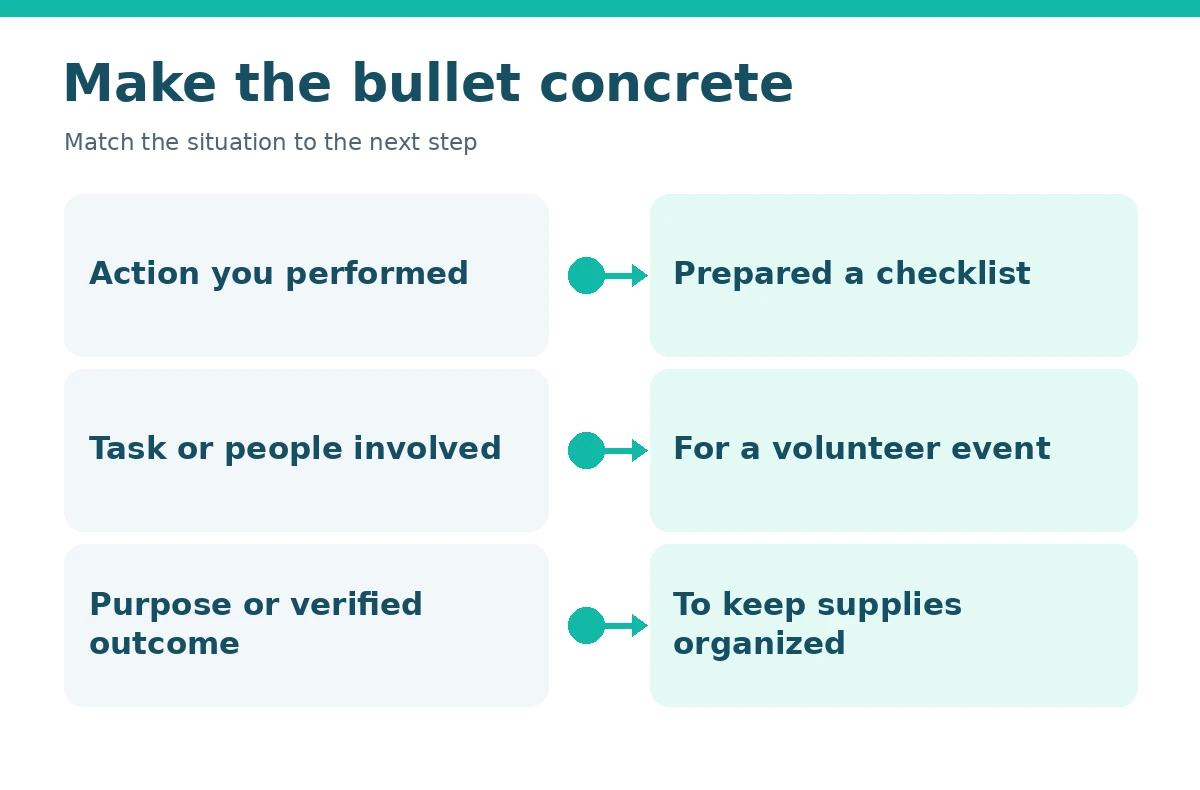
A strong bullet normally identifies an action, a specific object, and a result or purpose that can be explained. “Helped people” gives little evidence. In a hypothetical situation, “Directed visitors to check-in stations and explained the event schedule during two weekend shifts” is more informative—but only if every detail is true of the applicant. If you tracked sign-ins, say that; if you merely handed out flyers, do not imply ownership of a registration system.
Use quantities only if you can verify them from your notes or the organization. If you cannot establish a count, a precise nonnumeric description still works: “Updated a shared supply checklist before each volunteer shift.” The Penn resume guide recommends meaningful descriptions of the contribution and the skills involved, not a string of unsubstantiated personality traits.
| Weak claim | More useful, if true |
|---|---|
| Helped at events | Explained check-in steps to attendees |
| Organized everything | Prepared the volunteer supply checklist |
| Great communicator | Answered visitor questions using event information |
Audit the Proof Before You Send It
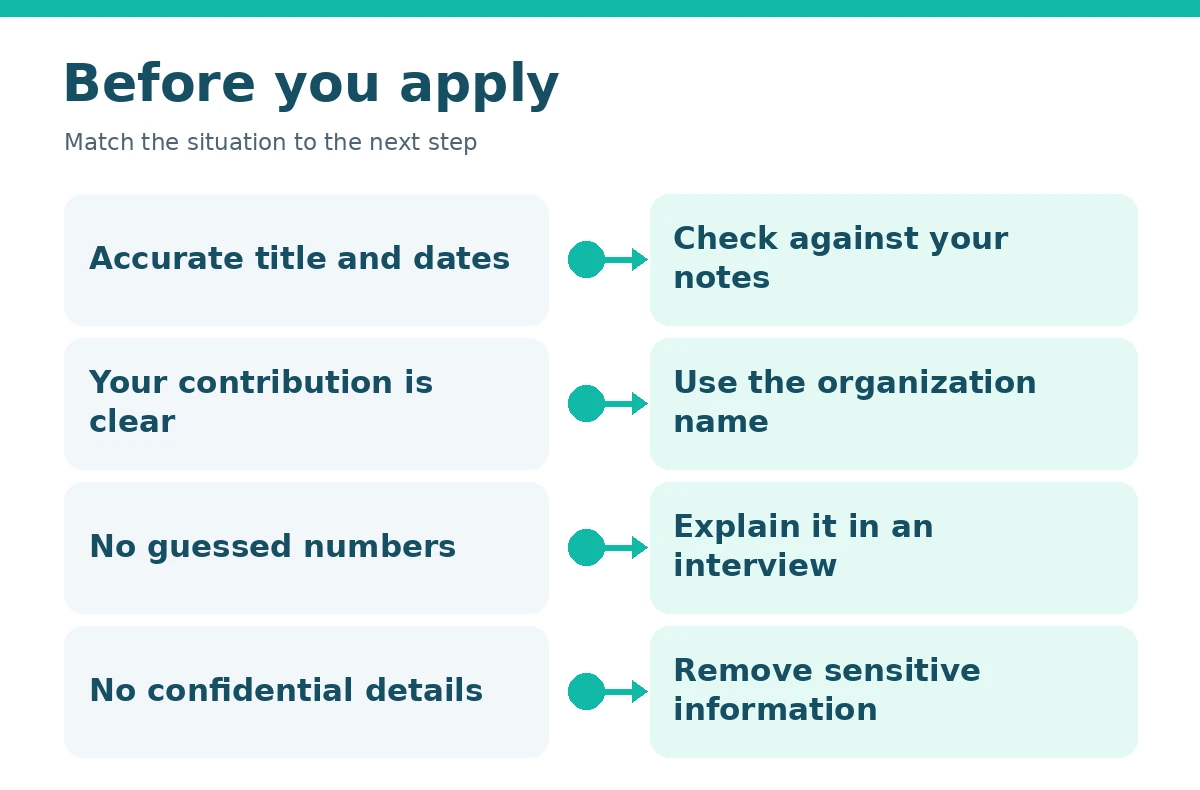
For each statement, ask what document, memory, coworker, or example would let you describe it clearly in an interview. You do not need a certificate for every task, but you should know whether you handled records, answered questions, solved a problem, or simply observed. If an outcome came from the entire team, write “contributed to” or describe your own part rather than taking credit for the group’s results.
Check spelling of the group’s public name, your title, and month-year dates. A resume is not a legal employment record, but accuracy is still essential. You can omit unrelated personal information about the group while keeping a truthful account of the work. If the volunteering involved confidential clients or sensitive data, describe the process at a high level and leave identifying details out.
Adapt the Same Experience to Different Jobs
One volunteer entry may support different job goals without changing the underlying facts. For customer service, emphasize questions handled and information clarified. For office support, emphasize records, schedules, or inventory you actually maintained. For operations, describe handoffs and checking steps. Tailoring means selecting the relevant part of real work, not rewriting your history to fit whatever terms appear in a job posting. Our walkthrough on how to put volunteer work on a resume without calling it paid work sets out each step.
Before deleting an entry, compare it with your other evidence. If a recent volunteer assignment is the clearest example of the required task, it may deserve more space than an older unrelated paid job. If you already have several recent paid examples showing the same skill, condense volunteering to one line or omit it. This is an editorial choice, not a universal ranking rule.
| Target job | Evidence to emphasize |
|---|---|
| Reception or customer service | Visitor questions and clear explanations |
| Administrative support | Schedules, sign-ins, inventory |
| Operations support | Task handoffs and process checks |
Revise a Hypothetical Entry Carefully
Hypothetical practice entry: “Volunteer Distribution Assistant | Community Resource Event | June–September 2025. Prepared labeled supply groups before scheduled events; checked pickup instructions with the team lead; explained collection steps to visitors.” No real organization, person, date, or outcome is being asserted here. This sample demonstrates observable duties without invented savings, attendance totals, or hiring results. If you want the full process, read how to put volunteer experience on a resume without Overclaiming.
To adapt the example, replace the entire scenario with your own experience. Identify the recurring task first, describe what you personally controlled second, and add an outcome only when you can substantiate it. If you did not interact with visitors, remove that clause. If you worked once rather than for several months, use the correct event date. A credible short entry beats a dramatic story you cannot defend. If you want the full process, read how to put an internship on your resume with honest project bullets.
How We Research and Check Resume Advice
Our method distinguishes the cited recommendations from the original decision tables, diagrams, and hypothetical examples created for this page.
This article does not claim a hidden employer screening rule, test an applicant tracking system, or predict job outcomes. Examples are constructed practice material, not actual candidate results. Confirm current application instructions and replace every fictional detail with your own verifiable history.
Source Notes and Affiliate Disclosure
cloudfront.careeronestop.org source guidance: CareerOneStop lists volunteering among optional resume sections when relevant to work goals. Accessed 2026-10-21. We cite this guidance only for the associated format or writing recommendation.
careerservices.upenn.edu source guidance: Penn Career Services says paid and unpaid relevant work can appear as experience and recommends concrete contribution-focused descriptions. Accessed 2026-10-21. We cite this guidance only for the associated format or writing recommendation.
cloudfront.careeronestop.org source guidance: CareerOneStop recommends collecting experience from paid and unpaid jobs, internships, and volunteering in a master resume. Accessed 2026-10-21. We cite this guidance only for the associated format or writing recommendation.
This guide contains no affiliate links. Read the site-wide affiliate disclosure. All examples are hypothetical and should not be copied as personal history.
More Resume and Cover Letter Guides
- Babysitting Experience on a Resume: Show Routines, Safety, and Trust
- How to Put Internship Experience on a Resume With Accurate Role Details
- Leadership Experience on a Resume: Prove Actions, Not Titles
- Military Experience on a Civilian Resume: Translate Duties Accurately
- Research Experience on a Resume: Explain Methods, Records, and Your Contribution
Yes, if its responsibilities are relevant. Use a heading such as Relevant Experience and label the position as volunteer. Otherwise a separate Volunteer Experience section is often clearer.
Make the role identifiable as volunteer work. You do not need to describe compensation, but you should never imply paid employment when none occurred.
Yes, when the tasks are useful evidence. Provide the event date and describe a specific contribution without suggesting a long-term position.
Use accurate actions, tools, or process details. Do not invent visitor totals or claimed improvements just to sound impressive.
You can give highly relevant volunteer work more space, but keep an honest chronological account of employment if the application asks for it.