
The first paragraph of a cover letter should identify the actual role you want, show a believable reason you are interested, and introduce evidence that you can help with the work. It does not need a dramatic hook or an invented personal connection. Read the posting, verify one relevant employer fact, and choose one truthful strength before writing. This focused guide covers the opening only; the full letter structure and formatting belong in the separate JobAsk cover letter guides. Every applicant and organization below is fictional.
Start by identifying the role and reader need
An opening sentence works when the employer can tell why this letter arrived. Include the real job title and organization name when known, using the description’s wording. If you are writing a general inquiry rather than responding to a posted opening, say that honestly; do not imply a vacancy exists. Texas A&M’s career center recommends naming the position where possible and explaining how the opportunity became known to you. A specific first sentence is more useful than “I am excited to apply for any opportunity at your amazing company.”
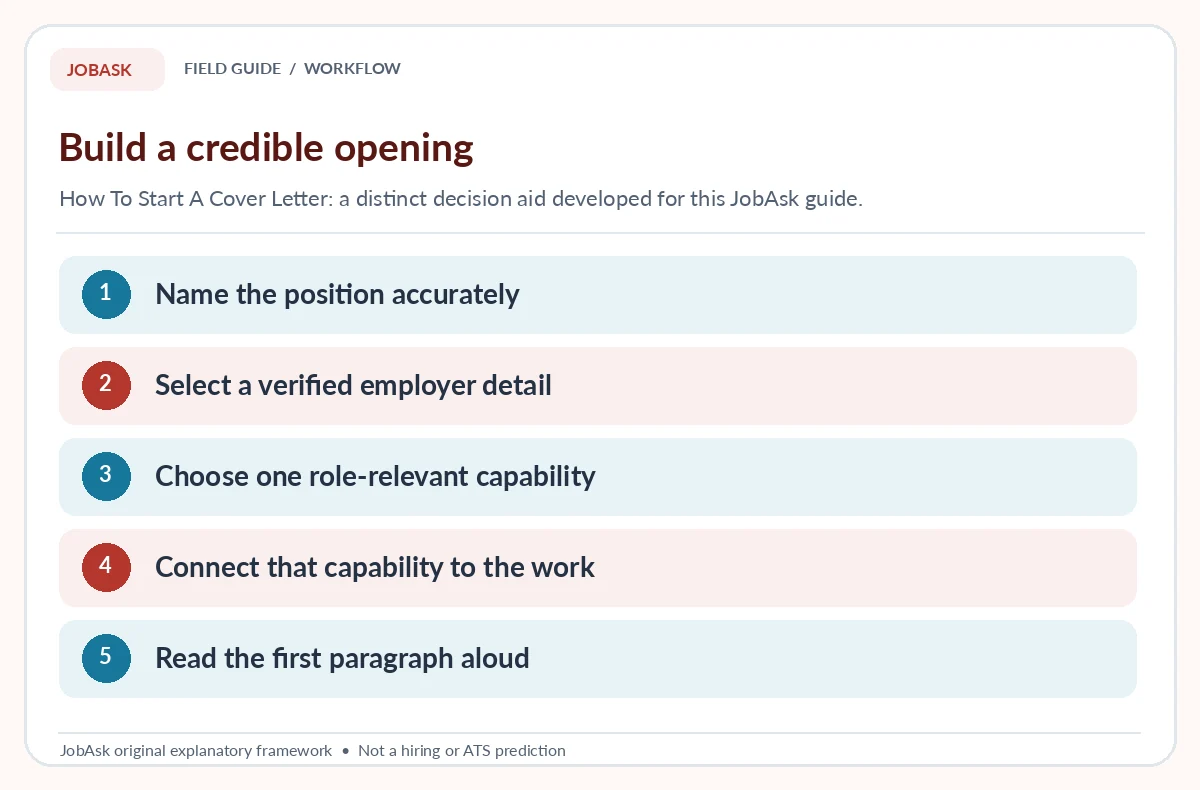
Before typing, highlight the position title, one central duty, and an employer detail you can check independently. Ask what the opening must accomplish: connect your experience to the role in a way the resume alone does not. You are not writing a summary of the entire company or a personal autobiography. One or two short sentences can establish the context and prepare the reader for a supporting example in the next paragraph. Do not lead with unverified claims about an employer’s culture or hiring standards.
Choose one accurate reason for your interest
Interest is credible when you connect it to the work or a fact you actually researched. A public program description, a clearly stated service, or a responsibility in the job posting can provide context. Check that the detail is current and that you can explain why it matters to you. University of Michigan career guidance suggests demonstrating genuine interest in the position or organization in the opening paragraph. That does not require a flattering anecdote or an unusual creative hook.
Hypothetical example: “I am applying for the Community Program Assistant role at Example Center because the position combines participant scheduling with clear public-facing communication.” Both the organization and opening are fictional. The detail describes the invented role’s duties rather than a claim about a real employer. In your own letter, replace this with information verified from the actual opening. If you cannot find a strong organization-specific fact, focus on a real duty you find meaningful instead of manufacturing an inspiring connection.
Connect the opening to demonstrable evidence
Once the role is clear, give a concise preview of a skill you can support. UW–Madison’s cover letter advice emphasizes matching the opening to a small set of relevant strengths. You can signal those strengths without restating your resume in full. For example, a real history of maintaining schedules is a more convincing lead-in for coordination work than simply calling yourself motivated and passionate. The next paragraph can show the actual setting, action, and outcome. Avoid specific success figures unless you can substantiate them.
Fictional model: “I am interested in the Program Support Assistant opening at Example Center. In my volunteer coordinator role, I maintained shift schedules and wrote short instructions for new helpers, experience I would bring to the position’s documentation work.” This is not a real past position; it shows how a person who had performed those tasks might connect evidence to a role. If the applicant has never held such duties, the example must be changed rather than copied. Relevant truth is more effective than borrowed polish.
Use a referral only when it is genuine and appropriate
A referral-based opening can identify how you learned about the opportunity, but it should not use a person’s name without permission or imply an endorsement that did not occur. A hypothetical, permission-based structure is: “After speaking with Jordan Lee, who encouraged me to learn about the role, I am writing about the Office Services Assistant position.” The statement is appropriate only when that interaction actually happened and the wording reflects what the person said. The fictional Jordan Lee is not an actual employee or contact.
If you did not receive a referral, there is nothing to compensate for. Use a direct opening built on tasks and evidence. Do not name-drop someone you saw on a company page or describe a casual social interaction as a recommendation. An accurate connection can be useful context, but a fabricated one creates an unnecessary credibility problem. When you apply through a portal that asks who referred you, follow its separate truthful instructions; the cover letter should not contradict the application record.
| Situation | Useful opening angle | Accuracy check |
|---|---|---|
| Straightforward application | Role + relevant task + evidence | Correct job title and real task |
| Genuine referral | Role + authorized contact | Permission and wording accurate |
| Changing fields | Target role + transferable work | No fabricated new-field experience |
| No verified employer detail | Role duties + honest interest | Avoid made-up company facts |

Adapt the opening for a genuine career transition
Career changers sometimes try to hide their previous field in the first sentence. A better approach is to identify a real transferable task and connect it to the target role without inventing new-industry experience. Hypothetical example: “I am applying for the Training Program Assistant position. My background coordinating volunteer schedules and developing step-by-step guides has given me practical experience in the organization and communication tasks described in the posting.” The example assumes the applicant really performed those activities; it does not prove expertise in training design.
Do not devote the entire opening to explaining why you are leaving your old career. Focus on the work you can contribute now, then develop a concrete illustration in the letter body. If credentials are required for the new job, confirm the rules before applying or suggesting you meet them. A truthful career-transition opening is narrow enough to defend in an interview. The planned JobAsk transferable-skills guide can go deeper; this article keeps attention on the first paragraph’s job of making your fit legible.
Rewrite generic hooks into specific statements
Generic opening, fictional: “As a dynamic self-starter passionate about success, I am thrilled to join your world-class team.” This could be pasted into almost any application and claims nothing useful. Revised opening: “I am applying for the Administrative Services Assistant role at Example Group. In a volunteer support role, I updated event registration records and prepared clear information for participants; those tasks match the posting’s emphasis on accurate records and communication.” Again, Example Group and the applicant are invented.
The revision identifies a role, links real types of experience to tasks, and leaves the later paragraphs room to provide evidence. Do not exaggerate how much you know about the employer based on its website. If the role genuinely demands a technical or regulated competency you cannot claim, avoid pretending that general enthusiasm fills that gap. This is a language-editing aid, not a scientifically tested formula for recruiter attention or an ATS secret. Clarity and accuracy are standards you can apply without guessing at hiring algorithms.

Perform a one-minute verification and editing audit
Read only the opening paragraph and ask five questions. Can the employer identify the intended role? Is the organization correctly named? Is the reason for interest specific without being invented? Also, is the strength previewed in the opening demonstrable elsewhere in the application? Would the paragraph still make sense if the recruiter read it without the rest of the letter? If you answered no, edit the missing part rather than adding more adjectives. University career centers emphasize a focused opening, not a fixed magic sentence.
Finally check that the opening leads naturally to the evidence in the body, and that it does not repeat the header, greeting, or resume headline unnecessarily. You can use a neutral greeting when a contact name is unavailable rather than making one up. This guide deliberately avoids repeating the full structure from JobAsk’s “Cover Letter Format” page and the comprehensive drafting advice in “How to Write a Cover Letter.” The key skill here is choosing a verifiable first-paragraph angle, not writing the whole document twice. For a step-by-step method, see how to write a cover letter that connects your experience to the role.
How We Research and What This Guide Cannot Verify
We read Texas A&M, UW–Madison, and Michigan career-center advice on the purposes of the opening paragraph. The referral, direct, and career-switcher openings are newly written fictional illustrations.
Sources reviewed October 19, 2026: Texas A&M describes an opening paragraph that identifies the role, source, and relevant interest. UW–Madison recommends connecting employer research and candidate strengths in the opening. University of Michigan sets out the first paragraph purpose and encourages genuine specific interest.
Disclosure: All organizations and people in model paragraphs are hypothetical. No career product, referral service, or affiliate partnership is represented in the three university-resource links. Read the JobAsk affiliate disclosure for the site-wide policy.
More Resume and Cover Letter Guides
- How to Write a Short Cover Letter With Specific Proof
- Cover Letter With No Experience: Honest Examples That Show Potential
- Warehouse Cover Letter: Prove Accuracy and Dependability
- Referral Cover Letter: Mention a Connection Without Overclaiming
- Career Change Cover Letter: Explain Your Move with Evidence
Usually a clear sentence naming the position and an accurate reason for applying. Adapt it to the actual role rather than copying a generic hook.
You can, especially if useful for context or requested, but keep the statement true and relevant.
Use an appropriate neutral greeting or department name when available. Do not invent a person or title.
Only if it is real, short, and directly relevant. A specific job-focused opening is often clearer than a long anecdote.
Keep it concise enough to establish role, interest, and relevant evidence without reproducing the entire body of the letter.