
To write a resume from scratch, begin with the actual job you want, collect accurate details about what you have done, then arrange that evidence into a readable document. Use your name and contact details, relevant experience, education and skills; a short headline or summary is optional. Start with facts rather than a polished template. A resume is a selective record of qualifications, not an autobiography or a guarantee that an automated system will accept an application.
This guide walks through one complete drafting sequence: job requirements → evidence inventory → section selection → specific bullets → layout → verification → export. CareerOneStop’s resume formatting guide recommends clear, consistent formatting, while its work-experience guide emphasizes showing responsibilities and accomplishments relevant to the position. A straightforward document that a person can check against your history is more useful than a highly decorated file full of vague claims.
Choose the Job Before Opening a Template
Find one real role description and mark the duties, required tools, credentials and working conditions that actually apply to you. You do not need to copy the entire vacancy. Sort its requirements into three columns: evidence you can show now, experience you need to explain, and requirements you cannot honestly claim. This simple filter gives your resume a purpose before you choose fonts or rearrange dates.
For example, a coordinator posting might require maintaining records, arranging meetings and explaining changes. Your proof might come from an actual scheduling responsibility, a student project or paid work. If you have only observed someone use a scheduling system, do not describe yourself as its administrator. The job target controls what is relevant; it does not authorize stretching your experience to match every listed keyword.

Collect Dates, Roles, Tools and Outputs
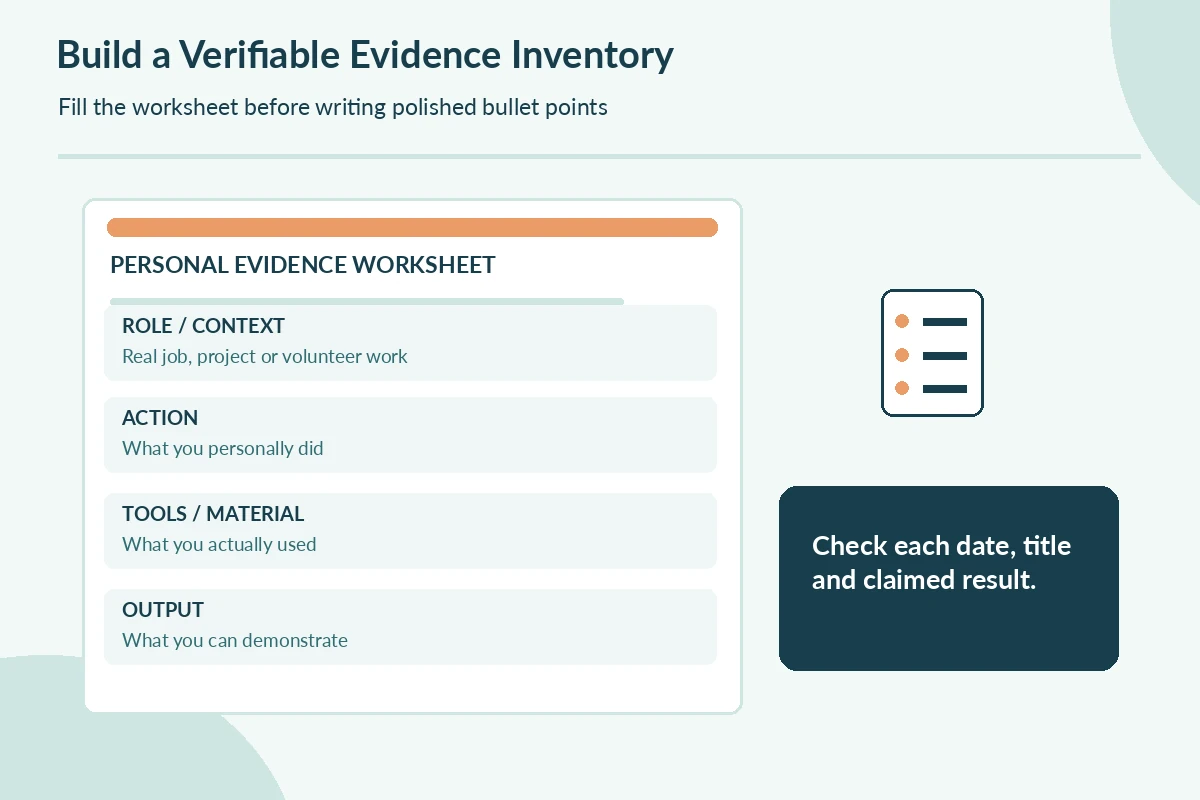
Create a private evidence worksheet for each real job, internship, project or volunteer engagement. Record the genuine organization or project label, your role, location if appropriate, dates, actual responsibilities, tools you used, people you worked with and outputs you can explain. Keep notes outside the resume so you can verify them later. If dates are uncertain, check available records instead of guessing a flattering tenure.
Use CareerOneStop’s work history guidance to structure work entries consistently. Think carefully about whether an outcome belongs to you, a team or the employer. You can describe your own checklist, research or follow-up without attributing an entire department’s results to yourself. Quantify only what can be substantiated; if a percentage is unknown, the action and concrete output may already be enough.
Put the Essential Sections in a Useful Order
At the top, include an email address you actually monitor and a suitable phone number; city and state are usually sufficient for location. Then choose the next section by relevance. Established relevant experience can lead; recent education or clearly documented projects may deserve earlier placement. A summary is not mandatory, especially when it would merely repeat generic adjectives. Do not add an objective that says only that you want a job.
The CareerOneStop top-of-resume guidance explains how to make the contact and headline area useful, and its education guide describes why education can appear before work history for newer graduates. Label unconventional activities accurately: “Volunteer Experience,” “Academic Projects,” and “Professional Experience” communicate different relationships. A personal portfolio may be linked when it is relevant and safe to share.

Write Specific Bullets Without Inventing Results
Each useful bullet should name a truthful action and provide enough context to understand the work: action → material or process → outcome or deliverable. Avoid beginning every line with “responsible for.” When an outcome is unknown, name the completed work rather than manufacturing a savings percentage. Short bullets should answer the question: what could a hiring manager plausibly ask me to describe in an interview?
Hypothetical illustration: weak: “Good at administrative tasks.” Clearer if true: “Maintained a shared event registration list, corrected duplicate entries and sent an updated count to the organizer.” This example is fictional and does not represent a real candidate or employer. It does not claim a particular accuracy rate or that the person independently owned a larger system. Review each statement against your evidence worksheet before using it.
Design for a Reader and Check the File
Use visible headings, consistent dates, comfortable spacing and simple typography. Avoid placing essential information only in icons, graphics or complicated sidebars. CareerOneStop describes a simple single-column resume as a practical choice for readability and parsing, but there is no universal formatting trick that guarantees ATS results. A company may request particular sections or formats; follow the actual application instructions.
Preview the file at normal zoom and on a second device when possible. Look for clipped dates, wrapped headings, blank pages, inconsistent bullets and links that do not open. If the employer requests a PDF, export and examine the PDF rather than assuming it matches the editable original. If it requests another format, use that. Keep a separate editable master so a formatting problem can be corrected without reconstructing the document.
Match Claims to the Posting, Not Every Keyword
Use the vacancy to decide which evidence appears most prominently. If it emphasizes reporting and customer questions, move your actual reporting or service responsibilities higher in their entries. Do not insert a tool name because an algorithm might reward it when you have never used the tool. Tailoring changes selection, order and wording; it does not change facts about your dates, employer or qualifications.
Make a simple traceability table with three fields: requirement, resume line, proof you can discuss. A requirement with no evidence should not be claimed. A strong line that is unrelated to the specific role may remain in your private master but be shortened in a targeted version. This prevents one generic master resume from absorbing every skill you have ever seen mentioned online.
Run a Human-Focused Final Audit
Read your name, contact channels, dates, titles, credentials and linked portfolio as separate check items. Ask someone to review the clarity of the file without giving them sensitive identity documents. Read bullets aloud: would you be able to explain the work and defend any number? Remove unsupported superlatives, blank template fields and spelling mistakes; check tense consistency for current versus completed work.
Keep one version history: a dated editable master and the precise file submitted for each application. This helps if an interviewer asks about an older line or a recruiter sees a version from a previous submission. Review the employer’s instructions immediately before sending, including how to name the file and whether additional application fields must be filled out. A polished attachment does not replace a required online application.
How We Research and Verify Resume Advice
We examined official career guidance and cross-checked it with another professional or official reference as available on October 26, 2026. This page supplies an original task-focused method rather than an employer survey or documented candidate result. Employer instructions, job duties and individual documentation must take precedence over generalized examples.
This article is educational, not a guarantee of interviews, hiring, software screening results or legal rights. Every example and invented situation is explicitly hypothetical and must be replaced by verified personal facts. We do not claim affiliate arrangements or employer partnerships. Read the affiliate disclosure before acting on any recommendation.
Related Guides
- How to Write a Professional Resume Summary With Evidence, Not Buzzwords
- How to Write Resume Bullet Points with Action, Scope, and Evidence
- Resume Summary Examples: Write a Specific, Evidence-Based Introduction
- How to Get a Job With No Experience: Build Evidence and Apply
- How to Write a Cover Letter From Scratch: Turn a Job Posting Into Proof
Typically contact information, relevant experience and education; add focused skills and optional qualifications where they help explain fit.
Only if it provides a specific, honest role direction that is not obvious from your evidence; it is not required for everyone.
Yes, when necessary to present relevant experience clearly. Length should reflect the role and evidence rather than an absolute rule.
No. Use verifiable numbers when they illuminate your contribution; otherwise explain accurate actions and outputs.
No. Clear formatting improves readability but cannot guarantee any employer system or hiring decision.