
To write a useful resume, identify the role you want, collect verifiable evidence from your experience, and make the most relevant details easy to find. This US-focused guide shows what to write and how to review it. It does not claim any format guarantees a particular applicant-tracking result.
Choose the job target before drafting every section
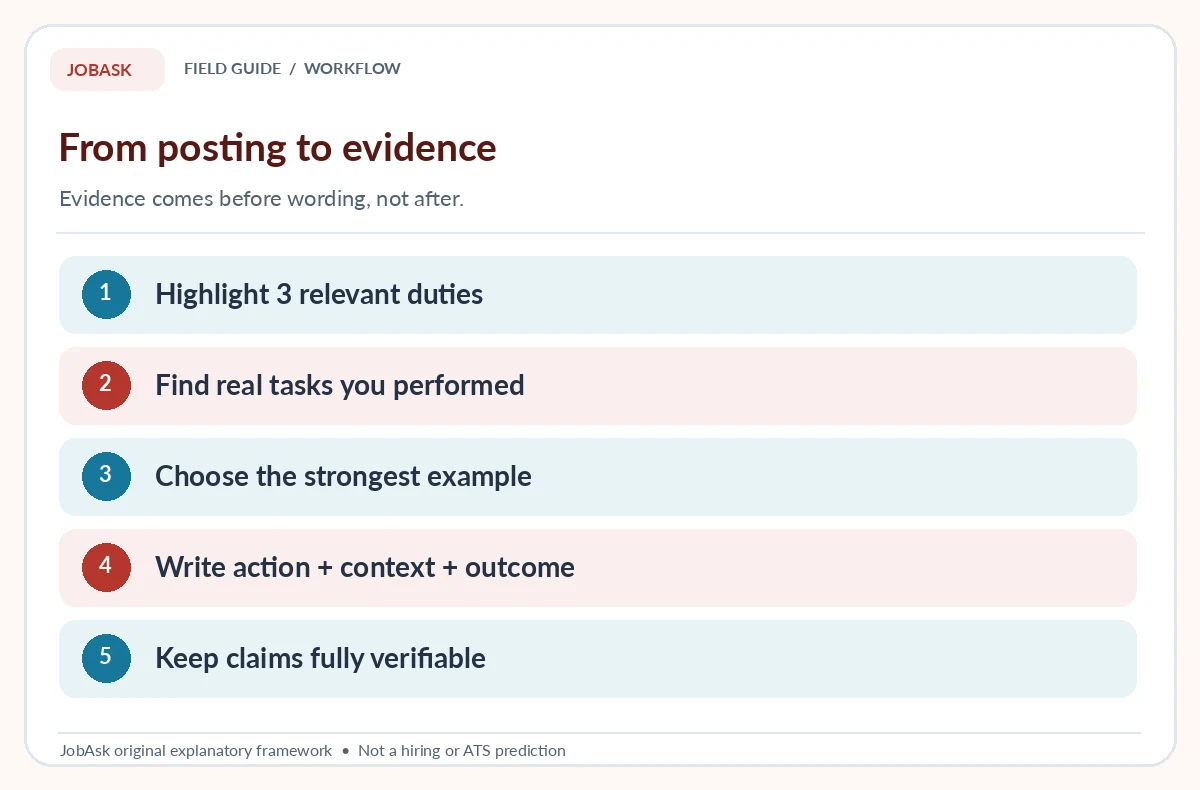
A useful resume is a short, accurate explanation of why your background is relevant to a particular type of work. Begin with one real job description, or with a consistent role family if you are building a master resume. Identify its main tasks, essential qualifications, and terminology. Then list your true evidence: work you actually completed, tools you actually used, coursework you can explain, and responsibilities you genuinely held. A resume is not the place to invent numbers because a sample looked impressive.
Separate your private master inventory from the version you submit. The inventory may include many projects and jobs; the submitted resume selects those that matter most for the position. For example, an applicant moving from retail to office coordination could emphasize scheduling, inventory records, team handovers, and accurate communication if those duties were part of the real retail job. If a crucial requirement is absent, do not disguise that gap with buzzwords. Consider what training or experience might close it.
Write a clear header and a relevant summary only if helpful
Use a name, reliable email, phone, and a location description appropriate to the posting. A personal mailing address is not necessary for every application; follow the employer’s instructions. A portfolio or profile link is useful only when it is professional, up to date, and relevant. Check that links work. Do not include a headshot or personal details simply because an unfamiliar template asks for them; practices differ by country, and this guide is written for US job applications.
A concise summary can help when you need to explain an established specialization or a credible career transition. It should not be a paragraph of generic adjectives such as “motivated team player.” An illustrative summary could say, “Customer-service associate with experience coordinating busy schedules and documenting requests; seeking an office operations role.” Use that only if the underlying history is true. If your experience sections already tell the story quickly, you can omit the summary and put more attention on concrete evidence.
Organize experience so a reader can follow it
For each relevant role, identify the organization, your actual title, dates, and concise bullets describing work you did. Grouping positions in reverse chronological order is a common starting point, but the best presentation depends on career stage and circumstances. CareerOneStop discusses chronological, functional, and combination approaches; it also emphasizes legible layouts and relevant work examples. This article focuses on content quality. A later dedicated “Resume Formats Compared” page can compare layout choices without creating a second general writing guide.
Include education, certifications, projects, volunteering, or skills where they support the target role. A recent graduate may lead with education and projects; a more experienced worker may lead with professional history. Distinguish unpaid projects from paid positions. If a credential is incomplete, name the coursework or expected completion accurately rather than claiming you already hold it. Use conventional headings so both a person and common software can locate information, but never assume one format guarantees an automated system will select you.
Turn vague duties into verifiable accomplishment bullets
Start a bullet with a specific verb and then describe the task, relevant context, and result you know. The result does not have to be a dramatic percentage. It might be a deliverable, an improvement you directly observed, a repeatable process, or a clear description of whom your work served. CareerOneStop recommends specific work descriptions that make related qualifications easy to find. You can include a number when you have records and can defend it; do not estimate a revenue increase or invent a retention rate for effect.
Here is an explicitly hypothetical revision. Weak: “Responsible for scheduling.” Better, if it describes your real work: “Coordinated appointment changes for a volunteer event and shared an updated schedule with organizers.” This version shows an action and an output without invented percentages. Another weak line is “Good at communication.” A more useful version, again only if true, is “Answered customer questions about pickup procedures and documented unresolved requests for the next shift.” Let the posting decide which legitimate example deserves more space.
| Job requirement | True evidence to find | Resume treatment |
|---|---|---|
| Coordinate schedules | A real team, project, or event schedule | One precise task-and-output bullet |
| Maintain accurate records | The log, spreadsheet, or files you actually updated | Name the tool only if you used it |
| Support customers | A real interaction type and your responsibility | Describe what you handled, not an invented rating |
| Use a specific application | Your genuine level of use or training | Do not claim proficiency from observation |

Show relevant skills without unsupported keyword claims
The skills section can be useful for software, equipment, languages, or specific technical methods that matter for the work. Use the names of tools you genuinely know. If you have only watched a tutorial, describe that as introductory learning rather than professional proficiency. Incorporate the job description’s natural vocabulary where it accurately matches your experience; avoid listing requirements you cannot discuss in an interview. This is a clarity exercise, not an attempt to manipulate a secret score.
Applicant-tracking systems vary by employer, product, configuration, and workflow. There is no defensible universal ATS pass percentage or magic keyword density. A straightforward document with understandable headings, reasonable spacing, and selectable text is a sensible accessibility and readability baseline. Follow a specific employer’s requested file type and application fields. If the portal asks you to reenter your history, compare each field with your resume before submission. Software behavior can vary, so the final check is the actual rendered document and form.
Edit through four deliberate quality passes
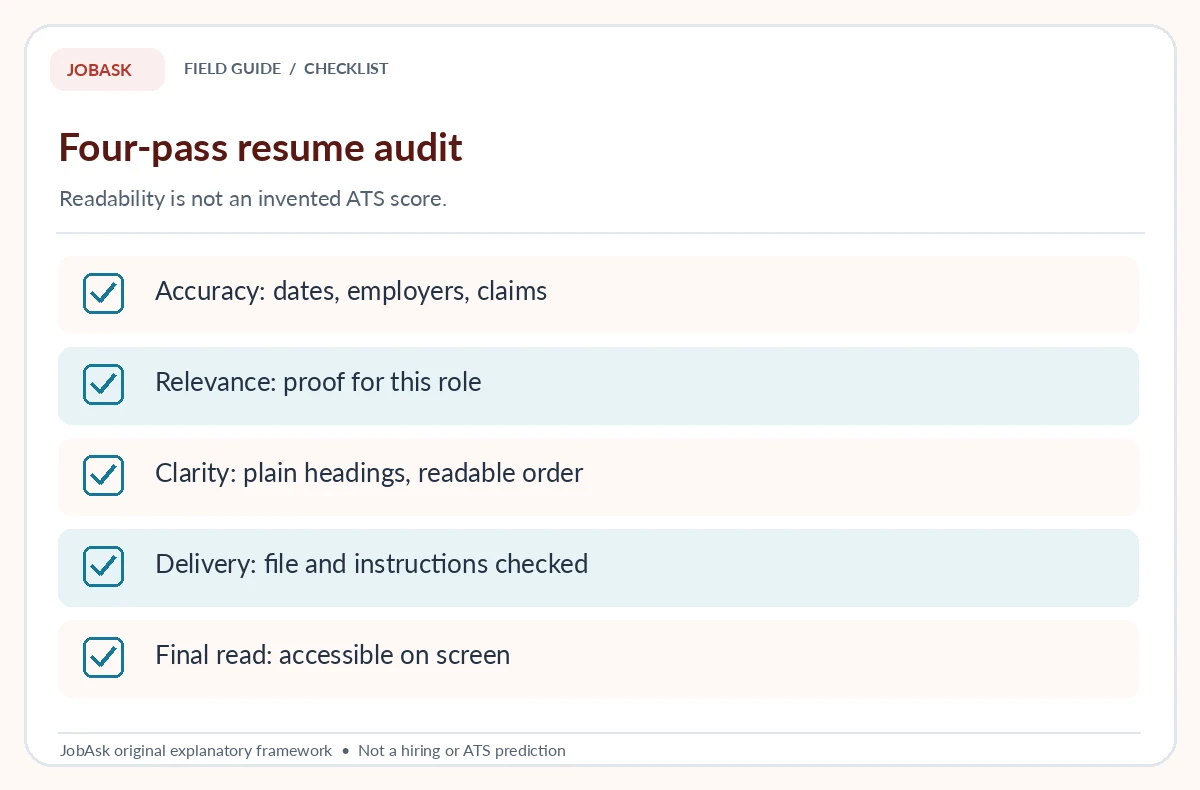
First, check facts: dates, titles, credentials, links, spelling of organizations, and whether you can explain every claim. Second, check fit: is the main evidence for this role visible before less relevant detail? Third, check clarity: do sections have readable headings, consistent tense, scannable lines, and a logical order? Fourth, check delivery: preview the document on another screen, confirm no clipped text, and follow the submission instructions. Keep your original master resume intact so tailoring does not erase useful material.
A useful way to test a bullet is to ask a trusted reader what capability it demonstrates without telling them your intention. If they cannot identify it, add context or simplify the wording. If they infer a skill you do not have, make the claim more precise. Ask for feedback on whether your most relevant accomplishment is immediately visible. UC Berkeley makes resume samples and action-word guidance available, but any sample should be adapted to your real experience rather than copied as someone else’s history. Our guide “Resume Work Experience” adds more detail on this.
Handle less conventional experience without disguising it
Career gaps, project work, caregiving, volunteering, and changes in direction are common but different situations. Decide what is genuinely relevant, identify transferable tasks where appropriate, and label activities correctly. A family caregiver may have coordinated appointments or records; whether to include that experience is a personal choice, and the resume should not imply formal professional employment if it was not. A student group leader might describe scheduling or project delivery when those tasks actually occurred. Our internship resume guide covers how to turn classes and projects into relevant proof.
Your resume cannot answer every possible question about your background, and that is fine. A cover letter or interview may provide useful context later. Avoid detailed explanations of sensitive personal circumstances unless needed for your own purposes. This guide does not cover specific government hiring formats, licensing rules, or employment-law rights; follow the appropriate official instructions when they apply.
Use an example as a learning aid, not as your history
The fictional applicant in the visual has coordinated a community event. That example demonstrates how a reader moves from an empty adjective to a concrete task. It is not a ready-made achievement that another applicant can claim. Replace every part with details from your own work, then look for an equally clear action and output. The strongest resume is not the one with the largest number of impressive claims; it is the one whose relevant claims you can substantiate and explain. If you want the full process, read how to write resume bullet points that prove your contribution.
How We Research and What We Can Verify
We checked CareerOneStop guidance on work-history evidence and document formatting, then consulted UC Berkeley’s sample resumes to distinguish general section advice from examples. The four-pass audit, role-to-evidence mapping, and before/after bullet revisions are JobAsk-created teaching tools using expressly hypothetical experience. No ATS platform was tested and no passing score, interview rate, or recruiter preference is claimed.
Source reading used for this guide: CareerOneStop: relevant duties, outcomes and work-history evidence. CareerOneStop: legible layout and readable resume styles. UC Berkeley: tailoring experience to the description and work level.
Disclosure: The resume worksheets and fictional examples are educational illustrations, not a commercial resume-writing offer. The three resource buttons lead to CareerOneStop and UC Berkeley, without referral fees or confirmed affiliate tracking. Consult JobAsk’s affiliate disclosure for the policy.
More Resume and Cover Letter Guides
- How Many Jobs Should You List on a Resume? Select Relevant Work
- Projects on a Resume: Describe School, Personal, and Team Work Clearly
- How to Write Resume Bullet Points with Action, Scope, and Evidence
- Skills for a Resume: Choose Relevant Abilities You Can Prove
- Relevant Coursework on a Resume: Choose Classes That Prove Job Skills
Use the space needed to show relevant experience clearly and follow the employer’s instructions. A shorter resume is often easier to scan, but length depends on background and requirements.
Keep a master resume, then choose and reorder truthful evidence for each role family or posting. Do not rewrite your history to satisfy unsupported requirements.
No. Verified measurements can help, but a clear task, scope, or deliverable is better than a made-up percentage.
No. Systems and configurations vary. Favor clear headings and readable files while following the employer’s requested format.
Use relevant coursework, verified projects, volunteering, or other legitimate responsibilities, clearly labeled. Explain what you did and what skill it demonstrates.