
Quick answer: To prepare for it manager interview questions, practice how you would handle incidents, change control, and team accountability. Answer with the real situation, your specific action, who had authority to decide, and how you checked the outcome. These are illustrative questions, not a claim to know any employer’s actual interview script.
Why IT Leadership Interviews Test Risk and Ownership
A hiring manager may ask about your experience, or offer a hypothetical task and ask what you would do. Those are different formats. An experience-based answer should describe something you genuinely did; a scenario answer should describe steps you would propose under the new employer’s policy. The U.S. Office of Personnel Management recommends questions based on job-related competencies and a clear account of situation, action, and result. It does not supply a magic script that guarantees a favorable interview.
For this role, the interview should reveal practical judgment about incidents, change control, and team accountability. O*NET’s occupational description is a starting point for relevant tasks, not a list of universal responsibilities or proof that one applicant performed them. Read the job advertisement and match its actual duties to a small number of true examples; leave out any work you have not done.
Five Questions About Incidents and Technology Trade-Offs
1. How do you decide which outage to address first? Name observed user and system impact, safety or security concerns, dependencies, and recovery options. Bring the incident owner and business stakeholders into an agreed severity and escalation process.
2. Describe a change that introduced an unexpected problem. Explain the change record, affected service, rollback or mitigation authority, communication, and review. Do not pretend you personally approved a change outside your remit.
3. What would you do if security and uptime goals conflict? Identify the risk, available containment options, policy and decision authority; make the trade-off visible instead of quietly bypassing a required security control.
4. How do you communicate an incident to nontechnical leaders? Explain what users can and cannot do, what is confirmed, what is unknown, who owns the next update, and when the team will reassess.
5. How do you develop engineers while maintaining accountability? Describe a real practice such as joint post-incident review, clear on-call expectations, supported delegation, and no-blame learning alongside explicit ownership.
An outage does not tell you its root cause simply because a chart is red. Your interview answer should begin with observed symptoms and affected users, then distinguish a service interruption from evidence of malicious activity. Security, engineering, product, and incident coordination teams may own different actions. State who would be paged under the organization’s actual incident process instead of presenting a single-person hero narrative.

Turn Impact Signals Into an Approved Response
Use a practical four-step answer: Confirm impact; then set incident roles; next choose approved action; finally verify recovery. The order matters because a polished answer that skips confirmation or goes beyond your authority may sound confident while describing a bad work decision. Explain which information is missing, whose permission is required, and how you would let affected people know the result.
For example, the question “A production service degrades after a release” is an invitation to show your reasoning rather than promise a perfect result. Confirm symptoms, classify impact, involve the on-call owner, check approved rollback criteria, and communicate an update cadence. In your answer, explain how you would know that the next action is appropriate. If the new employer uses a different procedure, say that you would learn and follow it.

Describe Leadership Without Inventing Technical Authority
Weak answer: “I would shut everything down immediately.” This answer omits the necessary checks, the decision maker, or evidence of follow-through. Stronger answer: “I assess impact, bring in the incident owner, follow approved containment, and verify restoration.” It shows a sequence that another person could verify. Treat these as writing models, not as a personal history you can repeat word for word.
Illustrative interview response: “I would establish impact from monitoring and user reports, declare severity using the organization’s criteria, assign a technical lead, notify the incident coordinator, and keep leaders updated with confirmed facts. Recovery actions would follow our change and security controls.” Notice that the speaker describes a specific choice and the boundaries around it. If you have never held a it manager position, adapt the structure to genuine coursework, volunteer responsibility, an internship, or a different job; label that context accurately rather than inventing professional experience.
Test Your Response to Realistic Service Disruptions
Scenario: A production service degrades after a release. Confirm symptoms, classify impact, involve the on-call owner, check approved rollback criteria, and communicate an update cadence. An interviewer may ask what you would do if the first plan failed. Prepare one reasonable alternative and an escalation point, but avoid presenting your preferred plan as a universal policy.
Scenario: A change seems faster if a control is skipped. Raise the risk and alternative, request the designated approval, and preserve the record. A manager title alone is not a blanket exception. An interviewer may ask what you would do if the first plan failed. Prepare one reasonable alternative and an escalation point, but avoid presenting your preferred plan as a universal policy.
Scenario: Two teams disagree over incident ownership. Use the agreed incident structure, assign an accountable coordinator, clarify technical owners, and escalate unresolved conflict. An interviewer may ask what you would do if the first plan failed. Prepare one reasonable alternative and an escalation point, but avoid presenting your preferred plan as a universal policy.
Separate Incident Coordination From Change Approval
A useful response distinguishes three roles: Service owner, Security owner, and Approval authority. They may be assigned differently at different organizations. Describe which duties you personally completed, which you coordinated, and which somebody else authorized. This is especially important where information access, safety, personnel decisions, or external claims could affect other people.
Practice two follow-up questions for your own examples: “What information did you verify before acting?” and “Who could reverse or approve that action?” If you do not know a policy, do not guess. A credible candidate can say, “I would check the written procedure and ask the responsible person before proceeding.” That is more useful than inventing confidence about an unfamiliar workplace.
A manager may have broad planning responsibilities yet still require a separate emergency change approver. Explain how you would document why a mitigation was chosen, preserve relevant logs, confirm an accountable technical lead, and measure recovery from the user’s perspective. A useful post-incident lesson is a change in training, monitoring, or approval clarity—not a claim that downtime will never happen again.
Prepare a Short Evidence Bank Before the Interview
Create three small notes from real events: one routine task performed accurately, one unexpected problem handled with a clear handoff, and one instance of feedback that led to an improvement. For each note, record the context, your individual part, what changed, and what evidence you could lawfully discuss. Do not take confidential records, names, credentials, screenshots, or proprietary documents into your interview.
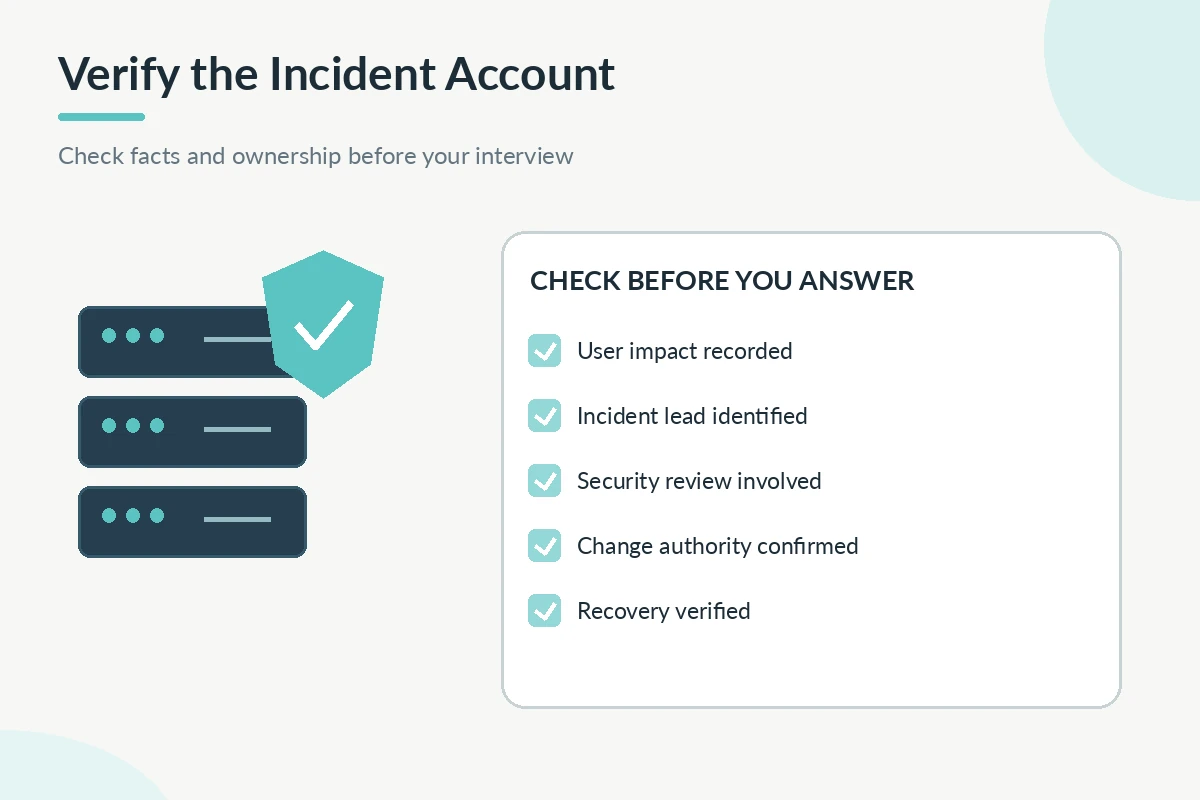
The quick check for this role is: User impact recorded; Incident lead identified; Security review involved; Change authority confirmed; Recovery verified. Keep your examples consistent with the dates and responsibilities on your resume. If your outcome is difficult to quantify, an accurate qualitative description of what you verified or communicated is preferable to fabricated percentages, revenue, customer counts, or guaranteed results.
Finish With Questions That Reveal the Real Role
Ask who owns security owner, what written procedures cover approval authority, how new staff are trained, and what a satisfactory first month actually looks like. These questions help you assess the role without implying that every workplace works alike. If the interviewer mentions a tool or certification you do not have, say what you know, identify the gap, and ask what training the employer expects.
Another hypothetical answer pattern: “A strong incident story separates the action I personally authorized from the investigation performed by engineers or security staff. I would explain the handoff and the measurable check that service was restored.” Use it as a structure for reporting what you did, not as a ready-made story to memorize. After a practice session, listen for unsupported “always,” “never,” or “I guaranteed” statements. Replace them with the precise procedure and outcome that your evidence supports.
How We Research These Interview Scenarios
The questions are editorial illustrations built from O*NET occupational descriptions, OPM interview design guidance, and additional official role-specific guidance. The sources help define task scope, response structure, and constraints; they do not verify any individual’s résumé or predict a particular employer’s questions. Examples contain no real employer, student, customer, incident, or numerical achievement. Review your own experience and the job posting before use.
JobAsk does not claim an endorsement or paid relationship with the referenced agencies. For information about any commercial relationships, read the affiliate disclosure before following any external recommendations.
More Interview Preparation Guides
- Education Assistant Interview Questions: Classroom Support and Student Privacy
- Marketing Assistant Interview Questions: Briefs, Claims, and Campaign Proof
- Team Lead Interview Questions: Coaching, Coverage, and Escalation
- Administrative Assistant Interview Questions: Scheduling, Records, and Priorities
- Hiring Manager Interview Preparation: Explain Decisions, Scope, and Results
Only use measures you can verify and explain, including their scope and period. Do not invent recovery times or attribute team outcomes solely to yourself.
Use an anonymized scenario. Do not reveal access details, unpatched vulnerabilities, client data, or confidential investigative findings.
No. Delegation varies. Explain the actual policy and the roles responsible for emergency authorization, security review, and execution.
Explain what you escalated, how you kept stakeholders informed, what limits applied, and what you learned from the review.
A manager should address decision rights, risk, resources, communication, and verification as well as understand the technical cause.