
Quick answer: An IT support resume objective should identify the help-desk or user-support role and offer a specific, defensible ability: documenting issues, testing a basic troubleshooting sequence, explaining steps clearly, or escalating a problem with useful notes. Do not claim enterprise administrator access or professional incident ownership because you completed a home lab. New applicants can use coursework, a school technology club, or customer-service experience if the setting is stated honestly and each technical skill can be demonstrated.
The examples below are hypothetical models, not accounts of actual applicants. Replace any sample skill, qualification, metric, employer, or responsibility with details you can personally verify. This is US-focused resume-writing guidance, not a guarantee that employers or screening software will favor a particular sentence.
Separate User Support From Network Administration
The Bureau of Labor Statistics distinguishes computer user support from network support, even though both are part of the broader support occupation. A help-desk posting may involve responding to requests by phone, chat, email, or in person, while a different role focuses on networks and systems. Read the vacancy for its actual ticket queue, supported devices, account permissions, troubleshooting tools, documentation rules, and escalation route. Do not present yourself as a network administrator when your experience is helping individual users.
Divide the requirements into “can independently explain,” “practiced in a lab,” and “not trained.” For example, diagnosing a Wi-Fi setting on your own laptop is a real learning exercise but not production network maintenance. Resetting a friend’s password informally does not prove authorized enterprise identity verification. Use the objective to connect the strongest relevant capabilities and leave sensitive privileges for the employer’s training and access procedures.
Write Objective Versions for Beginners and Switchers
Hypothetical objective for a student project: “IT support applicant seeking an entry-level help-desk position, bringing hands-on coursework in basic device troubleshooting, clear written issue notes, and a customer-focused approach.” Keep “coursework” visible so a reader does not confuse it with paid experience. If your coursework did not cover issue tracking, remove that part rather than inventing a ticketing system.
Hypothetical objective for a customer-service career changer: “Customer-service associate transitioning to IT user support, offering experience clarifying user problems, documenting steps taken, and handing off unresolved requests with context.” It focuses on communication work already done while remaining candid about technical training. A candidate with professional support experience may gain more from a compact summary naming actual tools and support scope than from a future-focused objective.
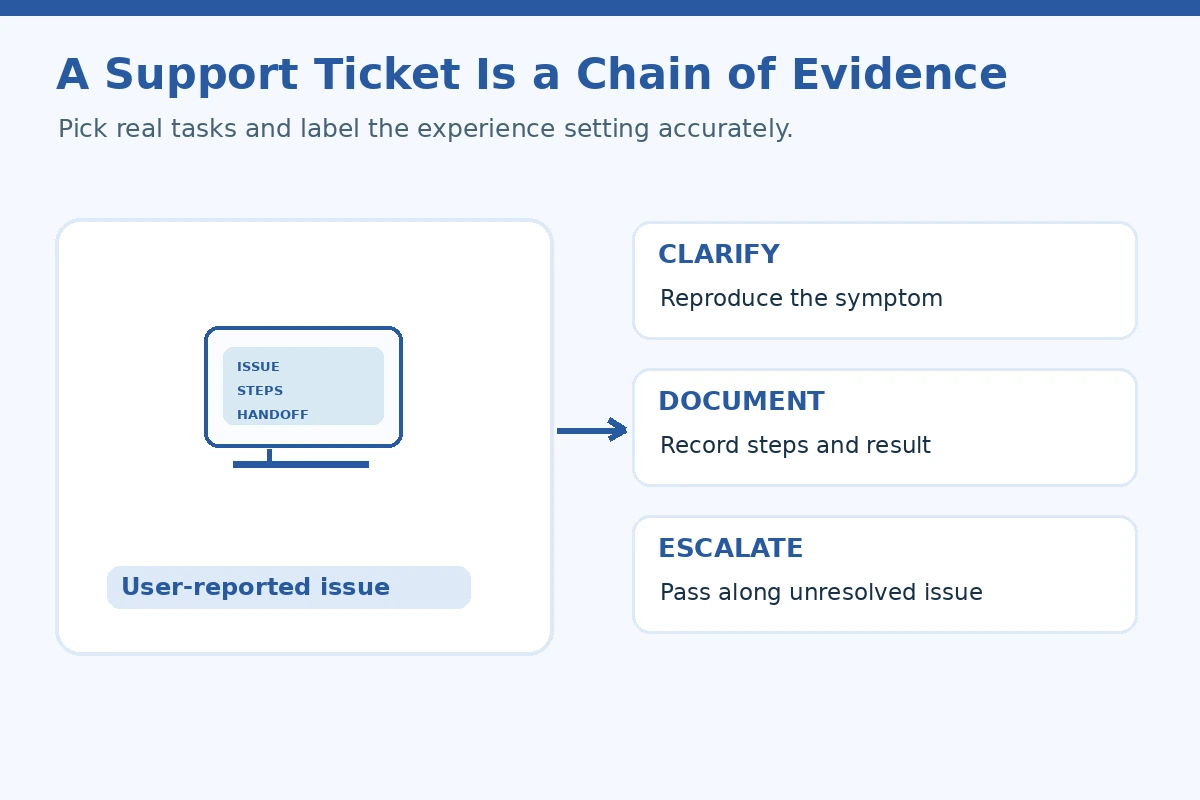
Use the Ticket as Proof of the Work Done
A believable support statement follows a sequence: receive the report, reproduce or clarify the issue, check permitted causes, document steps, and either resolve within your scope or escalate. You do not need invented ticket closure counts or response-time promises. A portfolio can use a clearly fictional sample ticket based on a lab exercise, with no real customer names, passwords, company addresses, device identifiers, or confidential screenshots.
When describing a result, distinguish what you verified from what you guessed. “Documented the reproduction steps and referred the unresolved account issue to a supervisor” is more precise than “fixed all account issues.” If you were observing a technician, say you shadowed them. If you were allowed to provide only guided instructions, do not imply you independently approved access changes or worked with production credentials.
Connect Tools to What You Actually Operated
Listings may mention operating systems, ticket tools, endpoint management products, user accounts, or networking concepts. Name only software or techniques you have used, and qualify the context when needed. “Practiced ticket categorization with a classroom sample queue” is different from “managed enterprise service desk incidents.” A generic “proficient in all Microsoft tools” is hard to defend and likely less informative than two real tasks.
Use short evidence bullets beneath the objective to show the difference. For a personal lab, state that it was a lab. For a part-time desk job, identify the user group and the routine support responsibilities you handled. Never include credentials from clients, copied company tickets, or private network layouts in an application. A prospective employer needs to understand your judgment, not receive privileged configuration details.

Improve a Vague Objective by Naming Limits
Weak example: “Technology expert seeking a challenging job and growth.” It tells the employer nothing about supported users, troubleshooting, or communication, and “expert” may not be earned. Better hypothetical wording: “Entry-level IT support candidate with experience documenting device setup issues in a supervised lab and explaining basic troubleshooting steps to classmates.” If you have actually worked in a live help-desk environment, you can replace the lab context with that work.
A good objective should not be overloaded with every vendor acronym from the posting. Pick a clear role label, one evidence-backed technical skill, and one communication or process strength. Then test whether the strongest supporting evidence appears in the next half page. If your experience is all academic, say so rather than describing project teammates as paying clients or class practice tickets as production incidents.
Run a Permissions and Interview Readiness Check
Before submitting, ask whether you could calmly walk through the troubleshooting example and identify when escalation was appropriate. Can you say which system you touched, whose permission you had, what result you observed, and what remained unresolved? If not, narrow the wording. This guards against accidental exaggeration while making you better prepared for practical interview questions.
Finally, check that certifications and courses are represented by their exact status. “Preparing for” or “completed course” is not a credential already awarded. Keep the resume readable, list practical tasks ahead of generic enthusiasm, and review contact details and file format. The objective can help a reader understand your target, but it cannot guarantee access to a company system, an interview, or a specific hiring outcome.

How We Research Role-Specific Resume Objectives
For this article, we reviewed BLS occupational guidance, CareerOneStop resume guidance, CareerOneStop or supporting source on 2026-10-29. The occupational evidence describes typical duties; the exact vacancy and current local requirements take priority. Resume-writing examples are editorial demonstrations, not official employer-approved wording. We distinguish factual duties from our practical recommendations and avoid inventing hiring statistics, promised ATS results, or personal work histories.
Review your own job advertisement and check all credentials, job dates, and privacy requirements before relying on any example. These guides are informational. Learn how the site approaches potential commercial relationships in our affiliate disclosure; no paid hiring outcome or partner endorsement is claimed.
More Resume and Cover Letter Guides
- IT Support Resume Summary: Show Troubleshooting, Tickets, and Scope
- Resume Objective: When to Use One and Write a Job-Specific Statement
- Library Assistant Resume Objective: Prove Patron Help and Materials Accuracy
- 911 Dispatcher Resume Objective: Show Calm Communication and Trainable Skills
- Resume Objective vs. Summary: Choose the Right Opening for Your Experience
Yes, when clearly labeled as labs and limited to tasks genuinely performed. Do not portray them as production support.
Only describe real practice, for example a course simulation, and label its context clearly.
It can be listed accurately as in progress; never imply the credential has already been earned.
One or two supported capabilities are enough; explain tools, outcomes, and context in projects or work bullets.
Identify the observed problem, documented steps, and transfer to an authorized person without implying higher access.