
A job search strategy is the way you decide how to use limited time, not simply a bigger list of places to apply. Start with roles that meet your constraints, give strong-fit applications enough attention, use respectful conversations to reduce uncertainty, and review the results each week. This US-focused decision framework does not predict responses, describe live vacancies, or prescribe an application count.
Decide what this week of searching must accomplish
The broad question “How do I find a job?” involves discovering openings, preparing materials, and tracking work. Strategy starts one level deeper: given your available time, where should you place effort this week? Write the role family you are targeting and the main bottleneck: not enough relevant listings, incomplete evidence in your resume, unclear role requirements, or many unfinished applications. Each bottleneck demands a different action. Sending more applications may not help when the actual problem is a confused target or missing documents.
Separate outcomes from actions you control. You cannot schedule an employer response, but you can choose to verify a posting, improve a truthful achievement bullet, or speak with a consenting contact about work in the field. A strategy can have a weekly goal without a numerical application quota. For a reader with two hours available, the best plan may differ from that of a reader with twenty. Record the actual time and obligations you have, not an imaginary ideal routine.
Use four lanes instead of one endless task list
Assign each activity to discovery, application quality, relationship-building, or learning and review. Discovery means finding and verifying suitable opportunities; application quality means matching credible evidence to instructions; relationship-building means having respectful information exchanges; learning and review means diagnosing blockers and updating the plan. CareerOneStop treats posting research, targeted resumes, contacts, applications, and records as related tasks. Keeping separate lanes prevents refreshing a job board from consuming the time you meant to spend finishing relevant applications.
Make a small weekly board with one next action in each lane. A hypothetical Monday plan might be “verify two roles against employer websites,” “finish one tailored application,” “send a low-pressure informational question,” and “review which roles met my schedule needs.” These are illustrative actions, not evidence of an ideal amount. If applying is urgent, allocate more attention to roles with genuine deadlines. If you have no plausible listings, learn about target employers and role terminology before polishing the same cover letter repeatedly.

Select channels by the information they actually give
An employer career site can help you check the organization and its current application instructions. A general job board can help you discover titles and compare descriptions. An institutional career service may offer accessible support, and professional conversations can clarify how work is performed. No channel guarantees authentic listings or a reply. Use several relevant channels without maintaining a dozen identical alert streams. Mark where each lead came from so you can recognize duplicates and verify its official status.
Choose channels based on the specific role family. For example, a school-sponsored placement board may be relevant to a recent student while a public employer careers page may be essential for a specialized opening. This is a hypothetical selection rule, not an endorsement of any particular board. Do not infer that a posting still accepts applications because it appears in search results. Read the employer instructions, check the domain, and do not send money, identity documents, or sensitive information to an unverified contact.
Rank next actions by relevance and uncertainty
Rather than assigning an unexplained numeric fit score, put each potential action into a practical bucket. Work on high-fit roles with a real deadline promptly. Research roles with one important uncertainty before investing in a long application. Skip clear mismatches after a quick documented decision. Save genuinely useful contacts for respectful follow-up and remove expired or duplicate postings. The purpose is not to maximize the count of saved jobs; it is to protect the time that improves relevant applications.
A hypothetical applicant sees three opportunities: one role with duties they can demonstrate and an approaching stated deadline, one role with an unclear location requirement, and one role with essential credentials they do not possess. The first gets application time, the second gets a question or official-site check, and the third is generally removed from the active list. This is a decision example only; there are no invented employers, job offers, or acceptance odds. Update a bucket if a verified answer changes it.
| Lane | This week’s decision | Evidence to review |
|---|---|---|
| Discovery | Verify genuinely relevant leads | Employer instructions and role fit |
| Application quality | Complete targeted responses | Truthful evidence, deadline, accuracy |
| Learning and contacts | Ask a consent-based question | Unresolved role information |
| Review | Remove friction and adjust tasks | Observed actions, not response-rate predictions |

Preserve enough time to make applications credible
Quality depends on whether you answer the actual application and support your claims with real experience. Review the role description, identify two or three requirements you can demonstrate, select accurate evidence, and follow all submission directions. CareerOneStop advises targeting a resume and recording roles and contacts. A strategy should reserve time for proofreading and attachments; a rushed, inaccurate form is not improved by being one of many submitted that day. Keep versions labeled so you can explain your own application later.
Use a simple effort ceiling to notice when one application consumes disproportionate time. The ceiling is your planning tool, not a universal recommendation. If a request is unusually long, assess the role, instructions, and whether the value justifies that time. Never invent metrics or credentials to move faster. If you discover that every application stalls at the same point, such as tailoring an experience section, spend one planning session on a reusable truthful evidence inventory rather than restarting from scratch each time.
Treat outreach as learning, not as a promised referral
An informational conversation can clarify job tasks, terminology, and employer practices without asking a stranger to hire you. Invite a brief conversation by explaining why the person’s professional perspective is relevant and giving them an easy way to decline. Do not claim a mutual contact without permission, and do not suggest someone owes you a recommendation. Capture useful public information, not private business details. The aim is to make a better decision, not to game a recruiter or claim special access.
Hypothetical message: “Hello Taylor, I am exploring entry-level operations roles and your public description of your work helped me understand the field. If you are open to a short conversation, I would appreciate hearing which tasks occupy most of your week. No problem if now is not a good time.” If there is no response, do not build a pursuit campaign. Respectful outreach belongs alongside applications and research, not above the recipient’s time or boundaries. Our guide “Job Search Networking” covers how to build useful conversations, not cold pitches.
Run a weekly review without treating silence as data
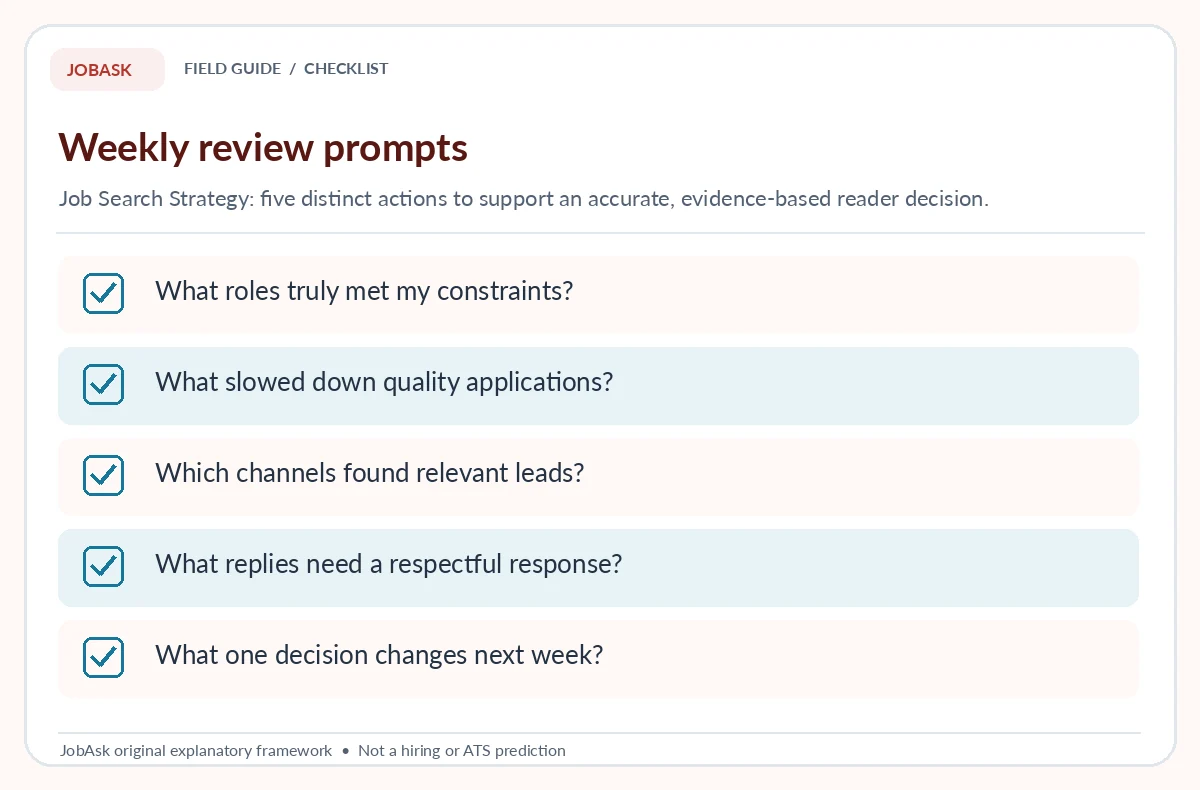
At the end of the week, record which channels surfaced relevant roles, where an application got delayed, and which uncertainties were resolved. Employer silence is not evidence that your resume failed an ATS, that a contact deliberately ignored you, or that an arbitrary application threshold is wrong. Hiring decisions and systems vary by employer. Review what is observable: fit, submission accuracy, deadlines, follow-up instructions, and your own available capacity. Decide one adjustment for next week instead of rebuilding the entire strategy from emotion.
Keep this strategy distinct from the basic “How to Find a Job” guide, which teaches the overall start-to-finish search sequence. A later dedicated Job Application Tracker guide can expand the record-keeping details; a job boards guide can compare discovery tools. Here the deliverable is a weekly allocation and decision rule. It should let you explain why each task deserves time and when you will change direction, without claiming any number of applications produces a particular outcome.
How We Research and What This Guide Cannot Verify
We checked the CareerOneStop job-application process and goal-setting guidance alongside university job-search resources. We use those sources for the documented value of checking listings, targeting applications, contacting people appropriately, and keeping records; the four-lane weekly board and action buckets are our own editorial planning frameworks.
Sources reviewed October 19, 2026: CareerOneStop recommends tracked applications, job postings, outreach, and role-specific preparation. CareerOneStop supports attainable, measurable, time-bound activity goals. UC Berkeley career guidance covers multiple discovery channels and preparing a focused search.
Disclosure: This article offers no employer placements, response-rate statistics, or sponsored search services. The three resource buttons are links to public education guidance, not commercial redirects. Read the JobAsk affiliate disclosure for the broader site policy.
Related Job Search Guides
- Career Change Job Search: Target Roles and Prove Transferable Skills
- Job Search Websites: Choose the Right Boards and Verify Listings
- Job Search After Layoff: A Practical Restart and Application Plan
- Apprenticeship Job Search Websites: Find Openings and Verify Training
- Construction Job Search Sites: Compare Trades, Apprenticeships, and Employers
There is no universal number. Plan around relevant roles, your available time, and accurate applications rather than a guaranteed-response quota.
No. Discovery can come from several sources, but confirm important posting and application details using official channels when possible.
Change it when observations identify a bottleneck, a constraint changes, or a better source of verified leads emerges.
No. Lack of a reply does not establish a reason for an employer decision or how its software handled your application.
No. Respectful conversations can complement applications and clarify roles; they are not guaranteed referral or hiring routes.